


Invasive potential of cattle fever ticks in the southern United States
- PMID: 24742062
- PMCID: PMC4021724
- DOI: 10.1186/1756-3305-7-189
Invasive potential of cattle fever ticks in the southern United States
Abstract
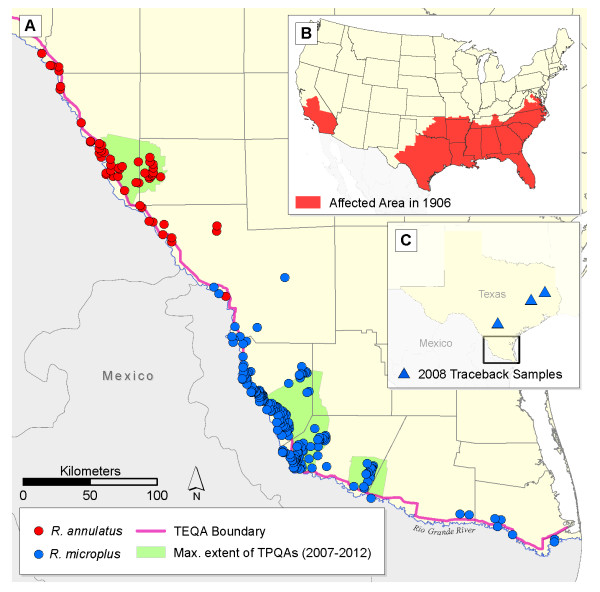
Abstract' background: For >100 years cattle production in the southern United States has been threatened by cattle fever. It is caused by an invasive parasite-vector complex that includes the protozoan hemoparasites Babesia bovis and B. bigemina, which are transmitted among domestic cattle via Rhipicephalus tick vectors of the subgenus Boophilus. In 1906 an eradication effort was started and by 1943 Boophilus ticks had been confined to a narrow tick eradication quarantine area (TEQA) along the Texas-Mexico border. However, a dramatic increase in tick infestations in areas outside the TEQA over the last decade suggests these tick vectors may be poised to re-invade the southern United States. We investigated historical and potential future distributions of climatic habitats of cattle fever ticks to assess the potential for a range expansion.
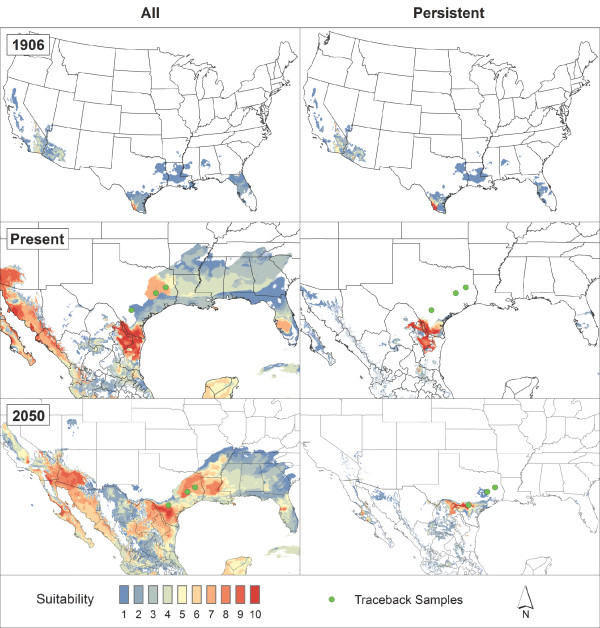
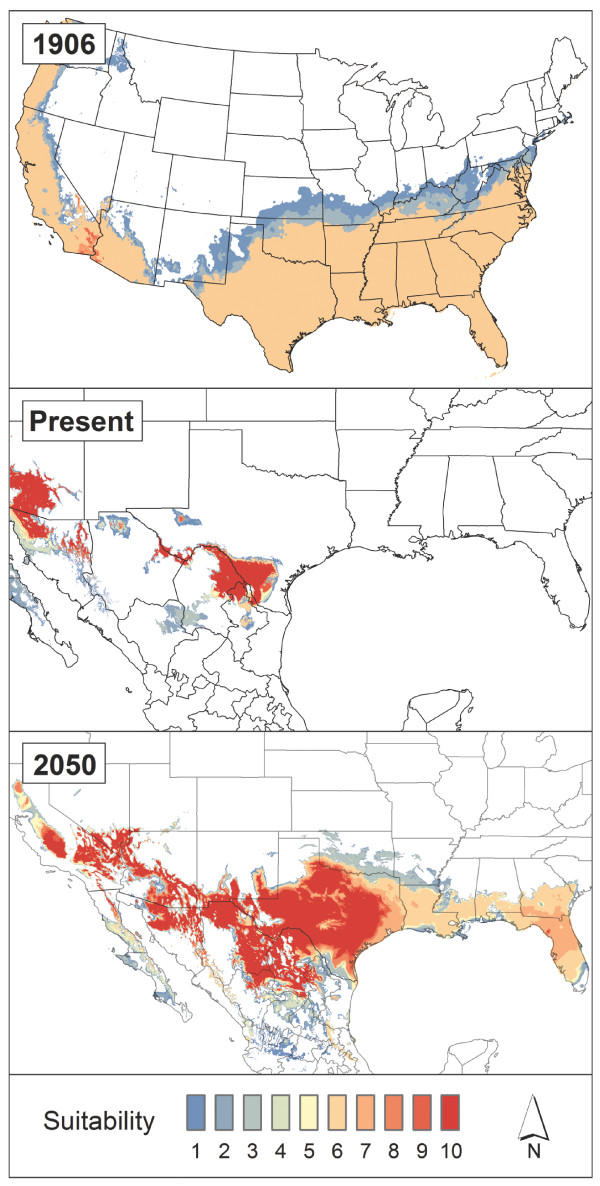
Methods: We built robust spatial predictions of habitat suitability for the vector species Rhipicephalus (Boophilus) microplus and R. (B.) annulatus across the southern United States for three time periods: 1906, present day (2012), and 2050. We used analysis of molecular variance (AMOVA) to identify persistent tick occurrences and analysis of bias in the climate proximate to these occurrences to identify key environmental parameters associated with the ecology of both species. We then used ecological niche modeling algorithms GARP and Maxent to construct models that related known occurrences of ticks in the TEQA during 2001-2011 with geospatial data layers that summarized important climate parameters at all three time periods.
Results: We identified persistent tick infestations and specific climate parameters that appear to be drivers of ecological niches of the two tick species. Spatial models projected onto climate data representative of climate in 1906 reproduced historical pre-eradication tick distributions. Present-day predictions, although constrained to areas near the TEQA, extrapolated well onto climate projections for 2050.
Conclusions: Our models indicate the potential for range expansion of climate suitable for survival of R. microplus and R. annulatus in the southern United States by mid-century, which increases the risk of reintroduction of these ticks and cattle tick fever into major cattle producing areas.
Figures
References
-
- McCosker PJ. The global importance of ticks. New York: Academic Press; 1981.
-
- Smith T, Kilborne FL. Investigations into the nature, causation, and prevention of Texas or southern cattle fever. Bulletin: US Department of Agriculture Bureau of Animal Industry; 1893. p. 1.
Publication types
MeSH terms
LinkOut - more resources
Full Text Sources
Other Literature Sources
