. 2014 May 30;289(22):15730-8.
doi: 10.1074/jbc.M113.538587. Epub 2014 Apr 17.

Targeted silencing of anthrax toxin receptors protects against anthrax toxins

Affiliations

Targeted silencing of anthrax toxin receptors protects against anthrax toxins

Maria T Arévalo et al. J Biol Chem. .

Abstract

Anthrax spores can be aerosolized and dispersed as a bioweapon. Current postexposure treatments are inadequate at later stages of infection, when high levels of anthrax toxins are present. Anthrax toxins enter cells via two identified anthrax toxin receptors: tumor endothelial marker 8 (TEM8) and capillary morphogenesis protein 2 (CMG2). We hypothesized that host cells would be protected from anthrax toxins if anthrax toxin receptor expression was effectively silenced using RNA interference (RNAi) technology. Thus, anthrax toxin receptors in mouse and human macrophages were silenced using targeted siRNAs or blocked with specific antibody prior to challenge with anthrax lethal toxin. Viability assays were used to assess protection in macrophages treated with specific siRNA or antibody as compared with untreated cells. Silencing CMG2 using targeted siRNAs provided almost complete protection against anthrax lethal toxin-induced cytotoxicity and death in murine and human macrophages. The same results were obtained by prebinding cells with specific antibody prior to treatment with anthrax lethal toxin. In addition, TEM8-targeted siRNAs also offered significant protection against lethal toxin in human macrophage-like cells. Furthermore, silencing CMG2, TEM8, or both receptors in combination was also protective against MEK2 cleavage by lethal toxin or adenylyl cyclase activity by edema toxin in human kidney cells. Thus, anthrax toxin receptor-targeted RNAi has the potential to be developed as a life-saving, postexposure therapy against anthrax.

Keywords: Anthrax Toxin; Bacterial Toxin; Macrophage; RNA Interference (RNAi); RNA Silencing; Receptor.


Figures

FIGURE 1.
FIGURE 1.
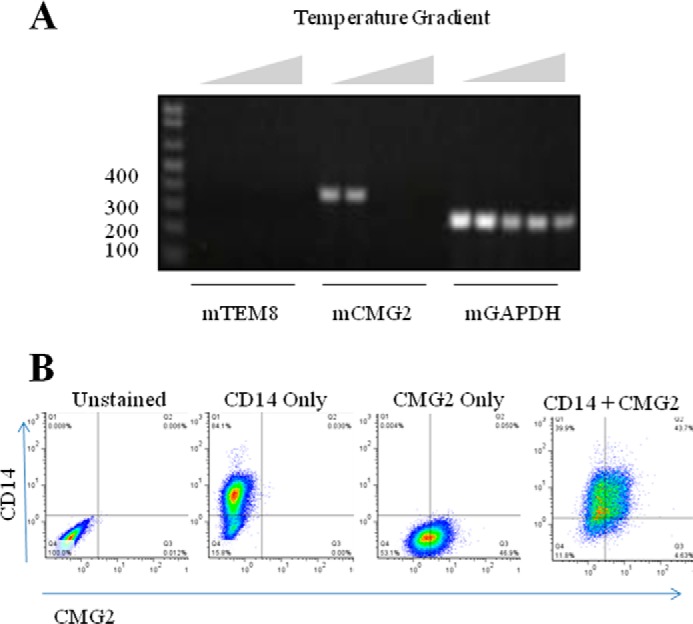
Anthrax toxin receptor expression in Raw 264.7 macrophage. Total RNA was isolated from Raw 264.7 cells, and Superscript III reverse transcriptase was used to synthesize cDNA. A, gradient PCR (55–68.5 °C) was used to amplify cDNA fragments corresponding to murine Tem8 (258 bp), Cmg2 (364 bp), and Gapdh (239 bp). B, flow cytometry methods were employed to measure expression of surface proteins. Representative plots are shown for cell samples that were unstained, stained for CD14 expression alone, stained for CMG2 expression alone, or dual stained for CD14 and CMG2 expression.
FIGURE 2.
FIGURE 2.
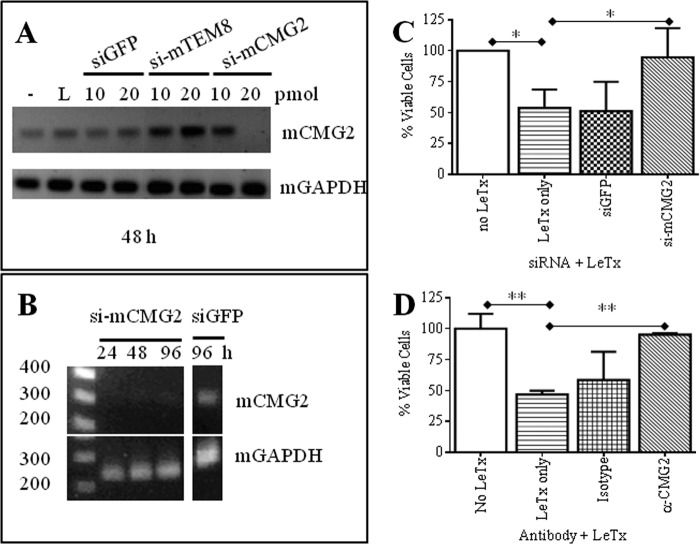
siRNA-targeted silencing of CMG2 and evaluation of anthrax LeTx toxicity in Raw 264.7 cells. A, Raw 264.7 cells were cultured in 24-well plates and treated as follows: 1) untransfected (−); 2) RNAiMAX alone (L), 3) siGFP, 10 and 20 pmol; 4) si-mTEM8, 10 and 20 pmol; and 5) si-mCMG2, 10 and 20 pmol. Total RNAs from these cells were isolated after 48 h, and RT-PCR was performed to amplify mCMG2 and mGAPDH fragments. B, 24–96 h post-transfection. Cells were treated with siRNAs at times 0 and at 48 h post-transfection. C, cells were cultured in 96-well plates and were transfected twice with 5 pmol of siGFP or si-mCMG2 or mock-transfected and then challenged with anthrax LeTx 48 h after that last transfection. Data were normalized to cell viability controls (no LeTx) in each experiment. The mean ± S.D. (error bars) of four experiments, performed in triplicates, is shown for all groups. One-way ANOVA revealed the groups to be significantly different (p = 0.0033), and Dunnett post hoc comparisons with mock-transfected, LeTx-treated cells (LeTx only) were performed. D, anti-CMG2 or isotype control antibodies were allowed to bind to Raw 264.7 cells prior to the addition of LeTx. One-way ANOVA revealed the groups to be significantly different (p = 0.0022), and Dunnett post hoc comparisons with cells treated with LeTx only were performed. *, p < 0.05; **, p < 0.01.
FIGURE 3.
FIGURE 3.
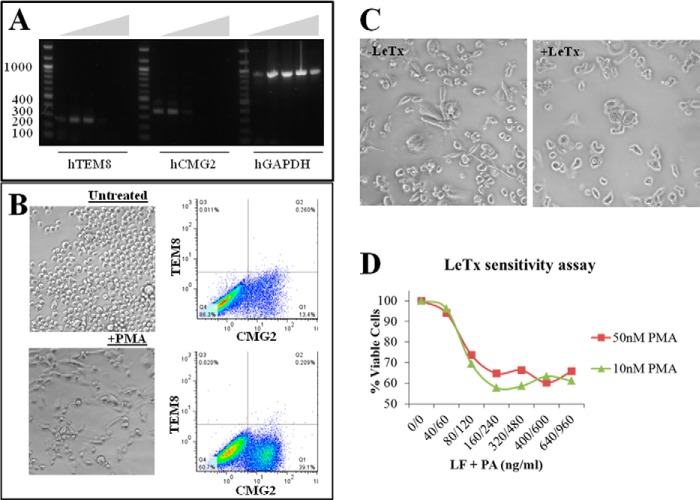
Differentiation of THP-1 cells and LeTx sensitivity. A, total RNA was isolated from THP-1 cells and Superscript III reverse transcriptase was used to synthesize cDNA. Gradient PCR (55–69.1 °C) was used to amplify cDNA fragments corresponding to human TEM8 (256 bp), CMG2 (344 bp), and GAPDH (930 bp). B, comparison of THP-1 (top) and PMA (10 nm)-differentiated THP-1 (bottom) morphology and surface expression of ANTXRs. Brightfield images were taken at ×20,000 magnification using a Nikon Eclipse Ti microscope. C, effects of LeTx in PMA (10 nm)-differentiated (right) compared with untreated cells (−LeTx, left). D, titration of LeTx in THP-1 cells treated with 10 and 50 nm PMA.
FIGURE 4.
FIGURE 4.
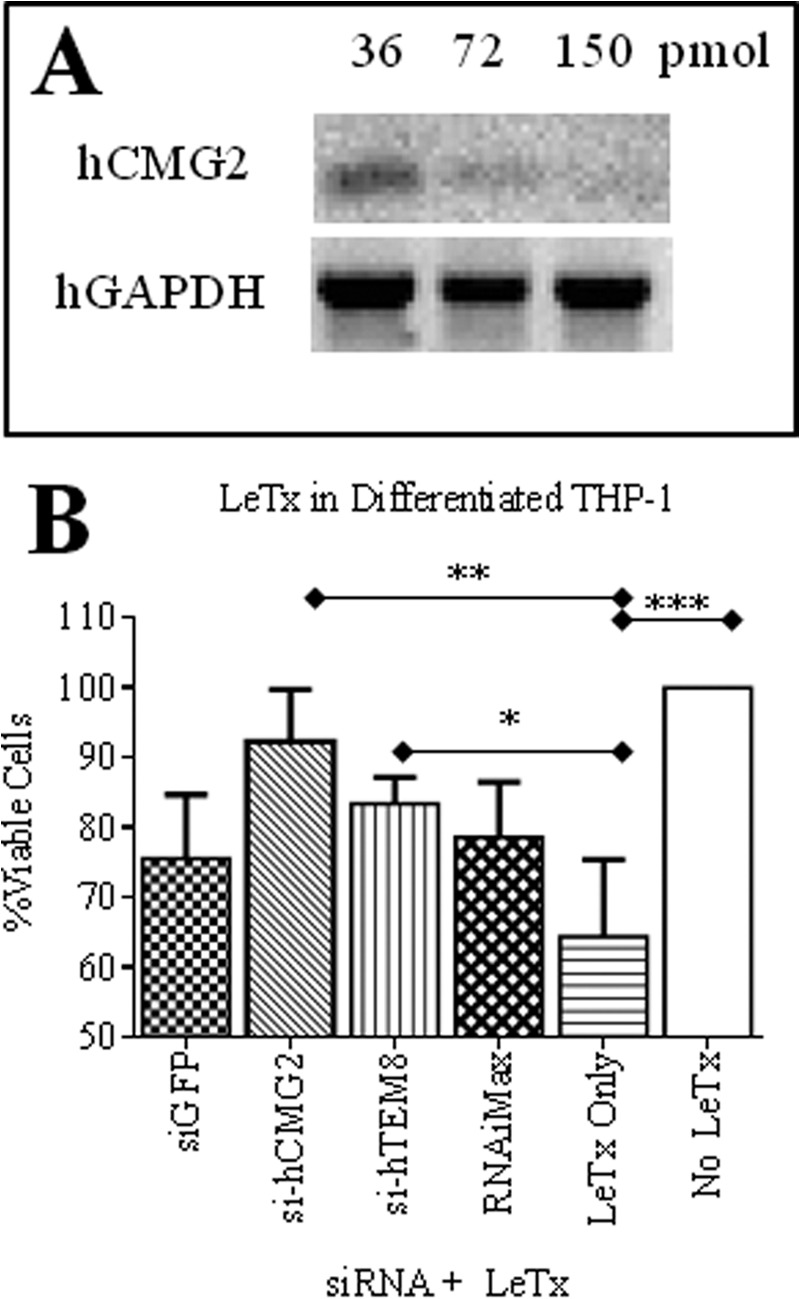
siRNA-targeted silencing of ANTXRs and evaluation of anthrax LeTx toxicity in differentiated THP-1 cells. A, differentiated THP-1 cells were treated for 24 h with different amounts of si-hCMG2. RT-PCR for hCMG2 and hGAPDH transcript expression was then performed from RNA extractions. B, THP-1 cells were cultured in 96-well plates with 10 nm PMA for 2 days. Then they were transfected with 3 pmol of siRNAs or mock-transfected. After 24 h, they were challenged with anthrax LeTx for 48 h. MTT was added, and cells were incubated for an additional day to evaluate cell viability. Data were normalized to cell viability controls (no LeTx) in each experiment. The mean ± S.D. (error bars) of three experiments, performed in replicates of six per group, is shown for each group. One-way ANOVA revealed the groups to be significantly different (p = 0.0012), and Dunnett post hoc comparisons with mock-transfected, LeTx-treated cells (LeTx only) were performed (*, p < 0.05; **, p < 0.01; ***, p < 0.001).
FIGURE 5.
FIGURE 5.
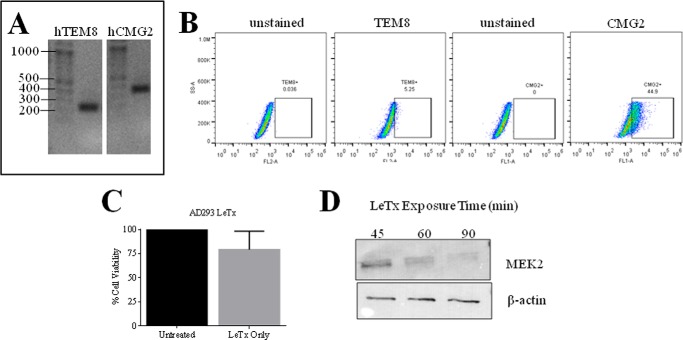
ANTXR expression in AD293 human embryonic kidney cells and susceptibility to LeTx. A, total RNA was extracted from AD293 cells, and ProtoScript Moloney murine leukemia virus reverse transcriptase was used to synthesize cDNA. PCR was then used to amplify TEM8 (256 bp) and CMG2 (344 bp). B, flow cytometry methods were employed to measure expression of surface TEM8 and CMG2. C, AD293 cells were treated with LeTx (1 μg/ml LF + 1.5 μg/ml PA) for 2 days, and cell viability was assessed by an MTT assay. The mean ± S.D. (error bars) of three separate experiments performed in triplicates is shown. D, MEK2 cleavage and β-actin expression after LeTx exposure for 45, 60, and 90 min are shown by Western blot.
FIGURE 6.
FIGURE 6.
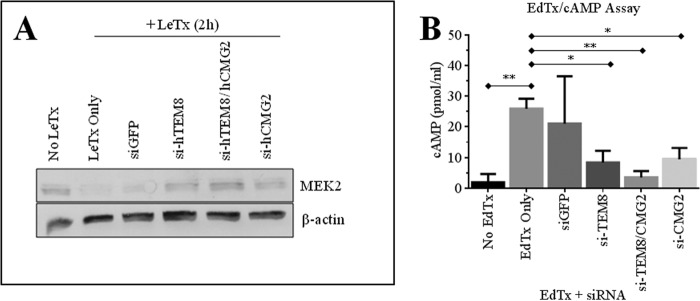
Evaluation of anthrax toxin-mediated MEK2 cleavage and intracellular cAMP in ANTXR-silenced cells. AD293 cells were cultured in 6-well plates and treated with 150 pmol siRNAs for 24 h prior to treatment with anthrax toxins. A, cells were treated with LeTx for 2 h. MEK2 cleavage and β-actin expression were assayed by Western blot. The figure is representative of three separate experiments. B, cells were treated with EdTx (0.25 μg/ml EF + 1 μg/ml PA) for 1 h. Cells were then lysed with 0.1 m HCl, and intracellular cAMP was measured using a commercial ELISA kit. Results (mean ± S.D. (error bars)) from three experiments are shown. One-way ANOVA revealed the groups to be significantly different (p = 0.0057), and Dunnett post hoc comparisons with mock-transfected, EdTx-treated cells (EdTx only) were performed (*, p < 0.05; **, p < 0.01).

References

    1. Grabenstein J. D. (2008) Vaccines: countering anthrax: vaccines and immunoglobulins. Clin. Infect. Dis. 46, 129–136 - PubMed
    1. Franz D. R. (2009) Preparedness for an anthrax attack. Mol. Aspects Med. 30, 503–510 - PubMed
    1. Bouzianas D. G. (2009) Medical countermeasures to protect humans from anthrax bioterrorism. Trends Microbiol. 17, 522–528 - PubMed
    1. Hudson M. J., Beyer W., Böhm R., Fasanella A., Garofolo G., Golinski R., Goossens P. L., Hahn U., Hallis B., King A., Mock M., Montecucco C., Ozin A., Tonello F., Kaufmann S. H. (2008) Bacillus anthracis: balancing innocent research with dual-use potential. Int. J. Med. Microbiol. 298, 345–364 - PMC - PubMed
    1. Bradley K. A., Young J. A. (2003) Anthrax toxin receptor proteins. Biochem. Pharmacol. 65, 309–314 - PubMed

Publication types

MeSH terms