


Association of circulating endothelial microparticles with cardiometabolic risk factors in the Framingham Heart Study
- PMID: 24742886
- PMCID: PMC4223610
- DOI: 10.1093/eurheartj/ehu153
Association of circulating endothelial microparticles with cardiometabolic risk factors in the Framingham Heart Study
Abstract
Objective: To examine the relation of endothelial microparticles (EMPs) with cardiometabolic risk in the community.
Background: Circulating EMPs are small membrane vesicles released after endothelial cell injury. Endothelial microparticles are reportedly increased among individuals with a high burden of cardiovascular risk factors. However, prior investigations have been limited to small, highly selected samples.
Methods: We studied 844 individuals without a history of cardiovascular disease in the Framingham Offspring cohort (mean age 66 ± 9 years, 57% women). We used standardized flow cytometry methods to identify and quantify circulating CD144+ and CD31+/CD41- EMPs. We then used multivariable regression analyses to investigate the relations of EMP phenotypes with cardiovascular and metabolic risk factors.
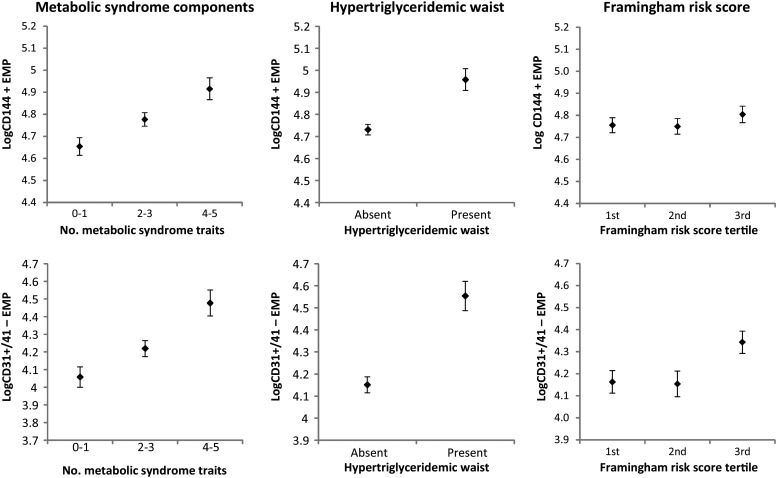
Results: In multivariable analyses, the following cardiovascular risk factors were associated with one or more of the circulating EMP populations: hypertension (P = 0.025 for CD144+,), elevated triglycerides (P = 0.002 for CD144+, P < 0.0001 for CD31+/CD41-), and metabolic syndrome (P < 0.0001 for CD144+,). Overall, each tertile increase in the Framingham risk score corresponded to a 9% increase in log-CD31+/CD41- EMPs (P = 0.022). Furthermore, the presence of hypertriglyceridaemic waist status was associated with 38% higher levels of CD144+ EMPs (P < 0.0001) and 46% higher levels of CD31+/CD41- EMPs (P < 0.0001).
Conclusion: In a large community-based sample, circulating EMP levels were associated with the presence of cardiometabolic risk factors, particularly dyslipidaemia. These data underscore the potential influence of high-risk metabolic profiles on endothelial integrity.
Keywords: Cardiovascular risk factors; Endothelium; Microparticles.
Published on behalf of the European Society of Cardiology. All rights reserved. © The Author 2014. For permissions please email: journals.permissions@oup.com.
Figures
References
-
- Dignat-George F, Boulanger CM. The many faces of endothelial microparticles. Arterioscler Thromb Vasc Biol. 2011;31:27–33. - PubMed
-
- Amabile N, Rautou PE, Tedgui A, Boulanger CM. Microparticles: key protagonists in cardiovascular disorders. Semin Thromb Hemost. 2010;36:907–916. - PubMed
-
- Ferreira AC, Peter AA, Mendez AJ, Jimenez JJ, Mauro LM, Chirinos JA, Ghany R, Virani S, Garcia S, Horstman LL, Purow J, Jy W, Ahn YS, de Marchena E. Postprandial hypertriglyceridemia increases circulating levels of endothelial cell microparticles. Circulation. 2004;110:3599–3603. - PubMed
-
- Sabatier F, Darmon P, Hugel B, Combes V, Sanmarco M, Velut JG, Arnoux D, Charpiot P, Freyssinet JM, Oliver C, Sampol J, Dignat-George F. Type 1 and type 2 diabetic patients display different patterns of cellular microparticles. Diabetes. 2002;51:2840–2845. - PubMed
-
- Preston RA, Jy W, Jimenez JJ, Mauro LM, Horstman LL, Valle M, Aime G, Ahn YS. Effects of severe hypertension on endothelial and platelet microparticles. Hypertension. 2003;41:211–217. - PubMed
Publication types
MeSH terms
Substances
Grants and funding
LinkOut - more resources
Full Text Sources
Other Literature Sources
Medical
