


Gastric bypass with long alimentary limb or long pancreato-biliary limb--long-term results on weight loss, resolution of co-morbidities and metabolic parameters
- PMID: 24744188
- PMCID: PMC4153949
- DOI: 10.1007/s11695-014-1245-7
Gastric bypass with long alimentary limb or long pancreato-biliary limb--long-term results on weight loss, resolution of co-morbidities and metabolic parameters
Abstract
Background: Several studies indicate that increasing the alimentary limb length in gastric bypass surgery produces only a minor improvement of excess BMI loss. Few studies have addressed the efficacy of increasing the length of the pancreatico-biliary limb.
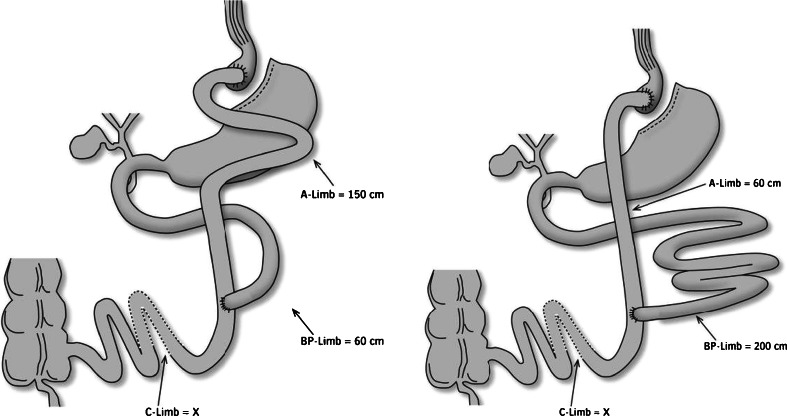
Methods: Here, we present a prospective randomized study of 187 consecutive laparoscopic Roux-Y gastric bypass operations operated over 2 years (2004-2005) in Iceland. The patients were operated with a gastric bypass with either a 2-m biliopancreatic (BP)-limb and a 60-cm alimentary (A)-limb (n = 93) or with a 150-cm A-limb and a 60-cm BP-limb (n = 94).
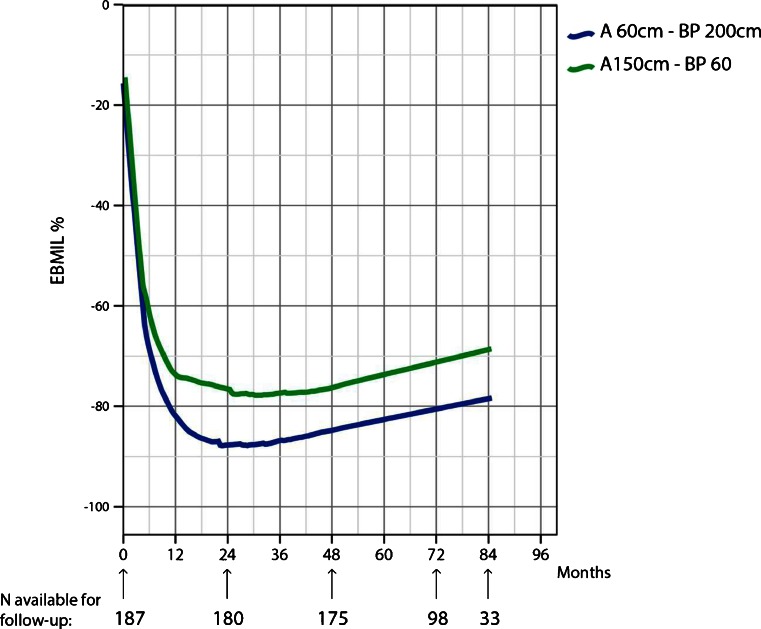
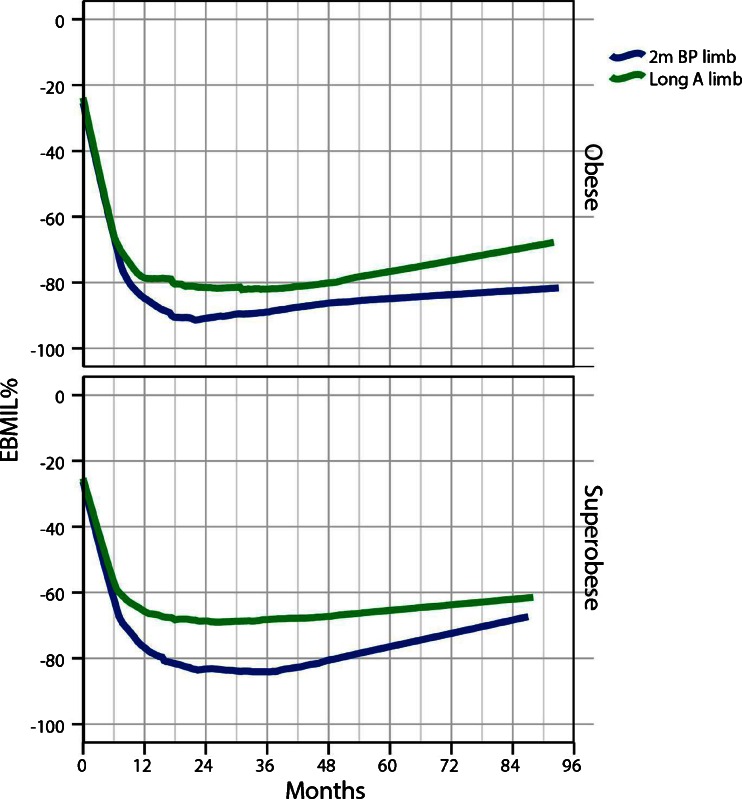
Results: Preoperative median BMI was 44.1 (38-70), median age 35.5 (17-74) years, and 85 % of the patients were female. Follow-up rate after 5 years was 85 %. Eighteen months following surgery, the weight loss was significantly higher in the BP-limb group (p < 0.001), and this difference remained 7 years after surgery. Weight regain occurred in both groups, and 7 years after surgery, excess BMI loss (EBMIL) was 78.4 % in the BP-limb group compared to 67.1 % in the A-limb group (p < 0.001). Most patients (78 %) needed supplementation adjustment (iron, vitamin D and calcium) during the study period, significantly more often in the BP-limb group compared to the A-limb group (p < 0.001). Patients in the BP-limb group had more frequent stools than patients in the A-limb group; otherwise, gastro-intestinal symptoms rating scoring were comparable. Complication rate was similar.
Conclusions: Gastric bypass with a 2-m BP-limb gives better weight loss than gastric bypass with a 60-cm BP-limb and a 150-cm A-limb. Metabolic follow-up is of utmost importance, as most patients needed repeated adjustments of their supplementation.
Conflict of interest statement
All authors declare that they have no conflict of interest and the study has not been supported by any grants.
Figures
References
Publication types
MeSH terms
LinkOut - more resources
Full Text Sources
Other Literature Sources
Medical
