


Biomechanics of head injury in olympic taekwondo and boxing
- PMID: 24744497
- PMCID: PMC3944542
- DOI: 10.5604/20831862.1077551
Biomechanics of head injury in olympic taekwondo and boxing
Abstract
Objective: The purpose was to examine differences between taekwondo kicks and boxing punches in resultant linear head acceleration (RLA), head injury criterion (HIC15), peak head velocity, and peak foot and fist velocities. Data from two existing publications on boxing punches and taekwondo kicks were compared.
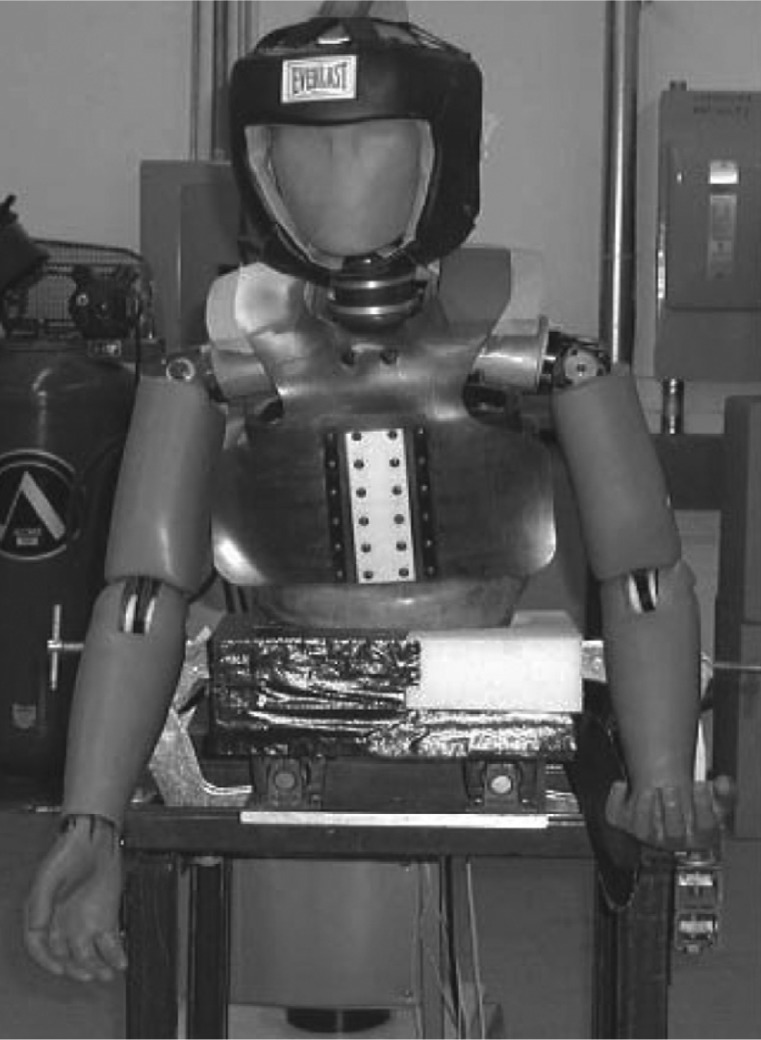
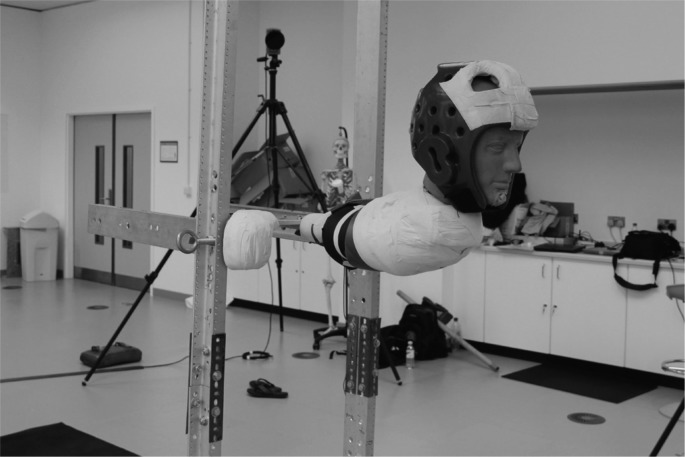
Methods: For taekwondo head impacts a Hybrid II Crash Dummy (Hybrid II) head was instrumented with a tri-axial accelerometer mounted inside the Hybrid II head. The Hybrid II was fixed to a height-adjustable frame and fitted with a protective taekwondo helmet. For boxing testing, a Hybrid III Crash Dummy head was instrumented with an array of tri-axial accelerometers mounted at the head centre of gravity.
Results: Differences in RLA between the roundhouse kick (130.11±51.67 g) and hook punch (71.23±32.19 g, d = 1.39) and in HIC15 (clench axe kick: 162.63±104.10; uppercut: 24.10±12.54, d = 2.29) were observed.
Conclusions: Taekwondo kicks demonstrated significantly larger magnitudes than boxing punches for both RLA and HIC.
Keywords: biomechanics; boxing injuries; head injury; taekwondo.
Figures
References
-
- Cohen JE, Margolin E, Moscovici S, Paldor I, Itshayek E. Life-threatening massive subarachnoid hemorrhage after Taekwondo-associated head trauma. Isr Med Assoc J. 2010;12:509–510. - PubMed
-
- Dun S, Fleisig GS, Loftice J, Kingsley D, Andrews JR. The relationship between age and baseball pitching kinematics in professional baseball pitchers. J Biomech. 2007;40:265–270. - PubMed
-
- El Ashker S. Technical and tactical aspects that differentiate winning and losing performances in boxing. Int J Perform Anal Sport. 2011;11:356–364.
LinkOut - more resources
Full Text Sources
Other Literature Sources