. 2014 Mar 31:5:250.
doi: 10.3389/fpsyg.2014.00250. eCollection 2014.

Snack food intake in ad libitum fed rats is triggered by the combination of fat and carbohydrates

Affiliations

Snack food intake in ad libitum fed rats is triggered by the combination of fat and carbohydrates

Tobias Hoch et al. Front Psychol. .

Abstract

Snack food like potato chips substantially contributes to energy intake in humans. In contrast to basic food, snacks are consumed additionally to other meals and may thereby lead to non-homeostatic energy intake. Snack food is also frequently associated with hedonic hyperphagia, a food intake independent from hunger. Analysis of brain activity patterns by manganese-enhanced MRI has previously revealed that the intake of potato chips in ad libitum fed rats strongly activates the reward system of the rat brain, which may lead to hedonic hyperphagia. The purpose of the present study was to develop a two-choice preference test to identify molecular determinants of snack food triggering extra food intake in ad libitum fed rats. Different kinds of test food were presented three times a day for 10 min each time. To minimize the influence of organoleptic properties, each test food was applied in a homogenous mixture with standard chow. Food intake as well as food intake-related locomotor activity were analyzed to evaluate the effects induced by the test foods in the two-choice preference test. In summary, fat (F), carbohydrates (CH), and a mixture of fat and carbohydrates (FCH) led to a higher food intake compared to standard chow. Notably, potato chip test food (PC) was highly significantly preferred over standard chow (STD) and also over their single main macronutrients F and CH. Only FCH induced an intake comparable to PC. Despite its low energy density, fat-free potato chip test food (ffPC) was also significantly preferred over STD and CH, but not over F, FCH, and PC. Thus, it can be concluded that the combination of fat and carbohydrates is a major molecular determinant of potato chips triggering hedonic hyperphagia. The applied two-choice preference test will facilitate future studies on stimulating and suppressive effects of other food components on non-homeostatic food intake.

Keywords: eating behavior; food intake; macronutrients; preference test; rat; snack food.


Figures
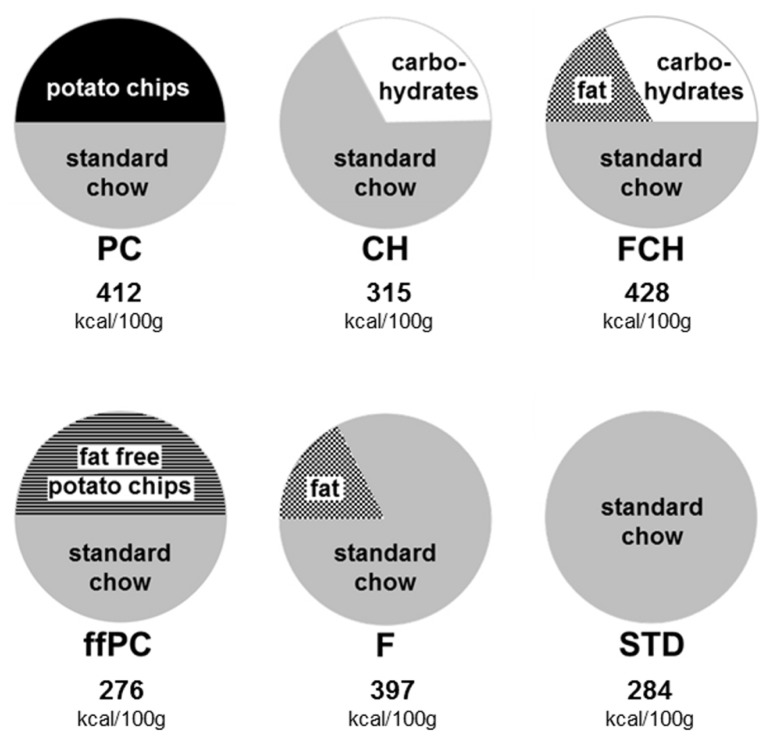
FIGURE 1
FIGURE 1
Composition (percent by weight) and energy content (kcal/100 g) of the test foods: potato chips (PC), fat-free potato chips (ffPC), carbohydrate content of PC (CH), fat content of PC (F), fat and carbohydrate mixture (FCH), and powdered standard chow (STD).
FIGURE 2
FIGURE 2
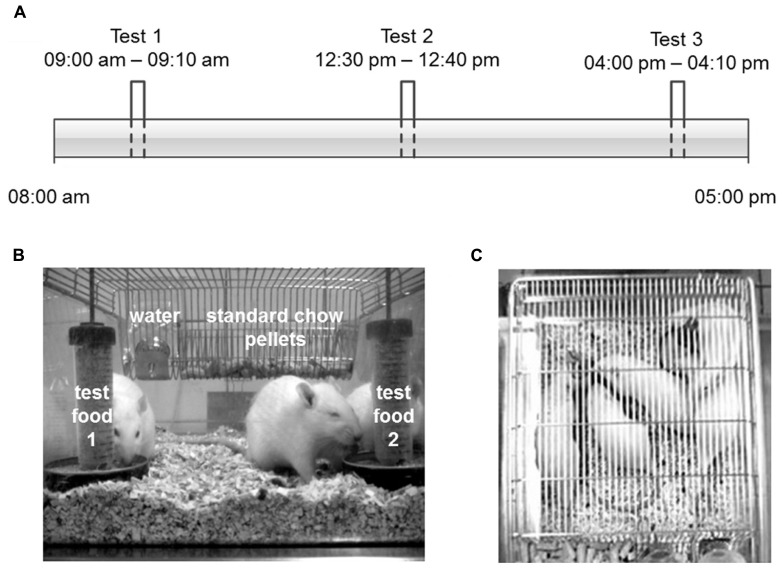
Overview on the study design: (A) Schedule for the three separate two-choice preference tests on one day at 9 am, 12.30 pm and 4 pm. (B) Front view of the cage during the two-choice preference tests with the two additional test food dispensers (test food 1 and 2), which were presented three times a day. In the background the STD pellets as well as tap water are visible, which were constantly available ad libitum. (C) View from above on the cage during a preference test for the evaluation of the feeding-related locomotor activity.
FIGURE 3
FIGURE 3
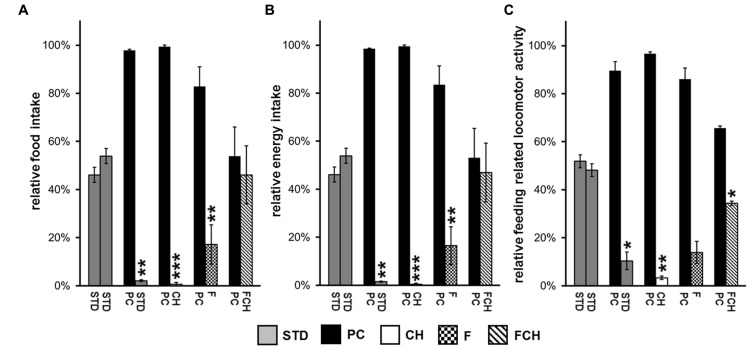
Two-choice preference tests between the different test foods: (A) Relative food intake, (B) relative energy intake, and (C) relative feeding-related locomotor activity testing standard chow (STD) in both food containers or potato chips (PC) vs. STD as well as their major macronutrients carbohydrates (CH), fat (F), and fat and carbohydrates (FCH). Mean ± standard deviation of the relative food/energy intake or locomotor activity of the independent animal groups (cages) are shown. ***p < 0.001, **p < 0.01, *p < 0.05.
FIGURE 4
FIGURE 4
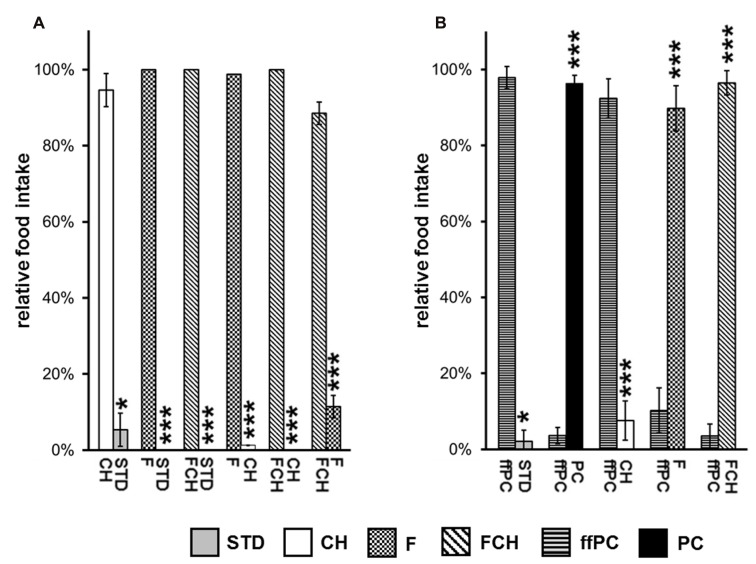
Relative food intake during two-choice preference tests (A) applying the major macronutrients of potato chips (PC), carbohydrates (CH), fat (F) as well as fat and carbohydrates (FCH), and standard chow (STD). (B) Two-choice preference test of fat-free potato chips (ffPC) vs. STD, PC, and the macronutrients (CH, F, FCH) of PC. Mean ± standard deviation of the relative food intake of the independent animal groups (cages) is shown. ***p < 0.001, *p < 0.05.
FIGURE 5
FIGURE 5
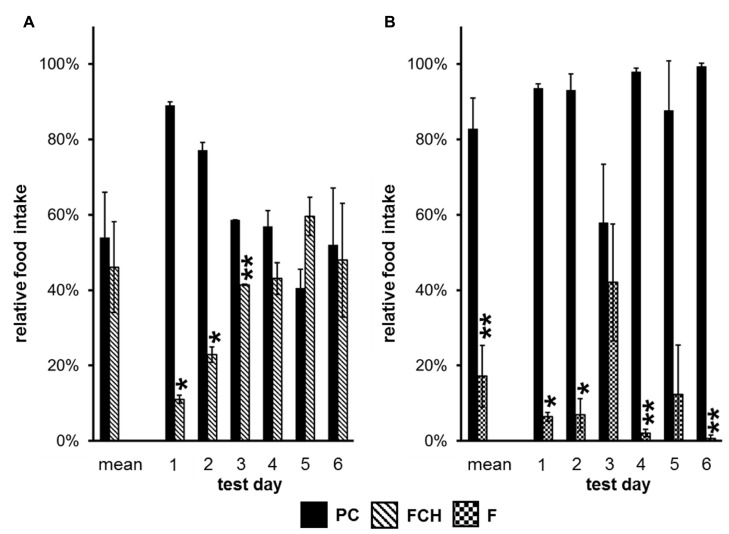
(A) Relative food intake (mean and single values of six different test days) during two-choice preference tests of potato chips (PC) vs. the mixture of fat and carbohydrates (FCH), and (B) PC vs. the fat content of potato chips (F). Mean ± standard deviation of the relative food intake of the independent animal groups (cages) is shown. **p < 0.01, *p < 0.05.

References

    1. Alsio J., Olszewski P. K., Levine A. S., Schioth H. B. (2012). Feed-forward mechanisms: addiction-like behavioral and molecular adaptations in overeating. Front. Neuroendocrinol. 33:127–139 10.1016/j.yfrne.2012.01.002 - DOI - PubMed
    1. Avena N. M., Rada P., Hoebel B. G. (2009). Sugar and fat bingeing have notable differences in addictive-like behavior. J. Nutr. 139 623–628 10.3945/jn.108.097584 - DOI - PMC - PubMed
    1. Beauchamp G. K., Bertino M. (1985). Rats (Rattus norvegicus) do not prefer salted solid food. J. Comp. Psychol. 99 240–247 10.1037/0735-7036.99.2.240 - DOI - PubMed
    1. Berner L. A., Bocarsly M. E., Hoebel B. G., Avena N. M. (2009). Baclofen suppresses binge eating of pure fat but not a sugar-rich or sweet-fat diet. Behav. Pharmacol. 20 631–634 10.1097/FBP.0b013e328331ba47 - DOI - PMC - PubMed
    1. Berthoud H. R. (2011). Metabolic and hedonic drives in the neural control of appetite: who is the boss? Curr. Opin. Neurobiol. 21 888–896 10.1016/j.conb.2011.09.004 - DOI - PMC - PubMed