


Energy cost of running and Achilles tendon stiffness in man and woman trained runners
- PMID: 24744857
- PMCID: PMC3970734
- DOI: 10.1002/phy2.178
Energy cost of running and Achilles tendon stiffness in man and woman trained runners
Abstract
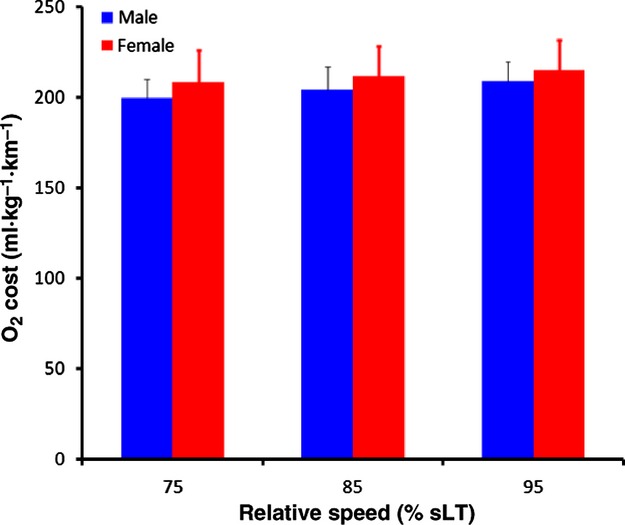
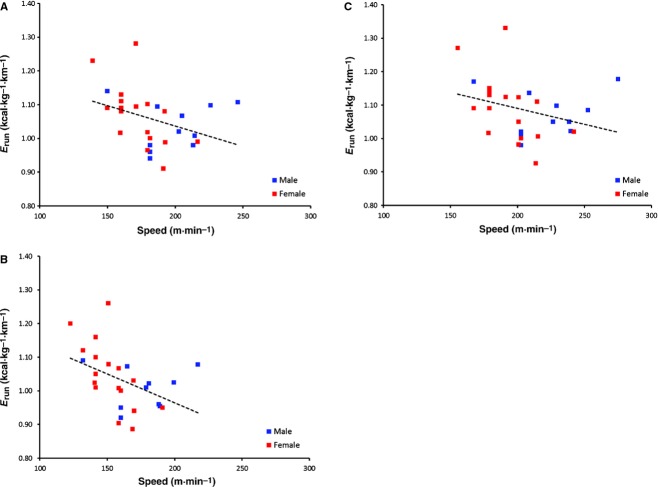
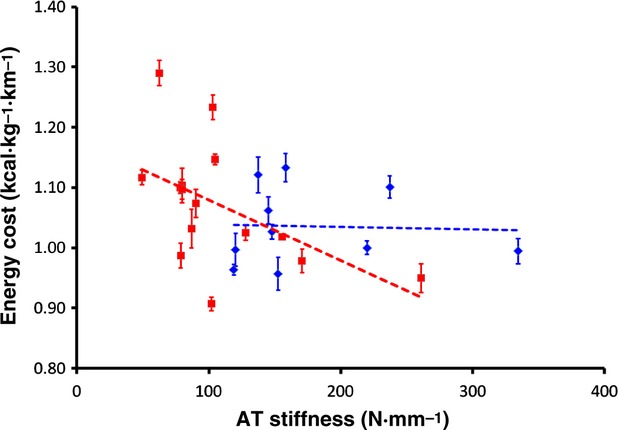
The energy cost of running (E run), a key determinant of distance running performance, is influenced by several factors. Although it is important to express E run as energy cost, no study has used this approach to compare similarly trained men and women. Furthermore, the relationship between Achilles tendon (AT) stiffness and E run has not been compared between men and women. Therefore, our purpose was to determine if sex-specific differences in E run and/or AT stiffness existed. E run (kcal kg(-1) km(-1)) was determined by indirect calorimetry at 75%, 85%, and 95% of the speed at lactate threshold (sLT) on 11 man (mean ± SEM, 35 ± 1 years, 177 ± 1 cm, 78 ± 1 kg, [Formula: see text]1 = 56 ± 1 mL kg(-1) min(-1)) and 18 woman (33 ± 1 years, 165 ± 1 cm, 58 ± 1 kg, [Formula: see text]2 = 50 ± 0.3 mL kg(-1) min(-1)) runners. AT stiffness was measured using ultrasound with dynamometry. Man E run was 1.01 ± 0.06, 1.04 ± 0.07, and 1.07 ± 0.07 kcal kg(-1) km(-1). Woman E run was 1.05 ± 0.10, 1.07 ± 0.09, and 1.09 ± 0.10 kcal kg(-1) km(-1). There was no significant sex effect for E run or RER, but both increased with speed (P < 0.01) expressed relative to sLT. High-range AT stiffness was 191 ± 5.1 N mm(-1) for men and 125 ± 5.5 N mm(-1), for women (P < 0.001). The relationship between low-range AT stiffness and E run was significant at all measured speeds for women (r (2) = 0.198, P < 0.05), but not for the men. These results indicate that when E run is measured at the same relative intensity, there are no sex-specific differences in E run or substrate use. Furthermore, differences in E run cannot be explained solely by differences in AT stiffness.
Keywords: Allometric scaling; economy of locomotion; oxygen uptake; respiratory exchange ratio; running economy.
Figures
References
-
- An K., Takahashi K., Harrigan T., Chao E. 1984. Determination of muscle orientations and moment arms. J. Biomech. Eng.; 106:280. - PubMed
-
- Arampatzis A., De Monte G., Karamanidis K., Morey‐Klapsing G., Stafilidis S., Bruggemann G. P. 2006. Influence of the muscle‐tendon unit's mechanical and morphological properties on running economy. J. Exp. Biol.; 209Pt. 17:3345-3357 - PubMed
-
- Askew G. N., Marsh R. L. 1998. Optimal shortening velocity (V/Vmax) of skeletal muscle during cyclical contractions: length‐force effects and velocity‐dependent activation and deactivation. J. Exp. Biol.; 201Pt. 10:1527-1540 - PubMed
-
- Barclay C. J., Lichtwark G. A., Curtin N. A. 2008. The energetic cost of activation in mouse fast‐twitch muscle is the same whether measured using reduced filament overlap or N‐benzyl‐p‐toluenesulphonamide. Acta Physiol.; 193:381-391 - PubMed
-
- Bergh U., Sjødin B., Forsberg A., Svedenhag J. 1991. The relationship between body mass and oxygen uptake during running in humans. Med. Sci. Sports Exerc.; 23:205. - PubMed
LinkOut - more resources
Full Text Sources
Other Literature Sources
Miscellaneous
