


Development of Localized Pulmonary Interstitial Emphysema in a Late Preterm Infant without Mechanical Ventilation
- PMID: 24744939
- PMCID: PMC3972850
- DOI: 10.1155/2014/429797
Development of Localized Pulmonary Interstitial Emphysema in a Late Preterm Infant without Mechanical Ventilation
Abstract
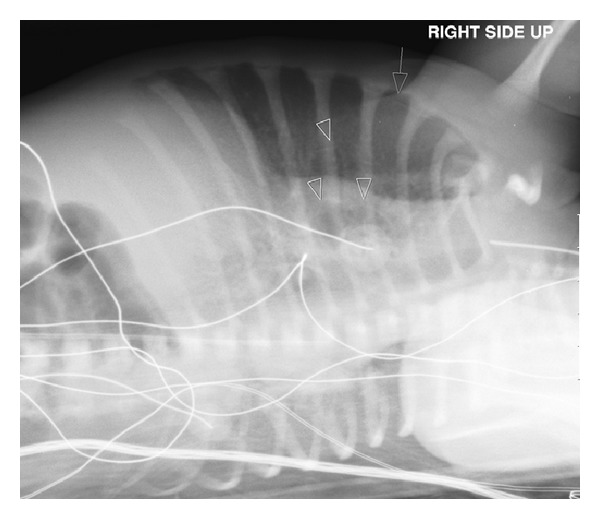
Pulmonary interstitial emphysema (PIE) is not an uncommon finding in premature infants with respiratory distress who need respiratory support by mechanical ventilation. PIE has been reported in a few cases of neonates in whom either no treatment other than room air was given or they were given continuous positive end-expiratory pressure (CPAP) support. We present a case of a premature neonate who presented with respiratory distress, in whom PIE and spontaneous pneumothorax (PTX) developed while on CPAP therapy only. The patient was treated conservatively with subsequent resolution of the radiological findings and clinical improvement. No surgical intervention was required. It is important to know that PIE may develop independently of mechanical ventilation. We would like to add this case to the literature and describe the pertinent plain film and computed tomography (CT) findings of this entity, the possible mechanism of development, and the differential diagnosis. A review of the literature is also provided.
Figures




References
-
- Crosswell HE, Stewart DL. Special feature: radiological case of the month. Pulmonary interstitial emphysema in a nonventilated preterm infant. Archives of Pediatrics & Adolescent Medicine. 2001;155(5):615–616. - PubMed
-
- Al-Abdi SY, Singhal N. Pulmonary interstitial emphysema and continuous positive airway pressure in a premature infant. Saudi Medical Journal. 2005;26(10):1627–1629. - PubMed
-
- Berk DR, Varich LJ. Localized persistent pulmonary interstitial emphysema in a preterm infant in the absence of mechanical ventilation. Pediatric Radiology. 2005;35(12):1243–1245. - PubMed
LinkOut - more resources
Full Text Sources
Other Literature Sources
