


Towards XNA nanotechnology: new materials from synthetic genetic polymers
- PMID: 24745974
- PMCID: PMC4039137
- DOI: 10.1016/j.tibtech.2014.03.010
Towards XNA nanotechnology: new materials from synthetic genetic polymers
Abstract
Nucleic acids display remarkable properties beyond information storage and propagation. The well-understood base pairing rules have enabled nucleic acids to be assembled into nanostructures of ever increasing complexity. Although nanostructures can be constructed using other building blocks, including peptides and lipids, it is the capacity to evolve that sets nucleic acids apart from all other nanoscale building materials. Nonetheless, the poor chemical and biological stability of DNA and RNA constrain their applications. Recent advances in nucleic acid chemistry and polymerase engineering enable the synthesis, replication, and evolution of a range of synthetic genetic polymers (XNAs) with improved chemical and biological stability. We discuss the impact of this technology on the generation of XNA ligands, enzymes, and nanostructures with tailor-made chemistry.
Copyright © 2014 The Authors. Published by Elsevier Ltd.. All rights reserved.
Figures
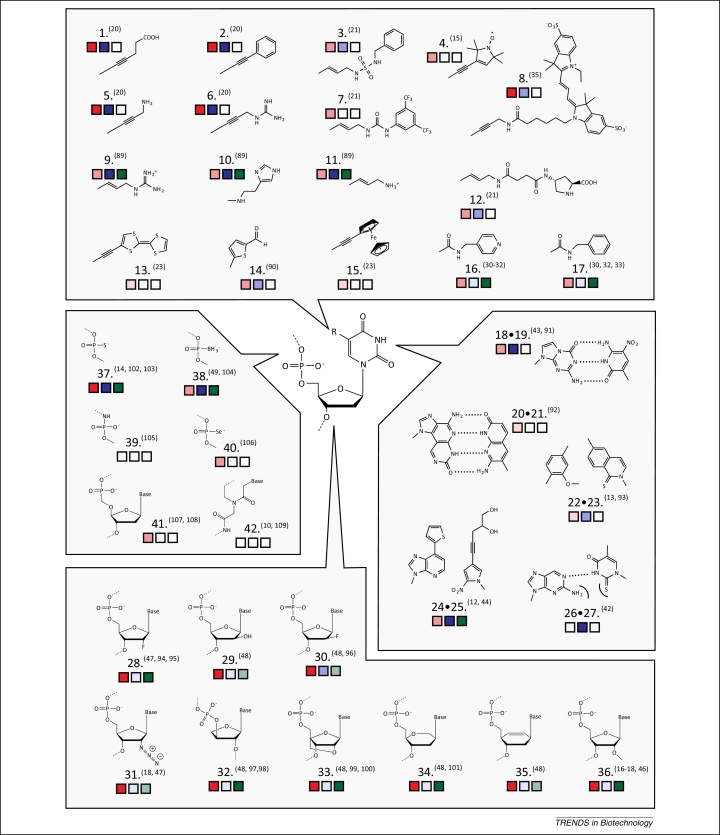
 , no reported incorporation or extension;
  , single or sparse incorporations;
  , multiple incorporations or partial substitution;
  , full substitution. The suitability of XNAs as templates are scored as: , no reported replication;
  , DNA synthesis from XNA template;
  , XNA synthesis from DNA/XNA hybrid template;
  , XNA replication. Functional complexity was scored as: , no proven function;
  , functional genetic material;
  , functional ligands or enzymes. The relevant references are indicated by the XNA shown [10,12–18,20,21,23,30–33,35,42–44,47–49,89–109].
References
Publication types
MeSH terms
Substances
Grants and funding
LinkOut - more resources
Full Text Sources
Other Literature Sources
