Review
. 2014 Dec:30:1-8.
doi: 10.1016/j.copbio.2014.03.006. Epub 2014 Apr 18.

Opportunities for merging chemical and biological synthesis

Affiliations
Review

Opportunities for merging chemical and biological synthesis

Stephen Wallace et al. Curr Opin Biotechnol. 2014 Dec.

Abstract

Organic chemists and metabolic engineers use largely orthogonal technologies to access small molecules like pharmaceuticals and commodity chemicals. As the use of biological catalysts and engineered organisms for chemical production grows, it is becoming increasingly evident that future efforts for chemical manufacture will benefit from the integration and unified expansion of these two fields. This review will discuss approaches that combine chemical and biological synthesis for small molecule production. We highlight recent advances in combining enzymatic and non-enzymatic catalysis in vitro, discuss the application of design principles from organic chemistry for engineering non-biological reactivity into enzymes, and describe the development of biocompatible chemistry that can be interfaced with microbial metabolism.


Figures

Figure 1
Figure 1
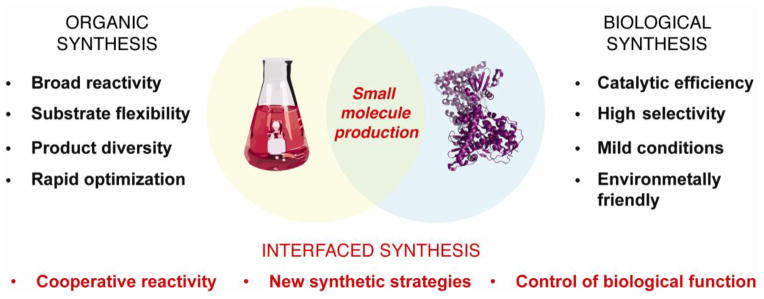
Opportunities for merging chemical and biological synthesis.
Figure 2
Figure 2
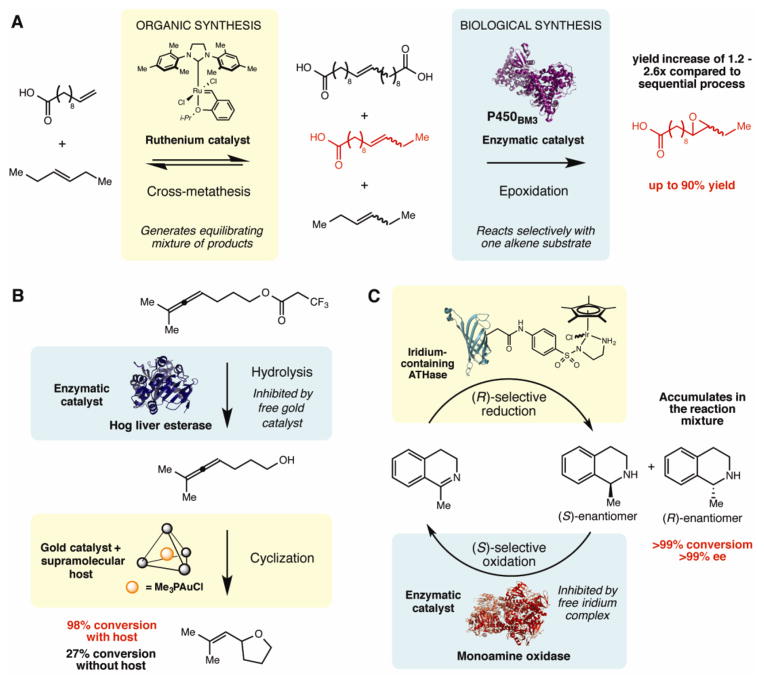
Approaches for combining enzymatic and non-enzymatic catalysis in vitro. A. A cooperative cross metathesis-epoxidation reaction using a ruthenium(I) catalyst and a P450BM3 enzyme. B. A tandem hydrolysis-cyclization sequence using a a lipase/esterase enzyme and a encapsulated gold(I)-catalyst. C. A dynamic kinetic resolution of cyclic amines using an engineered monoamine oxidase and an artificial transfer hydrogenase (ATHase) consisting of biotin-conjugated iridium-catalyst bound to streptavidin.
Figure 3
Figure 3
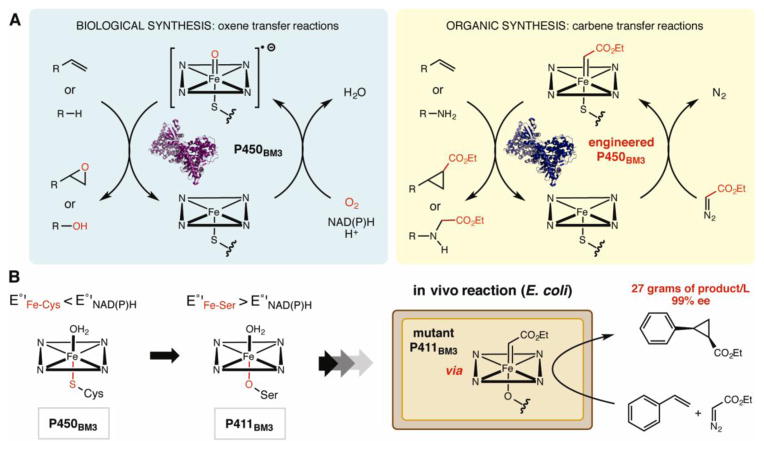
Engineering enzymes to display non-biological reactivity using organic chemistry as inspiration. A. The mechanistic similarities between natural oxene transfer reactions of cytochrome P450 enzymes and carbene transfer reactions. B. A simple axial ligand mutation facilitated catalysis of cyclopropanation by P411BM3 in a whole-cell format.
Figure 4
Figure 4
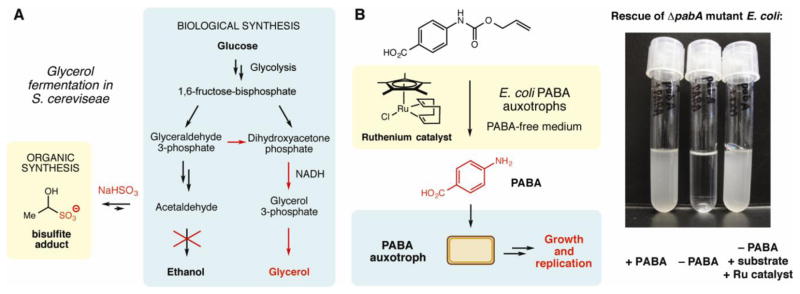
Integrating non-enzymatic chemistry with cellular metabolism. A. Neuberg’s bisulfite-steered glycerol fermentations. The chemical reagent sodium bisulfite was used to redirect the natural fermentation in S. cereviseae to form glycerol. NADH = nicotinamide adenine dinucleotide. B. Auxotroph rescue with non-enzymatic chemistry. A Ru-catalyzed deprotection reaction was used to support growth of an E. coli PABA auxotroph. PABA = para-aminobenzoic acid.

References

    1. Nicolaou KC. The emergence of the structure of the molecule and the art of its synthesis. Angew Chem Int Ed. 2013;52:131–146. - PubMed
    1. Nicolaou KC, Hale CRH, Nilewski C, Ioannidou HA. Constructing molecular complexity and diversity: total synthesis of natural products of biological and medicinal importance. Chem Soc Rev. 2012;41:5185–5238. - PMC - PubMed
    1. Schreiber S. Organic synthesis toward small-molecule probes and drugs. Proc Natl Acad Sci USA. 2011;108:6699–6702. - PMC - PubMed
    1. Keasling J. Manufacturing molecules through metabolic engineering. Science. 2010;330:1355–1358. - PubMed
    1. Carothers JM, Goler JA, Keasling JD. Chemical synthesis using synthetic biology. Curr Opin Biotechnol. 2009;20:498–503. - PubMed

Publication types

LinkOut - more resources