Review
. 2014 Oct;35(4):494-511.
doi: 10.1016/j.yfrne.2014.04.002. Epub 2014 Apr 18.

Reproductive neuroendocrine dysfunction in polycystic ovary syndrome: insight from animal models

Affiliations
Review

Reproductive neuroendocrine dysfunction in polycystic ovary syndrome: insight from animal models

Alison V Roland et al. Front Neuroendocrinol. 2014 Oct.

Abstract

Polycystic ovary syndrome (PCOS) is a common endocrinopathy with elusive origins. A clinically heterogeneous disorder, PCOS is likely to have multiple etiologies comprised of both genetic and environmental factors. Reproductive neuroendocrine dysfunction involving increased frequency and amplitude of gonadotropin-releasing hormone (GnRH) release, as reflected by pulsatile luteinizing hormone (LH) secretion, is an important pathophysiologic component in PCOS. Whether this defect is primary or secondary to other changes in PCOS is unclear, but it contributes significantly to ongoing reproductive dysfunction. This review highlights recent work in animal models, with a particular emphasis on the mouse, demonstrating the ability of pre- and postnatal steroidal and metabolic factors to drive changes in GnRH/LH pulsatility and GnRH neuron function consistent with the observed abnormalities in PCOS. This work has begun to elucidate how a complex interplay of ovarian, metabolic, and neuroendocrine factors culminates in this syndrome.

Keywords: Androgens; Gonadotropin-releasing hormone neurons; Polycystic ovary syndrome; Prenatal androgenization.


Figures

Figure 1
Figure 1
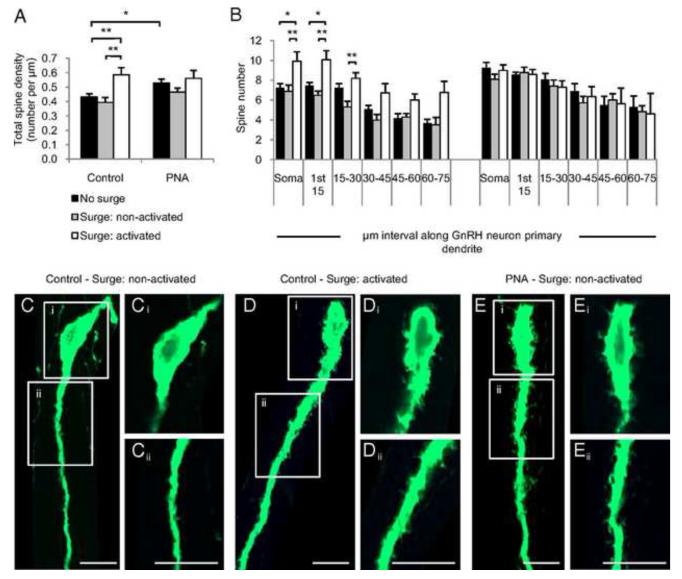
PNA mice fail to show an increase in dendritic spines in c-fos-expressing GnRH neurons at the time of the estradiol benzoate (EB)-induced surge. A, GnRH neuron spine density is increased in control mice in c-fos-positive neurons at the time of the surge, compared to inactivated neurons and neurons in untreated mice. PNA mice do not show this increase. Untreated PNA mice exhibit a greater spine density than untreated controls. B, In c-fos-expressing GnRH neurons in EB-treated control animals, the increase in spines is detected at the soma and first 30 um of the primary dendrite. C-E, Projected confocal images of representative GnRH neurons. i-ii, Individual confocal images (450 nm optical thickness) from selected subregions of panels C–E. *, P<0.05. From (Moore et al., 2013) with permission.
Figure 2
Figure 2
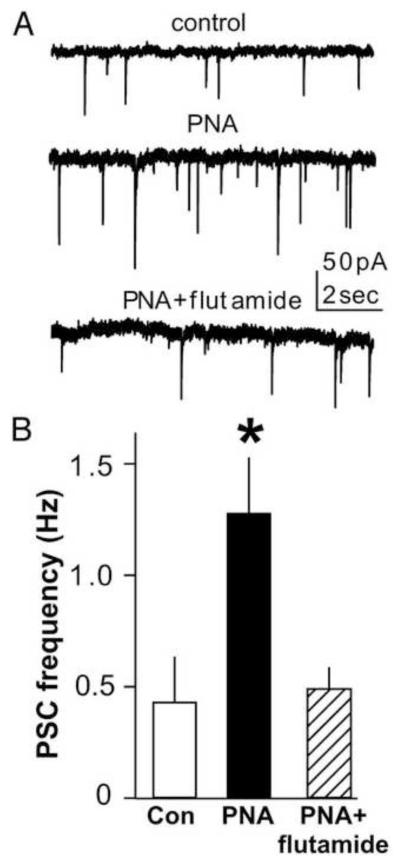
PNA mice exhibited increased frequency and amplitude of GABAergic postsynaptic currents in GnRH neurons that is reversed by treatment with flutamide in vivo. A, Representative current traces from a PNA, control, and PNA mouse treated with flutamide. B, Summary bar graph indicating the increase in mean GABA PSC frequency in PNA mice and reversal by flutamide. *, P<0.05. From (Sullivan and Moenter, 2004a) with permission.
Figure 3
Figure 3
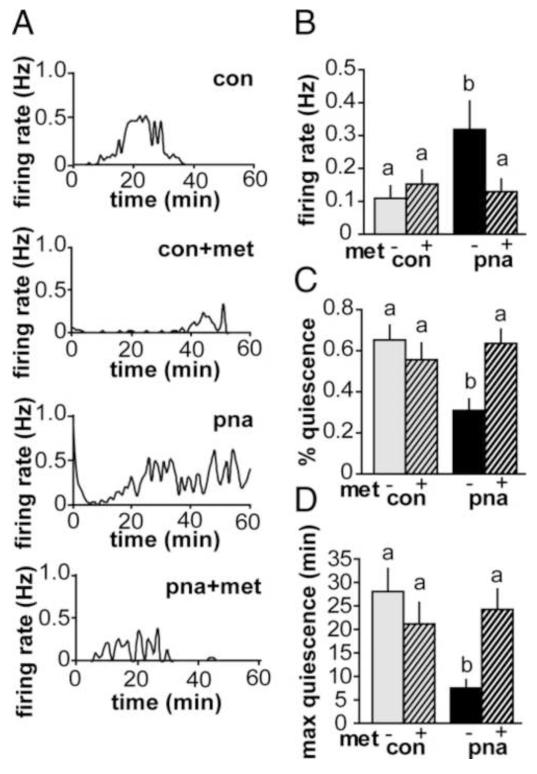
PNA mice exhibit increased activity of GnRH neurons that is reversible by treatment with metformin in vivo. A, Representative plots of firing rate over time from control (con), control+metformin (con+met), PNA, and PNA+metformin (PNA+met) treatment groups illustrating elevated GnRH neuronal activity in untreated PNA animals. B, Bar graphs summarizing the effects of PNA and metformin on measures of firing rate, percent of time cells were quiescent ( 1 event/min), and maximum duration of quiescence during a one-hour recording. Different letters indicate significant differences among groups. From (Roland and Moenter, 2011a) with permission.
Figure 4
Figure 4
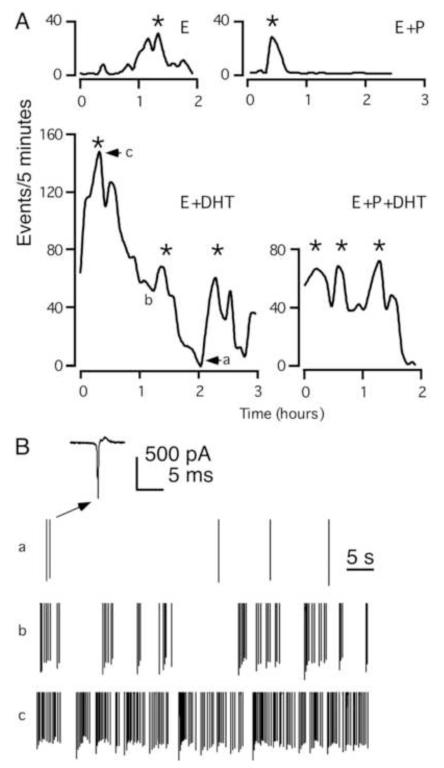
Androgen increases GnRH neuron firing activity in females. A, Representative plot of firing rate over time in GnRH neurons from mice treated with estradiol (E) alone, E+progesterone (P), E+DHT, or E+P+DHT. Asterisks mark increased firing rate determined by the Cluster pulse-detection algorithm (Veldhuis and Johnson, 1986). Lowercase letters in the E+DHT example indicate areas detailed in B. B, An individual action current is shown on top. a, b, and c are 1-minute excerpts of action currents indicated in A. These illustrate action currents during low (a), medium (b), and high (c) firing rates in this cell. From (Pielecka et al., 2006) with permission.
Figure 5
Figure 5
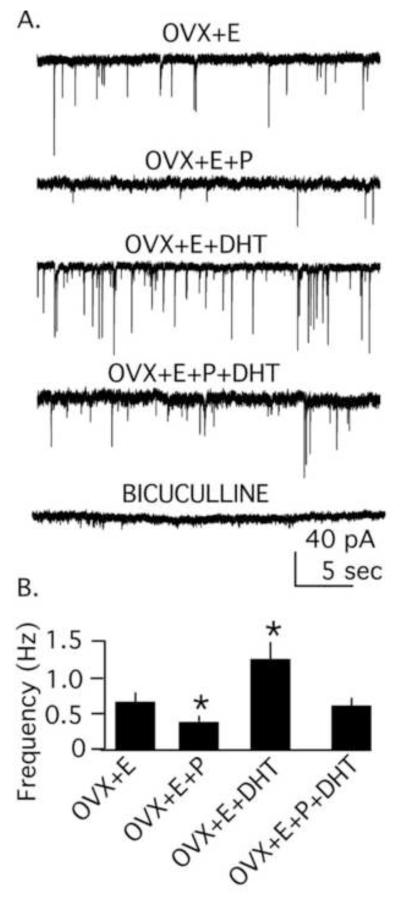
DHT increases and P reduces GABAergic PSC frequency in GnRH neurons from female mice. A, Representative current traces showing GABAergic PSCs in GnRH neurons from OVX mice treated with estradiol (E) alone, E+progesterone (P), E+DHT, or E+P+DHT. PSCs are blocked by the GABAA receptor antagonist bicuculline. B, Summary bar graph. *, P<0.05 versus OVX+E. From (Sullivan and Moenter, 2005) with permission.
Figure 6
Figure 6
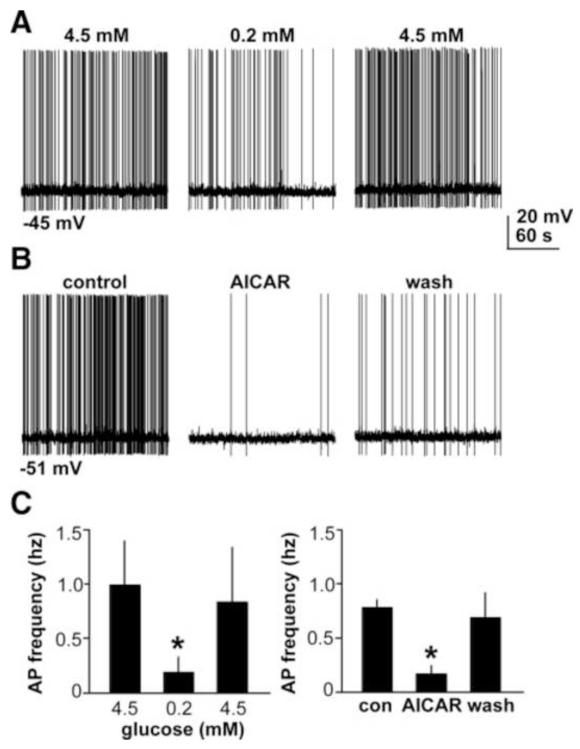
Low glucose and an AMPK activator inhibit GnRH neuron firing activity. A, Representative current-clamp traces from a GnRH neuron in response to a switch in extracellular glucose from 4.5 mM to 0.2 mM. Low glucose suppresses firing activity. B, Representative current-clamp traces from a GnRH neuron in response to acute application of the AMPK activator AICAR. AICAR has a similar inhibitory effect as low glucose. C, Mean action potential (AP) frequency before and after low glucose or AICAR, and after 15–25 min of washout (wash). *, P < 0.05. s, second; con, control. From (Roland and Moenter, 2011b) with permission.
Figure 7
Figure 7
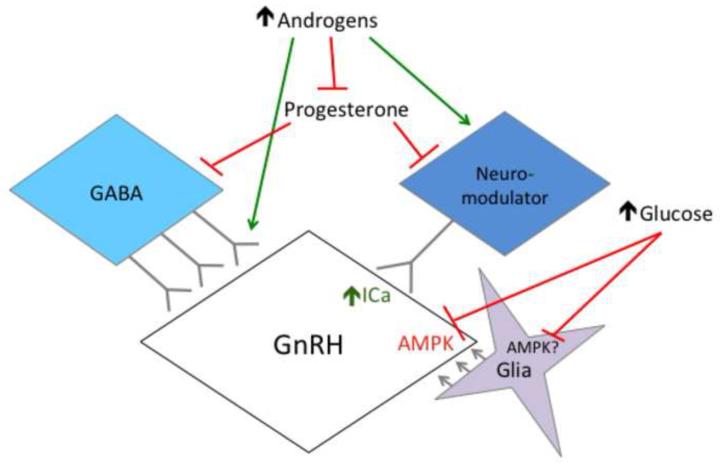
Summary of activating effects of androgens and glucose on GnRH neurons. Androgens activate (green lines) GnRH neurons by increasing excitatory GABAergic neurotransmission, enhancing neuromodulator-evoked calcium currents, and blocking (red lines) the inhibitory effects of progesterone on these parameters. Glucose activates GnRH neurons by suppressing the inhibitory influence of AMPK, which may be expressed in the GnRH neuron or in glial cells.

References

    1. Abbott DH, Barnett DK, Bruns CM, Dumesic DA. Androgen excess fetal programming of female reproduction: a developmental aetiology for polycystic ovary syndrome? Hum. Reprod. Update. 2005;11:357–374. doi:10.1093/humupd/dmi013. - PubMed
    1. Abbott DH, Barnett DK, Levine JE, Padmanabhan V, Dumesic DA, Jacoris S, Tarantal AF. Endocrine antecedents of polycystic ovary syndrome in fetal and infant prenatally androgenized female rhesus monkeys. Biol. Reprod. 2008;79:154–163. doi:10.1095/biolreprod.108.067702. - PMC - PubMed
    1. Abbott DH, Bruns CR, Barnett DK, Dunaif A, Goodfriend TL, Dumesic DA, Tarantal AF. Experimentally induced gestational androgen excess disrupts glucoregulation in rhesus monkey dams and their female offspring. Am. J. Physiol. Endocrinol. Metab. 2010;299:E741–751. doi:10.1152/ajpendo.00058.2010. - PMC - PubMed
    1. Abbott DH, Dumesic DA, Eisner JR, Colman RJ, Kemnitz JW. Insights into the development of polycystic ovary syndrome (PCOS) from studies of prenatally androgenized female rhesus monkeys. Trends Endocrinol. Metab. TEM. 1998;9:62–67. - PubMed
    1. Abbott DH, Dumesic DA, Franks S. Developmental origin of polycystic ovary syndrome - a hypothesis. J. Endocrinol. 2002;174:1–5. - PubMed