


The impact of preoperative and postoperative pulmonary hypertension on long-term surgical outcome after mitral valve repair for degenerative mitral regurgitation
- PMID: 24747547
- PMCID: PMC4989987
- DOI: 10.5761/atcs.oa.13-00364
The impact of preoperative and postoperative pulmonary hypertension on long-term surgical outcome after mitral valve repair for degenerative mitral regurgitation
Abstract
Purpose: The aim of this study is to elucidate the impact of preoperative and postoperative pulmonary hypertension (PH) on long-term clinical outcomes after mitral valve repair for degenerative mitral regurgitation.
Methods: A total of 654 patients who underwent mitral valve repair for degenerative mitral regurgitation between 1991 and 2010 were retrospectively reviewed. Patients were divided into PH(+) group (137 patients) and PH(-) group (517 patients). Follow-up was complete in 99.0%. The median follow-up duration was 7.5 years.
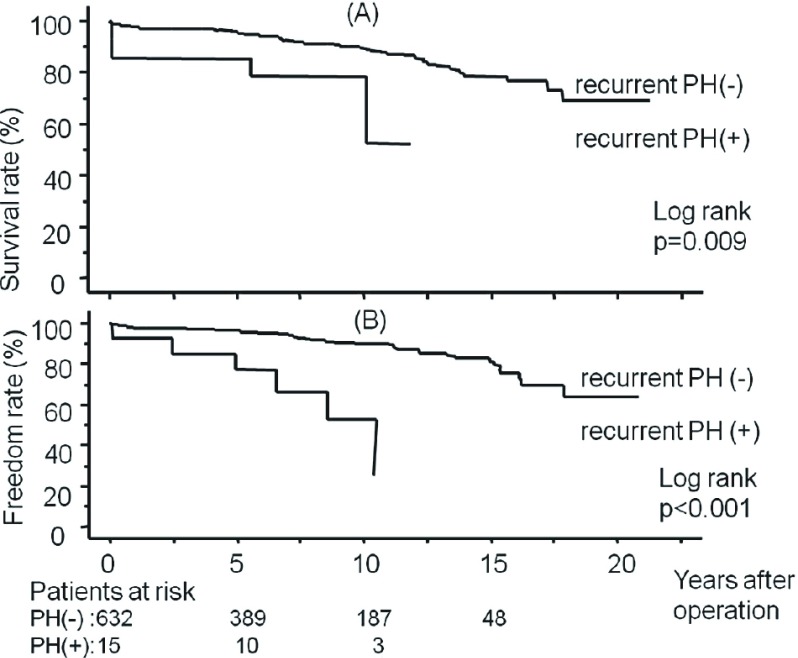
Results: Patients in PH(+) group were older, more symptomatic and had higher tricuspid regurgitation grade. Thirty-day mortality was not different between 2 groups (p = 0.975). Long-term survival rate was lower in PH(+) group; 10-year survival rate after the operation was 85.2% ± 4.0% in PH(+) group and 89.7% ± 1.8% in PH(-) group (Log-rank, p = 0.019). The incidence of late cardiac events were not different between groups, however, the recurrence of PH was more frequent in PH(+) group. The recurrence of PH had an adverse impact on survival rate, late cardiac events and symptoms. Univariate analysis showed age and preoperative tricuspid regurgitation grade were the predictors of PH recurrence.
Conclusion: Early surgical indication should be advocated for degenerative mitral regurgitation before the progression of pulmonary hypertension and tricuspid regurgitation.
Figures
References
-
- Montant P, Chenot F, Robert A, et al. Long-term survival in asymptomatic patients with severe degenerative mitral regurgitation: a propensity score-based comparison between an early surgical strategy and a conservative treatment approach. J Thorac Cardiovasc Surg 2009; 138: 1339-48. - PubMed
-
- Le Tourneau T, Richardson M, Juthier F, et al. Echocardiography predictors and prognostic value of pulmonary artery systolic pressure in chronic organic mitral regurgitation. Heart 2010; 96: 1311-7. - PubMed
-
- Barbieri A, Bursi F, Grigioni F, et al. Prognostic and therapeutic implications of pulmonary hypertension complicating degenerative mitral regurgitation due to flail leaflet: a multicenter long-term international study. Eur Heart J 2011; 32: 751-9. - PubMed
-
- Kang DH, Kim JH, Rim JH, et al. Comparison of early surgery versus conventional treatment in asymptomatic severe mitral regurgitation. Circulation 2009; 119: 797-804. - PubMed
-
- Fukumoto Y, Shimokawa H. Recent progress in the management of pulmonary hypertension. Circ J 2011; 75: 1801-10. - PubMed
MeSH terms
LinkOut - more resources
Full Text Sources
Other Literature Sources
Medical
