


A proton beam therapy system dedicated to spot-scanning increases accuracy with moving tumors by real-time imaging and gating and reduces equipment size
- PMID: 24747601
- PMCID: PMC3991640
- DOI: 10.1371/journal.pone.0094971
A proton beam therapy system dedicated to spot-scanning increases accuracy with moving tumors by real-time imaging and gating and reduces equipment size
Abstract
Purpose: A proton beam therapy (PBT) system has been designed which dedicates to spot-scanning and has a gating function employing the fluoroscopy-based real-time-imaging of internal fiducial markers near tumors. The dose distribution and treatment time of the newly designed real-time-image gated, spot-scanning proton beam therapy (RGPT) were compared with free-breathing spot-scanning proton beam therapy (FBPT) in a simulation.
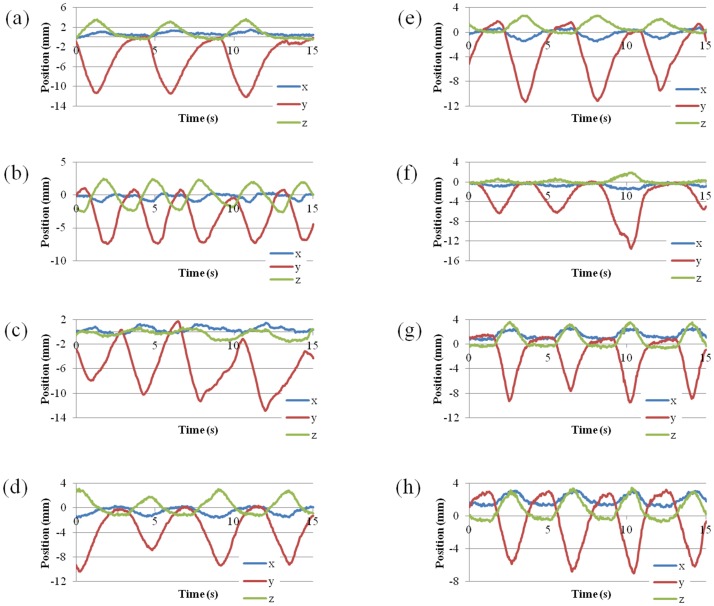
Materials and methods: In-house simulation tools and treatment planning system VQA (Hitachi, Ltd., Japan) were used for estimating the dose distribution and treatment time. Simulations were performed for 48 motion parameters (including 8 respiratory patterns and 6 initial breathing timings) on CT data from two patients, A and B, with hepatocellular carcinoma and with clinical target volumes 14.6 cc and 63.1 cc. The respiratory patterns were derived from the actual trajectory of internal fiducial markers taken in X-ray real-time tumor-tracking radiotherapy (RTRT).
Results: With FBPT, 9/48 motion parameters achieved the criteria of successful delivery for patient A and 0/48 for B. With RGPT 48/48 and 42/48 achieved the criteria. Compared with FBPT, the mean liver dose was smaller with RGPT with statistical significance (p<0.001); it decreased from 27% to 13% and 28% to 23% of the prescribed doses for patients A and B, respectively. The relative lengthening of treatment time to administer 3 Gy (RBE) was estimated to be 1.22 (RGPT/FBPT: 138 s/113 s) and 1.72 (207 s/120 s) for patients A and B, respectively.
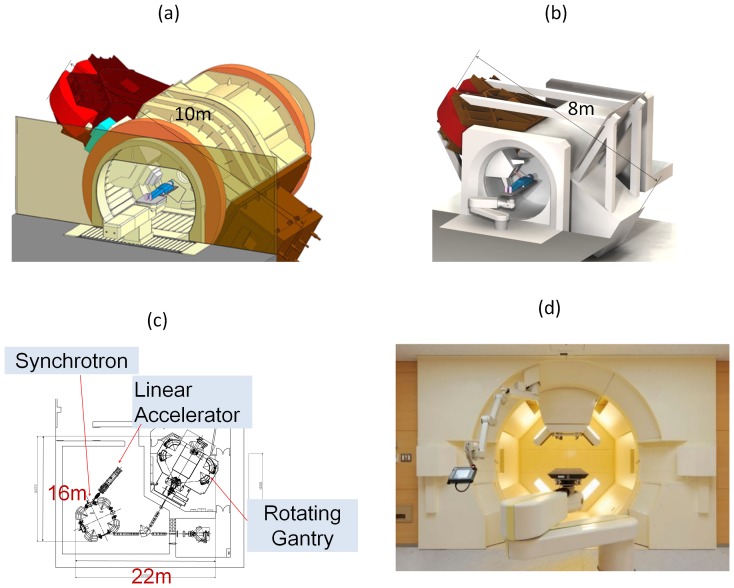
Conclusions: This simulation study demonstrated that the RGPT was able to improve the dose distribution markedly for moving tumors without very large treatment time extension. The proton beam therapy system dedicated to spot-scanning with a gating function for real-time imaging increases accuracy with moving tumors and reduces the physical size, and subsequently the cost of the equipment as well as of the building housing the equipment.
Conflict of interest statement
Figures




References
-
- Kawachi K, Kanai T, Matsuzawa H, Inada T (1983) Three dimensional spot beam scanning method for proton conformation radiation therapy. Acta Radiol Suppl. 364: 81–8. - PubMed
-
- Smith A, Gillin M, Bues M, Zhu XR, Suzuki K, et al. (2009) The M. D. Anderson proton therapy system. Med Phys 36: 4068–83. - PubMed
-
- Hall EJ (2006) Intensity-modulated radiation therapy, protons, and the risk of second cancers. Int J Radiat Oncol Biol Phys. 65: 1–7. - PubMed
-
- Rietzel E, Bert C (2010) Respiratory motion management in particle therapy. Med Phys. 37: 449–460. - PubMed
-
- Tsunashima Y, Vedam S, Dong L, Umezawa M, Sakae T, et al. (2008) Efficiency of respiratory-gated delivery of synchrotron-based pulsed proton irradiation. Phys Med Biol 53: 1947–59. - PubMed
Publication types
MeSH terms
LinkOut - more resources
Full Text Sources
Other Literature Sources
Medical
