. 2014 May;20(5):524-30.
doi: 10.1038/nm.3542. Epub 2014 Apr 20.

The microbiota regulates neutrophil homeostasis and host resistance to Escherichia coli K1 sepsis in neonatal mice

Affiliations

The microbiota regulates neutrophil homeostasis and host resistance to Escherichia coli K1 sepsis in neonatal mice

Hitesh S Deshmukh et al. Nat Med. 2014 May.

Abstract

Neonatal colonization by microbes, which begins immediately after birth, is influenced by gestational age and the mother's microbiota and is modified by exposure to antibiotics. In neonates, prolonged duration of antibiotic therapy is associated with increased risk of late-onset sepsis (LOS), a disorder controlled by neutrophils. A role for the microbiota in regulating neutrophil development and susceptibility to sepsis in the neonate remains unclear. We exposed pregnant mouse dams to antibiotics in drinking water to limit transfer of maternal microbes to the neonates. Antibiotic exposure of dams decreased the total number and composition of microbes in the intestine of the neonates. This was associated with decreased numbers of circulating and bone marrow neutrophils and granulocyte/macrophage-restricted progenitor cells in the bone marrow of antibiotic-treated and germ-free neonates. Antibiotic exposure of dams reduced the number of interleukin-17 (IL-17)-producing cells in the intestine and production of granulocyte colony-stimulating factor (G-CSF). Granulocytopenia was associated with impaired host defense and increased susceptibility to Escherichia coli K1 and Klebsiella pneumoniae sepsis in antibiotic-treated neonates, which could be partially reversed by administration of G-CSF. Transfer of a normal microbiota into antibiotic-treated neonates induced IL-17 production by group 3 innate lymphoid cells (ILCs) in the intestine, increasing plasma G-CSF levels and neutrophil numbers in a Toll-like receptor 4 (TLR4)- and myeloid differentiation factor 88 (MyD88)-dependent manner and restored IL-17-dependent resistance to sepsis. Specific depletion of ILCs prevented IL-17- and G-CSF-dependent granulocytosis and resistance to sepsis. These data support a role for the intestinal microbiota in regulation of granulocytosis, neutrophil homeostasis and host resistance to sepsis in neonates.


Figures

Figure 1
Figure 1. Perinatal antibiotic exposure alters the pattern of microbial colonization in the intestine and attenuates the postnatal granulocytosis
(a) 16S rDNA copy numbers from the intestinal contents of neonatal mice exposed to combination of 3 (3ABX) or 5 (5ABX) antibiotics or no antibiotics (No ABX) was determined using real-time PCR. (b) Relative abundance of phylum and class level commensal bacteria obtained from 16S rDNA pyrosequencing of the intestinal contents of age- and sex-matched neonatal mice exposed to combination of 5 antibiotics (ABX) or no antibiotics (No ABX). Each bar represents the pooled intestinal contents from > 8 age-defined neonatal mice from more than 3 different litters. (c) Age- and sex-matched neonatal mice exposed to combination of 3 (3ABX) or 5 (5ABX) antibiotics or no antibiotics (No ABX) were examined for number of circulating or (d) bone marrow neutrophils. (e-f) Bone marrows from age- and sex-matched neonatal mice exposed to combination of 3 antibiotics (ABX) or no antibiotics (No ABX) were examined for number of hematopoietic stem cells or lineage committed progenitor cells. Flow cytometry plots are gated on live cells. Representative histograms from 3 separate experiments. (g) Age- and sex-matched neonatal mice exposed to combination of 3 (3ABX) or 5 (5ABX) antibiotics or no antibiotics (No ABX) were examined for plasma G-CSF levels. (h) Age-matched germ free (GF) or conventionalized (CNV) mice or neonatal mice exposed to combination of 5 antibiotics (ABX) were examined for number of circulating or (i) bone marrow neutrophils or (j) plasma G-CSF levels. Data are representative of three independent experiments containing 10-12 mice per group. Results are shown as the means ± s.e.m.
Figure 2
Figure 2. Microbiota regulates postnatal granulocytosis and controls host resistance to E. coli
(a) 5 day-old sex-matched neonatal mice exposed to combination of 3 (3ABX) or 5 antibiotics (5ABX) or no antibiotics (No ABX) were examined for susceptibility after inoculation with E. coli via intraperitoneal route. (b) 5 day-old sex-matched neonatal mice exposed to combination of 3 (3ABX) or (c) 5 antibiotics (5ABX) or no antibiotics (No ABX) were examined for circulating neutrophils or (d) plasma G-CSF levels 4h after inoculation with E. coli. (e) 5 day-old sex-matched neonatal mice exposed to combination of 3 (3ABX) or (f) 5 antibiotics (5ABX) or no antibiotics (No ABX) were treated with G-CSF and examined for susceptibility after inoculation with E. coli via intraperitoneal route. * Significantly different from neonatal mice not exposed to antibiotics (No ABX), ** significantly different from ABX-exposed neonatal mice. (g) Transfer of intestinal contents from postnatal day 3 old control (no antibiotic-exposed) mice to sex-matched neonatal mice exposed to combination of 5 antibiotics (5ABX) or (h) 3 antibiotics (3ABX) via oral gavage on postnatal day 3 and assessment of susceptibility to E. coli 48 h following transfer (postnatal day 5). (i) Transfer of intestinal contents from postnatal day 3 old control (no antibiotic-exposed) mice to sex-matched neonatal mice exposed to combination of 5 antibiotics (ABX) via oral gavage on postnatal day 3 and assessment of circulating or (j) bone marrow neutrophils 48 h following transfer (postnatal day 5). Data are representative of three independent experiments with 12 mice per group. Results are shown as the means ± s.e.m. * Significantly different from control (No ABX) neonatal mice, ** significantly different from ABX-exposed neonatal mice.
Figure 3
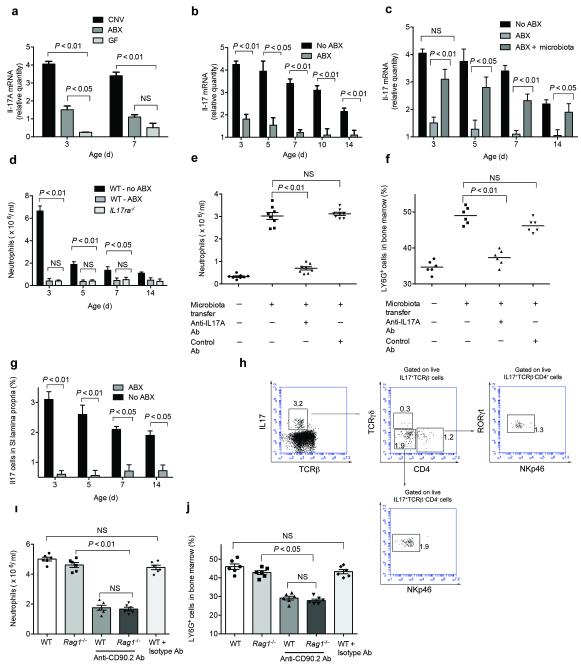
Figure 3. Microbiota-derived signals regulate postnatal granulocytosis via IL17 and G-CSF dependent pathway
(a) Age-matched germ free (GF) or conventionalized (CNV) mice or neonatal mice exposed to combination of 5 antibiotics (ABX) or (b) age- and sex-matched neonatal mice exposed to combination of 5 antibiotics (ABX) or no antibiotics (No ABX) were examined for IL17A transcripts in the intestine. (c) Transfer of intestinal contents from age- and sex-matched control (no antibiotic-exposed) mice to neonatal mice exposed to combination of 5 antibiotics (ABX) via oral gavage and assessment of IL17A transcripts 48 h following transfer. (d) Neonatal mice deficient in receptor for IL17A (Il17ra−/−) and age- and sex-matched wild type (WT) littermates exposed or not exposed to combination of 5 antibiotics (ABX) were examined for number of circulating neutrophils. (e) Treatment with neutralizing antibody against IL17A daily on postnatal day 0-3 and transfer of intestinal contents from postnatal day 3 control (no antibiotic-exposed) mice to neonatal mice exposed to combination of 5 antibiotics (ABX) via oral gavage on postnatal day 3 and assessment of circulating or (f) bone marrow neutrophils 48 h following transfer (postnatal day 5). (g) Age- and sex-matched neonatal mice exposed to combination of 5 antibiotics (ABX) or no antibiotics (No ABX) were examined for frequency of IL17+ cells in small intestine lamina propria. (h) 3 day-old neonatal mice were examined for IL17+ cells in small intestine lamina propria. Flow cytometry plots are gated on live IL17+ cells and frequency of each distinct population of cells is indicated. Representative histograms from 5 separate experiments. (i) Treatment of neonatal Rag1−/− mice with anti-CD90.2 antibody or isotype control antibody (5 μg g-1 body weight) daily on postnatal day 0-3 and assessment of circulating and (j) bone marrow neutrophils on postnatal day 3. Data are representative of three independent experiments with 8-12 mice per group. Results are shown as the means ± s.e.m.
Figure 4
Figure 4. Microbiota-derived signals regulate postnatal granulocytosis via TLR4 and MyD88 dependent pathway
(a and c) Neonatal mice deficient in MyD88 (Myd88−/−) or TLR4 (Tlr4−/−) and age and sex matched wild type (WT) littermates exposed or not exposed to combination of 5 antibiotics (ABX) were examined for number of circulating neutrophils or (b and d) bone marrow neutrophils. (e) Administration of LPS (10 ng) to neonatal mice exposed to combination of 5 antibiotics (ABX) or no antibiotics (No ABX) via oral gavage and assessment of IL17 transcripts in small intestine or (f) plasma G-CSF (g) circulating neutrophils or (h) bone marrow neutrophils 48 h following gavage. Data are representative of three independent experiments with 8-10 mice per group. Results are shown as the means ± s.e.m.

Comment in

References

    1. Penders J, et al. Factors influencing the composition of the intestinal microbiota in early infancy. Pediatrics. 2006;118:511–521. - PubMed
    1. Kuppala VS, Meinzen-Derr J, Morrow AL, Schibler KR. Prolonged initial empirical antibiotic treatment is associated with adverse outcomes in premature infants. The Journal of pediatrics. 2011;159:720–725. - PMC - PubMed
    1. Sarkar S, Bhagat I, Hieber S, Donn SM. Can neutrophil responses in very low birth weight infants predict the organisms responsible for late-onset bacterial or fungal sepsis? Journal of perinatology: official journal of the California Perinatal Association. 2006;26:501–505. - PubMed
    1. Schwiertz A, et al. Development of the intestinal bacterial composition in hospitalized preterm infants in comparison with breast-fed, full-term infants. Pediatric research. 2003;54:393–399. - PubMed
    1. Pflughoeft KJ, Versalovic J. Human microbiome in health and disease. Annual review of pathology. 2012;7:99–122. - PubMed

Publication types

MeSH terms