


From metagenomics to pure culture: isolation and characterization of the moderately halophilic bacterium Spiribacter salinus gen. nov., sp. nov
- PMID: 24747894
- PMCID: PMC4054224
- DOI: 10.1128/AEM.00430-14
From metagenomics to pure culture: isolation and characterization of the moderately halophilic bacterium Spiribacter salinus gen. nov., sp. nov
Abstract
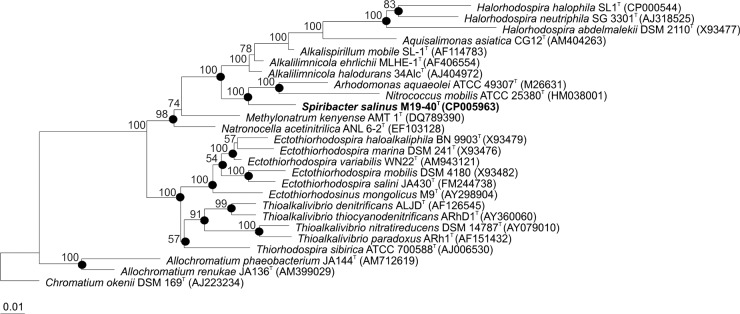
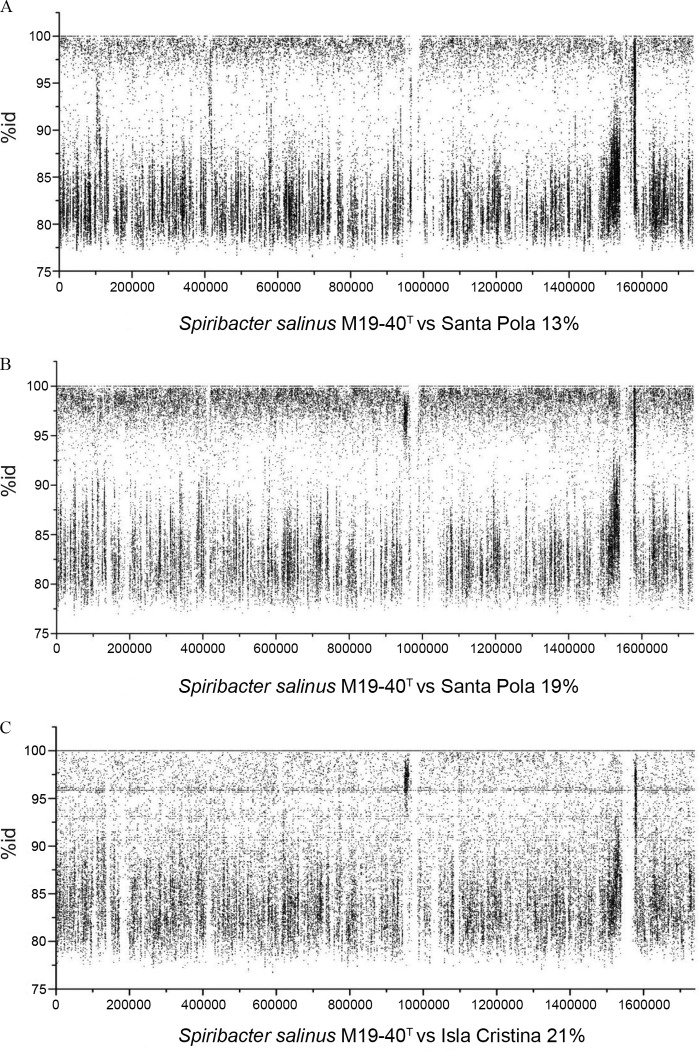
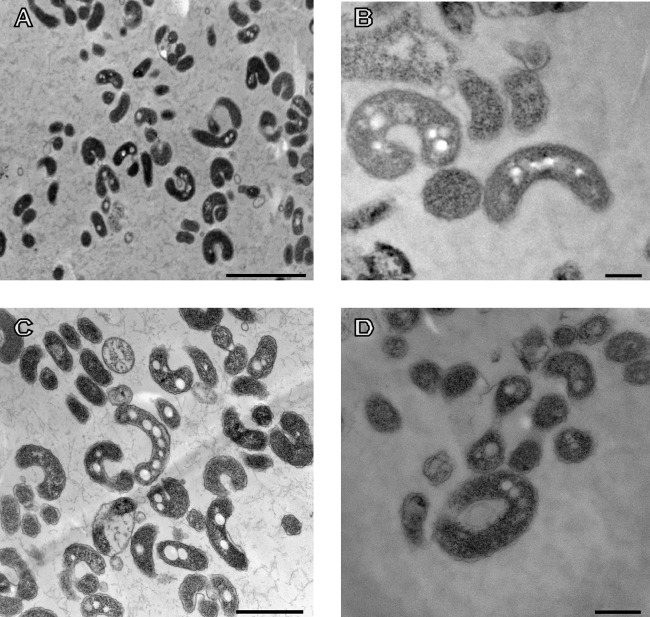
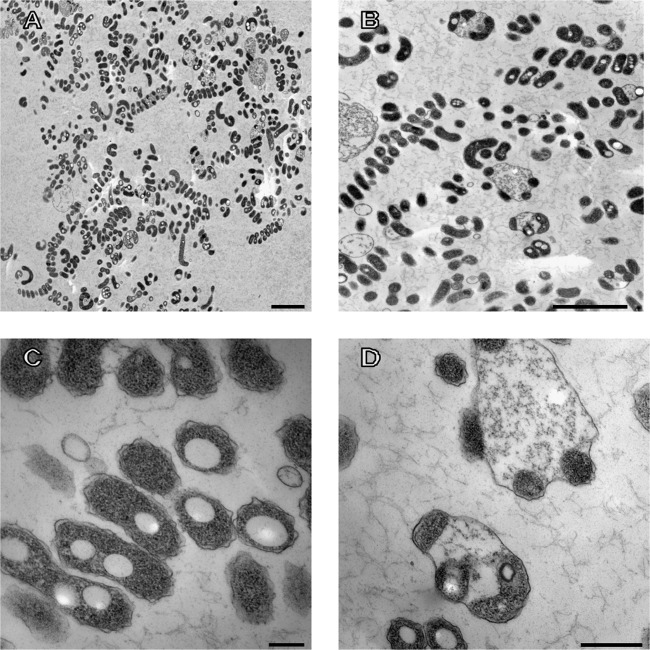
Recent metagenomic studies on saltern ponds with intermediate salinities have determined that their microbial communities are dominated by both Euryarchaeota and halophilic bacteria, with a gammaproteobacterium closely related to the genera Alkalilimnicola and Arhodomonas being one of the most predominant microorganisms, making up to 15% of the total prokaryotic population. Here we used several strategies and culture media in order to isolate this organism in pure culture. We report the isolation and taxonomic characterization of this new, never before cultured microorganism, designated M19-40(T), isolated from a saltern located in Isla Cristina, Spain, using a medium with a mixture of 15% salts, yeast extract, and pyruvic acid as the carbon source. Morphologically small curved cells (young cultures) with a tendency to form long spiral cells in older cultures were observed in pure cultures. The organism is a Gram-negative, nonmotile bacterium that is strictly aerobic, non-endospore forming, heterotrophic, and moderately halophilic, and it is able to grow at 10 to 25% (wt/vol) NaCl, with optimal growth occurring at 15% (wt/vol) NaCl. Phylogenetic analysis based on 16S rRNA gene sequence comparison showed that strain M19-40(T) has a low similarity with other previously described bacteria and shows the closest phylogenetic similarity with species of the genera Alkalilimnicola (94.9 to 94.5%), Alkalispirillum (94.3%), and Arhodomonas (93.9%) within the family Ectothiorhodospiraceae. The phenotypic, genotypic, and chemotaxonomic features of this new bacterium showed that it constitutes a new genus and species, for which the name Spiribacter salinus gen. nov., sp. nov., is proposed, with strain M19-40(T) (= CECT 8282(T) = IBRC-M 10768(T) = LMG 27464(T)) being the type strain.
Copyright © 2014, American Society for Microbiology. All Rights Reserved.
Figures
References
-
- Ventosa A. 2006. Unusual micro-organisms from unusual habitats: hypersaline environments, p 223–253 In Logan NA, Lappin-Scott HM, Oyston PCF. (ed), Prokaryotic diversity: mechanism and significance. Cambridge University Press, Cambridge, United Kingdom
-
- Ventosa A, Quesada E, Rodriguez-Valera F, Ruiz-Berraquero F, Ramos-Cormenzana A. 1982. Numerical taxonomy of moderately halophilic Gram-negative rods. J. Gen. Microbiol. 128:1959–1968
Publication types
MeSH terms
Substances
Associated data
- Actions
LinkOut - more resources
Full Text Sources
Other Literature Sources
Molecular Biology Databases
