


Generation and repair of AID-initiated DNA lesions in B lymphocytes
- PMID: 24748462
- PMCID: PMC4039616
- DOI: 10.1007/s11684-014-0324-4
Generation and repair of AID-initiated DNA lesions in B lymphocytes
Abstract
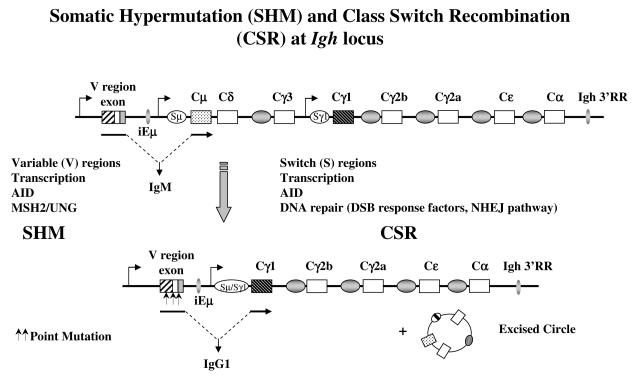
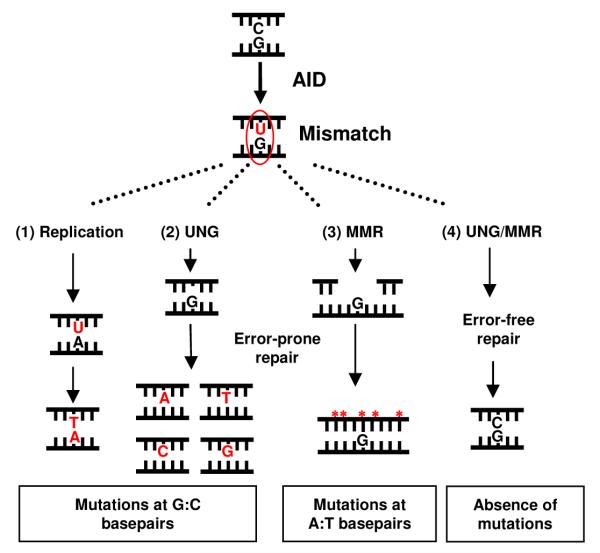
Activation-induced deaminase (AID) initiates the secondary antibody diversification process in B lymphocytes. In mammalian B cells, this process includes somatic hypermutation (SHM) and class switch recombination (CSR), both of which require AID. AID induces U:G mismatch lesions in DNA that are subsequently converted into point mutations or DNA double stranded breaks during SHM/CSR. In a physiological context, AID targets immunoglobulin (Ig) loci to mediate SHM/CSR. However, recent studies reveal genome-wide access of AID to numerous non-Ig loci. Thus, AID poses a threat to the genome of B cells if AID-initiated DNA lesions cannot be properly repaired. In this review, we focus on the molecular mechanisms that regulate the specificity of AID targeting and the repair pathways responsible for processing AID-initiated DNA lesions.
Figures
References
-
- Ganesh K, Neuberger MS. The relationship between hypothesis and experiment in unveiling the mechanisms of antibody gene diversification. FASEB J. 2011;25(4):1123–32. - PubMed
-
- Kato L, et al. An evolutionary view of the mechanism for immune and genome diversity. J Immunol. 2012;188(8):3559–66. - PubMed
-
- Wang JH. The role of activation-induced deaminase in antibody diversification and genomic instability. Immunol Res. 2013;55(1-3):287–97. - PubMed
-
- Muramatsu M, et al. Class switch recombination and hypermutation require activation-induced cytidine deaminase (AID), a potential RNA editing enzyme. Cell. 2000;102(5):553–63. - PubMed
-
- Di Noia JM, Neuberger MS. Molecular mechanisms of antibody somatic hypermutation. Annu Rev Biochem. 2007;76:1–22. - PubMed
Publication types
MeSH terms
Substances
Grants and funding
LinkOut - more resources
Full Text Sources
Other Literature Sources
