


Outcomes of an innovative model of acute delirium care: the Geriatric Monitoring Unit (GMU)
- PMID: 24748778
- PMCID: PMC3986297
- DOI: 10.2147/CIA.S60259
Outcomes of an innovative model of acute delirium care: the Geriatric Monitoring Unit (GMU)
Abstract
Objective: Delirium is associated with poor outcomes following acute hospitalization. The Geriatric Monitoring Unit (GMU) is a specialized five-bedded unit for acute delirium care. It is modeled after the Delirium Room program, with adoption of core interventions from the Hospital Elder Life Program and use of evening light therapy to consolidate circadian rhythms and improve sleep in older inpatients. This study examined whether the GMU program improved outcomes in delirious patients.
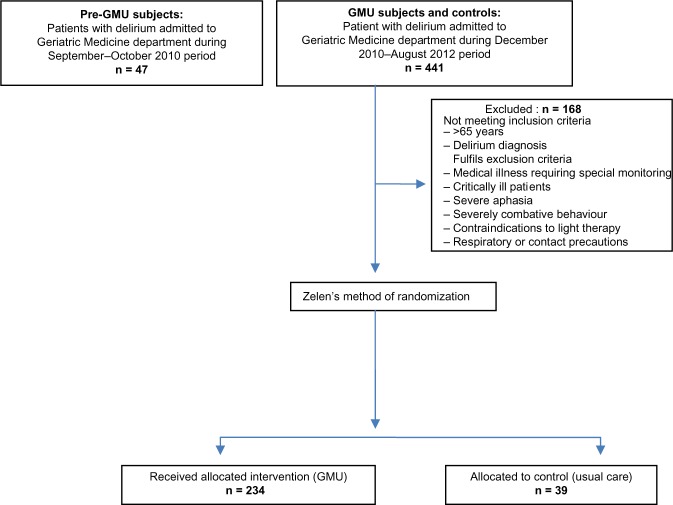
Method: A total of 320 patients, including 47 pre-GMU, 234 GMU, and 39 concurrent control subjects, were studied. Clinical characteristics, cognitive status, functional status (Modified Barthel Index [MBI]), and chemical restraint-use data were obtained. We also looked at in-hospital complications of falls, pressure ulcers, nosocomial infection rate, and discharge destination. Secondary outcomes of family satisfaction (for the GMU subjects) were collected.
Results: There were no significant demographic differences between the three groups. Pre-GMU subjects had longer duration of delirium and length of stay. MBI improvement was most evident in the GMU compared with pre-GMU and control subjects (19.2±18.3, 7.5±11.2, 15.1±18.0, respectively) (P<0.05). The GMU subjects had a zero restraint rate, and pre-GMU subjects had higher antipsychotic dosages. This translated to lower pressure ulcer and nosocomial infection rate in the GMU (4.1% and 10.7%, respectively) and control (1.3% and 7.7%, respectively) subjects compared with the pre-GMU (9.1% and 23.4%, respectively) subjects (P<0.05). No differences were observed in mortality or discharge destination among the three groups. Caregivers of GMU subjects felt the multicomponent intervention to be useful, with scheduled activities voted the most beneficial in patient's recovery from the delirium episode.
Conclusion: This study shows the benefits of a specialized delirium management unit for older persons. The GMU model is thus a relevant system of care for rapidly "graying" nations with high rates of frail elderly hospital admissions, which can be easily transposed across acute care settings.
Keywords: delirium; elderly; function.
Figures
References
-
- Agnostini JV, Inouye Sk. Delirium. In: Hazzard WR, Blass JP, Halter JB, Ouslander JG, Tinetti ME, editors. Principles in Geriatric Medicine and Gerontology. 5th ed. New York, NY: McGraw-Hill; 2003. pp. 1503–1515.
-
- Inouye SK. Delirium in hospitalized older patients. Clin Geriatr Med. 1998;14(4):745–764. - PubMed
-
- Moran JA, Dorevitch MI. Delirium in the hospitalized elderly. Australian Journal of Hospital Pharmacy. 2001;31:35–40.
-
- Murray AM, Levkoff SE, Wetle TT, et al. Acute delirium and functional decline in the hospitalized elderly patient. J Gerontol. 1993;48(5):M181–M186. - PubMed
Publication types
MeSH terms
Associated data
LinkOut - more resources
Full Text Sources
Other Literature Sources
Medical
