


Exercise-induced signal transduction and gene regulation in skeletal muscle
- PMID: 24748841
- PMCID: PMC3979001
Exercise-induced signal transduction and gene regulation in skeletal muscle
Abstract
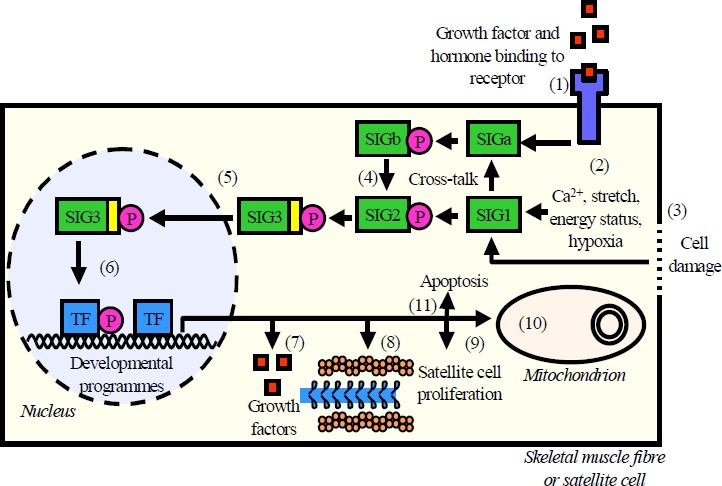
Skeletal muscle adapts to various forms of exercise depending on the force, speed and duration characteristics of the contraction pattern. The stresses and signals associated with each contraction pattern are likely to specifically activate a network of signal transduction pathways that integrate this information. These pathways include the calcineurin, Calcium/calmodulin-dependent protein kinase (CaMK), mitogen-activated protein kinase (MAPK), protein kinase C (PKC), nuclear factor kappa B (NF-κB), AMP-dependent protein kinase (AMPK), insulin signalling and developmental pathways. Activated signal transduction pathways activate or increase the expression of transcription factors via various mechanisms. Skeletal muscle genes are usually regulated by combinatorial control exerted by several transcription factors and possibly other mechanisms. In addition, adaptations such as an increase in mitochondrial biogenesis or the activation of satellite cell proliferation involve distinct regulatory mechanisms.
İskelet kası egzersizin değişik biçimlerine kasılma modelinin güç, hız ve süre özelliklerine bağlı bir şekilde uyum sağlar. Her kasılma biçimi ile ilişkili sinyal ve stres muhtemelen spesifik olarak sinyal transduction yolunun bir ağını aktive eder. Bu yollar, kalkineurin, Kalsiyum/kalmodulin-bağımlı protein kinaz (CaMK), mitojen-activated protein kinaz (MAPK), protein kinaz C (PKC), nuklear faktör kappa B (NF-κB), AMP-dependent protein kinaz (AMPK), insulin sinyal ve gelişme yollarını içermektedir. Aktive edilmiş transduction yolları değişik mekanizmalar yolu ile kopyalama (transcription) faktörlerinin ifadelerini artırır veya aktive eder. İskelet kası genleri genellikle değişik kopyalama faktörleri tarafından kullanılan birleştirici kontrol ile veya muhtemelen diğer mekanizmalar tarafından düzenlenir. Ayrıca satelayt hücre proliferasyonunun aktivasyonu veya mitokondriyal biogenesizdeki bir artış gibi adaptasyonlar farklı düzenleme mekanizmalarını içermektedir.
Keywords: Adaptation; calcineurin myosin heavy chain; mitochondrial biogenesis; satellite cells.
Figures
References
-
- Allemeier C. A., Fry A. C., Johnson P., Hikida R. S., Hagerman F. C., Staron R. S. (1994) Effects of sprint cycle training on human skeletal muscle. Journal of Applied Physiology 77,2385-2390 - PubMed
-
- Allen D. L., Sartorius C. A., Sycuro L. K., Leinwand L. A. (2001) Different pathways regulate expression of the skeletal myosin heavy chain genes. Journal of Biological Chemistry 276, 43524-43533 - PubMed
-
- Andersen J. L., Klitgaard H., Saltin B. (1994) Myosin heavy chain isoforms in single fibres from m. vastus lateralis of sprinters: influence of training. Acta Physiologica Scandinavica 151, 135-142 - PubMed
-
- Arnold H. H., Winter B. (1998) Muscle differentiation: more complexity to the network of myogenic regulators. Current Opinion in Genetics & Development. 8, 539-544 - PubMed
-
- Aronson D., Boppart M. D., Dufresne S. D., Fielding R. A., Goodyear L. J. (1998) Exercise stimulates c-Jun NH2 kinase activity and c-Jun transcriptional activity in human skeletal muscle. Biochemical and Biophysical Research Communications 251, 106-110 - PubMed
Publication types
LinkOut - more resources
Full Text Sources