


Post-traumatic immunosuppression is reversed by anti-coagulated salvaged blood transfusion: deductions from studying immune status after knee arthroplasty
- PMID: 24749651
- PMCID: PMC4226602
- DOI: 10.1111/cei.12351
Post-traumatic immunosuppression is reversed by anti-coagulated salvaged blood transfusion: deductions from studying immune status after knee arthroplasty
Abstract
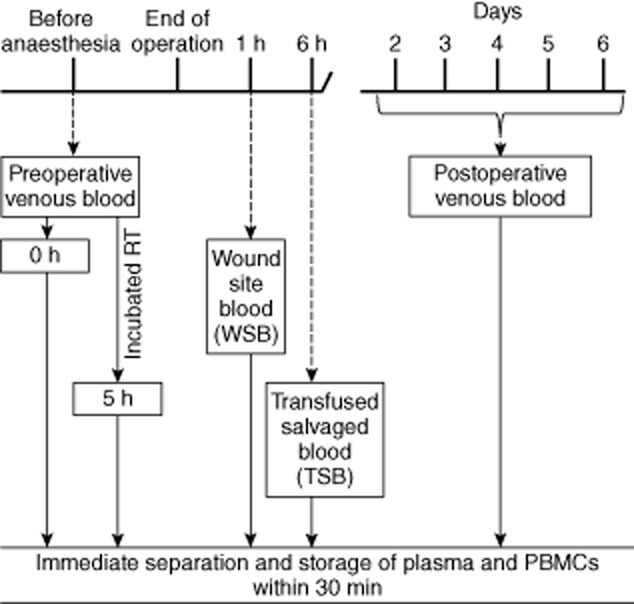
Major trauma increases vulnerability to systemic infections due to poorly defined immunosuppressive mechanisms. It confers no evolutionary advantage. Our objective was to develop better biomarkers of post-traumatic immunosuppression (PTI) and to extend our observation that PTI was reversed by anti-coagulated salvaged blood transfusion, in the knowledge that others have shown that non-anti-coagulated (fibrinolysed) salvaged blood was immunosuppressive. A prospective non-randomized cohort study of patients undergoing primary total knee arthroplasty included 25 who received salvaged blood transfusions collected post-operatively into acid-citrate-dextrose anti-coagulant (ASBT cohort), and 18 non-transfused patients (NSBT cohort). Biomarkers of sterile trauma included haematological values, damage-associated molecular patterns (DAMPs), cytokines and chemokines. Salvaged blood was analysed within 1 and 6 h after commencing collection. Biomarkers were expressed as fold-changes over preoperative values. Certain biomarkers of sterile trauma were common to all 43 patients, including supranormal levels of: interleukin (IL)-6, IL-1-receptor-antagonist, IL-8, heat shock protein-70 and calgranulin-S100-A8/9. Other proinflammatory biomarkers which were subnormal in NSBT became supranormal in ASBT patients, including IL-1β, IL-2, IL-17A, interferon (IFN)-γ, tumour necrosis factor (TNF)-α and annexin-A2. Furthermore, ASBT exhibited subnormal levels of anti-inflammatory biomarkers: IL-4, IL-5, IL-10 and IL-13. Salvaged blood analyses revealed sustained high levels of IL-9, IL-10 and certain DAMPs, including calgranulin-S100-A8/9, alpha-defensin and heat shock proteins 27, 60 and 70. Active synthesis during salvaged blood collection yielded increasingly elevated levels of annexin-A2, IL-1β, Il-1-receptor-antagonist, IL-2, IL-4, IL-6, IL-8, IL-10, IL-12p70, IL-17A, IFN-γ, TNF-α, transforming growth factor (TGF)-β1, monocyte chemotactic protein-1 and macrophage inflammatory protein-1α. Elevated levels of high-mobility group-box protein-1 decreased. In conclusion, we demonstrated that anti-coagulated salvaged blood reversed PTI, and was attributed to immune stimulants generated during salvaged blood collection.
Keywords: DAMPs; arthroplasty; cytokines; post-traumatic immunosuppression; sterile trauma.
© 2014 British Society for Immunology.
Figures
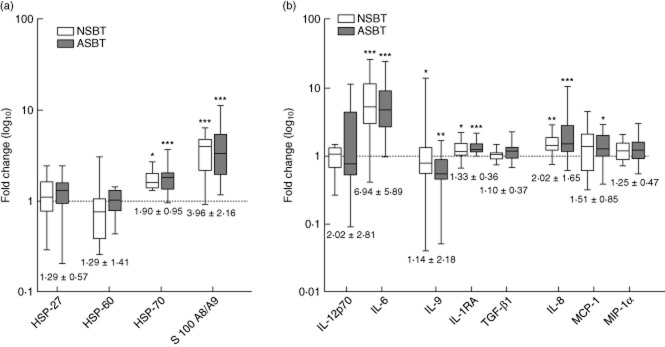
 ) and autologous salvaged blood transfused (ASBT) (
 ) cohorts: (a) damage-associated molecular patterns (DAMPs); (b) cytokines and chemokines. Combined mean fold-changes ± standard deviation are beneath each box. Significance of differences between post-operative and preoperative values are represented by *. Thus: *P < 0·05; **P < 0·001 and ***P < 0·0001.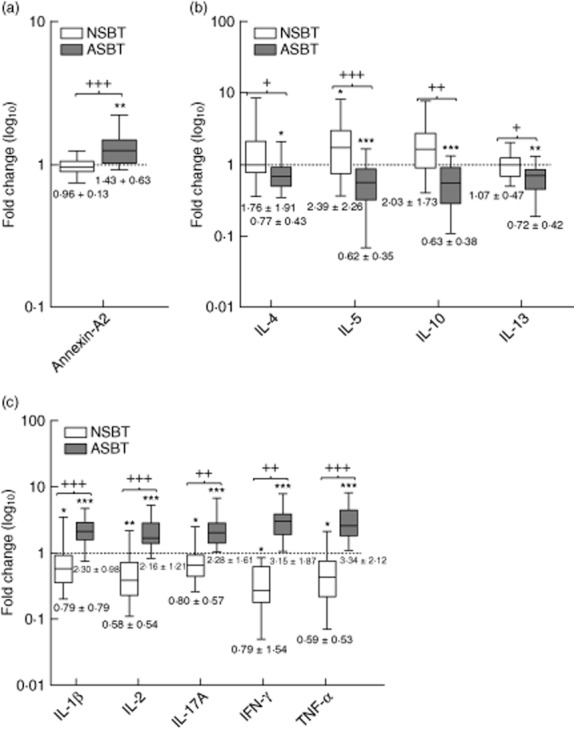
 ) and autologous salvaged blood transfused (ASBT) (
 ) cohorts. Mean fold-changes ± standard deviation are beneath each box: (a) damage-associated molecular patterns (DAMP) Annexin-A2; (b) anti-inflammatory cytokines; (c) proinflammatory cytokines. Significance of differences between preoperative and post-operative values are represented by * and differences between NSBT and ASBT cohort fold-values are represented by +. Thus: */+P < 0·05; **/++P < 0·001 and ***/+++P < 0·0001.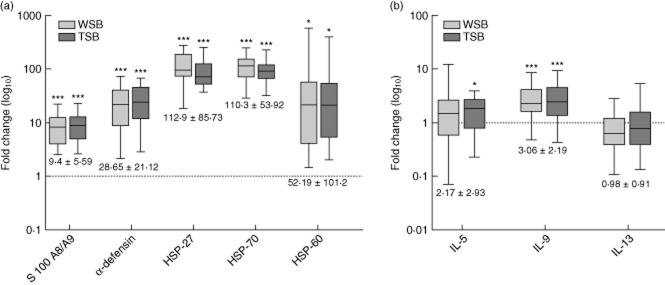
 ) and transfused salvaged blood (TSB) (
 ). Combined mean fold-changes ± standard deviation are beneath each box: (a) damage-associated molecular patterns (DAMPs) and (b) cytokines. Significance of differences between WSB or TSB and preoperative values are represented by *. Thus: *P < 0·05; **P < 0·001 and ***P < 0·0001.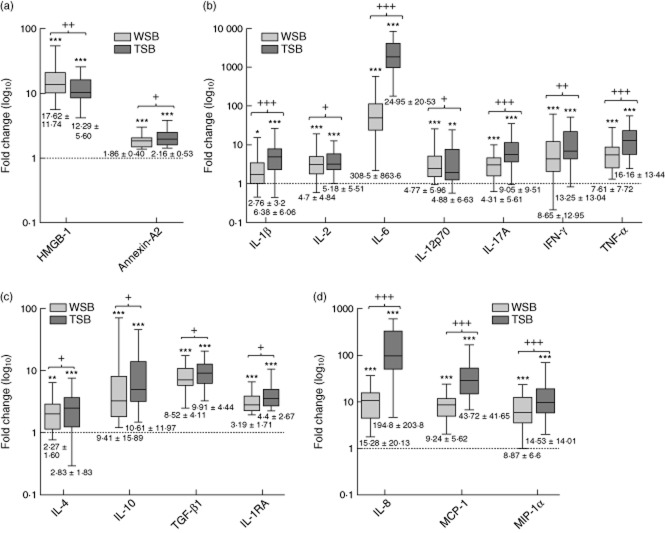
 ) and transfused salvaged blood (TSB) (
 ). Mean fold-changes ± standard deviation are beneath each box: (a) damage-associated molecular patterns (DAMPs) high mobility group box protein-1 (HMGB-1) and annexin-A2, (b) proinflammatory cytokines, (c) anti-inflammatory cytokines and (d) chemokines. Significance of differences between preoperative and WSB or TSB values are represented by *, and differences between WSB and TSB fold-values are represented by +. Thus: */+P < 0·05; **/++P < 0·001 and ***/+++P < 0·0001.
References
-
- Nightingale F, Nightingale FNoh. Florence Nightingale: measuring hospital care outcomes: excerpts from the books Notes on matters affecting the health, efficiency, and hospital administration of the British army founded chiefly on the experience of the late war, and Notes on hospitals. Oakbrook Terrace, IL: Joint Commission on Accreditation of Healthcare Organizations; 1999.
-
- Murray CK, Hinkle MK, Yun HC. History of infections associated with combat-related injuries. J Trauma. 2008;64:S221–231. - PubMed
-
- Smallman-Raynor MR, Cliff AD. Impact of infectious diseases on war. Infect Dis Clin North Am. 2004;18:341–368. - PubMed
-
- Ostendorf U, Ewig S, Torres A. Nosocomial pneumonia. Curr Opin Infect Dis. 2006;19:327–338. - PubMed
-
- Halleberg Nyman M, Johansson JE, Persson K, Gustafsson M. A prospective study of nosocomial urinary tract infection in hip fracture patients. J Clin Nurs. 2011;20:2531–2539. - PubMed
Publication types
MeSH terms
Substances
LinkOut - more resources
Full Text Sources
Other Literature Sources
Medical
Research Materials
