


Role of cues and contexts on drug-seeking behaviour
- PMID: 24749941
- PMCID: PMC4209936
- DOI: 10.1111/bph.12735
Role of cues and contexts on drug-seeking behaviour
Abstract
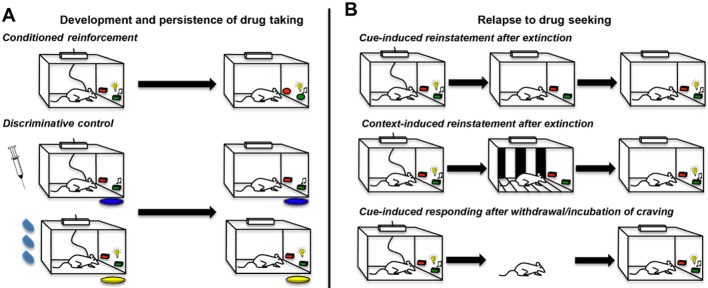
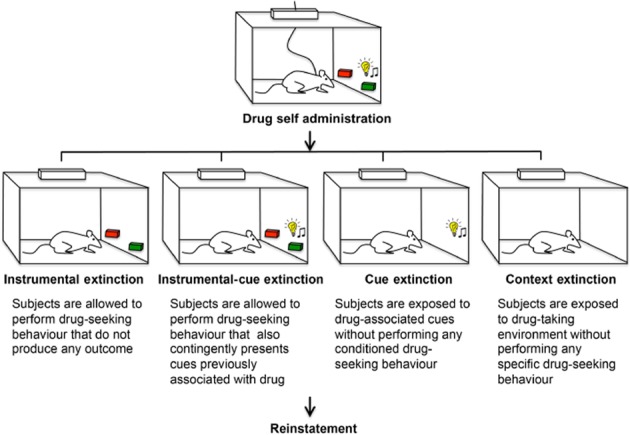
Environmental stimuli are powerful mediators of craving and relapse in substance-abuse disorders. This review examined how animal models have been used to investigate the cognitive mechanisms through which cues are able to affect drug-seeking behaviour. We address how animal models can describe the way drug-associated cues come to facilitate the development and persistence of drug taking, as well as how these cues are critical to the tendency to relapse that characterizes substance-abuse disorders. Drug-associated cues acquire properties of conditioned reinforcement, incentive motivation and discriminative control, which allow them to influence drug-seeking behaviour. Using these models, researchers have been able to investigate the pharmacology subserving the behavioural impact of environmental stimuli, some of which we highlight. Subsequently, we examine whether the impact of drug-associated stimuli can be attenuated via a process of extinction, and how this question is addressed in the laboratory. We discuss how preclinical research has been translated into behavioural therapies targeting substance abuse, as well as highlight potential developments to therapies that might produce more enduring changes in behaviour.
© 2014 The British Pharmacological Society.
Figures
References
-
- Acosta JI, Boynton FA, Kirschner KF, Neisewander JL. Stimulation of 5-HT1B receptors decreases cocaine- and sucrose-seeking behavior. Pharmacol Biochem Behav. 2005;80:297–307. - PubMed
-
- Adamczyk P, McCreary AC, Przegalinski E, Mierzejewski P, Bienkowski P, Filip M. The effects of fatty acid amide hydrolase inhibitors on maintenance of cocaine and food self-administration and on reinstatement of cocaine-seeking and food-taking behavior in rats. Acta Physiol Pol. 2009;12:119–125. - PubMed
-
- Adamczyk P, Miszkiel J, McCreary AC, Filip M, Papp M, Przegaliñski E. The effects of cannabinoid CB1, CB2 and vanilloid TRPV1 receptor antagonists on cocaine addictive behavior in rats. Brain Res. 2012;1444:45–54. - PubMed
-
- Adams CL, Cowen MS, Short JL, Lawrence AJ. Combined antagonism of glutamate mGlu5 and adenosine A2A receptors interact to regulate alcohol-seeking in rats. Int J Neuropsychopharmacol. 2008;11:229–241. - PubMed
Publication types
MeSH terms
Substances
LinkOut - more resources
Full Text Sources
Other Literature Sources
