


Viral infection is not uncommon in adult patients with severe hospital-acquired pneumonia
- PMID: 24752070
- PMCID: PMC3994115
- DOI: 10.1371/journal.pone.0095865
Viral infection is not uncommon in adult patients with severe hospital-acquired pneumonia
Abstract
Background: Viral pathogens have not generally been regarded as important causes of severe hospital-acquired pneumonia (HAP), except in patients with hematologic malignancy or transplant recipients. We investigated the role and distribution of viruses in adult with severe HAP who required intensive care.
Methods: From March 2010 to February 2012, adult patients with severe HAP required admission to the intensive care unit (ICU), 28-bed medical ICU in a tertiary care hospital, were prospectively enrolled. Respiratory viruses were detected using multiplex reverse-transcription polymerase chain reaction and/or shell vial culture.
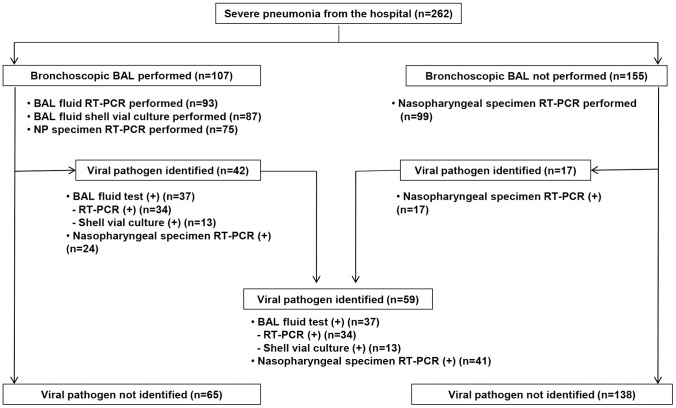
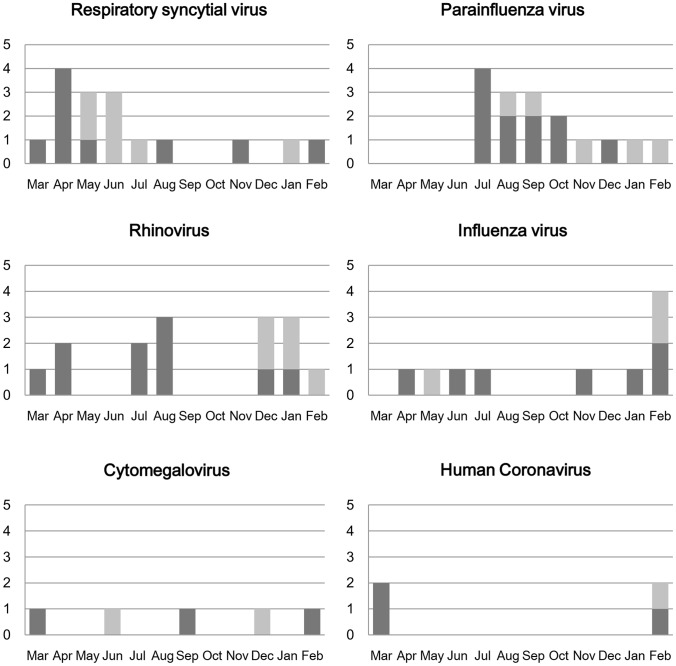
Results: A total of 262 patients were enrolled and 107 patients (40.8%) underwent bronchoscopic BAL for etiologic diagnosis. One hundred and fifty-six patients (59.5%) had bacterial infections and 59 patients (22.5%) had viral infections. Viruses were detected in BAL fluid specimens of 37 patients (62.7%, 37/59). The most commonly identified viruses were respiratory syncytial virus and parainfluenza virus (both 27.1%, 16/59), followed by rhinovirus (25.4%, 15/59), and influenza virus (16.9%, 10/59). Twenty-one patients (8.0%, 21/262) had bacterial-viral coinfections and Staphylococcus aureus was the most commonly coexisting bacteria (n = 10). Viral infection in non-immunocompromised patients was not uncommon (11.1%, 16/143), although it was not as frequent as that in immunocompromised patients (36.4%, 43/119). Non-immunocompromised patients were significantly older than immunocompromised patients and had significantly higher rates of underlying chronic obstructive pulmonary disease, tuberculous destroyed lung and chronic kidney disease. The 28 day mortalities of patients with bacterial infections, viral infections and bacterial-viral coinfections were not significantly different (29.5%, 35.6% and 19.0%, respectively; p = 0.321).
Conclusions: Viral pathogens are not uncommon in adult patients with severe HAP who required ICU admission. Since viral pathogens may cause severe HAP and could be a potential source of viral transmission, further investigation is required to delineate the role of viral pathogens in severe HAP.
Conflict of interest statement
Figures
References
-
- Celis R, Torres A, Gatell JM, Almela M, Rodriguez-Roisin R, et al. (1988) Nosocomial pneumonia. A multivariate analysis of risk and prognosis. Chest 93: 318–324. - PubMed
-
- Mandell LA, Campbell GD Jr (1998) Nosocomial pneumonia guidelines: an international perspective. Chest 113: 188S–193S. - PubMed
-
- American Thoracic Society, Infectious Diseases Society of America (2005) Guidelines for the management of adults with hospital-acquired, ventilator-associated, and healthcare-associated pneumonia. Am J Respir Crit Care Med 171: 388–416. - PubMed
-
- Graman PS, Hall CB (1989) Epidemiology and control of nosocomial viral infections. Infect Dis Clin North Am 3: 815–841. - PubMed
Publication types
MeSH terms
LinkOut - more resources
Full Text Sources
Other Literature Sources
Medical
