


An N-terminal threonine mutation produces an efflux-favorable, sodium-primed conformation of the human dopamine transporter
- PMID: 24753048
- PMCID: PMC4053999
- DOI: 10.1124/mol.114.091926
An N-terminal threonine mutation produces an efflux-favorable, sodium-primed conformation of the human dopamine transporter
Abstract
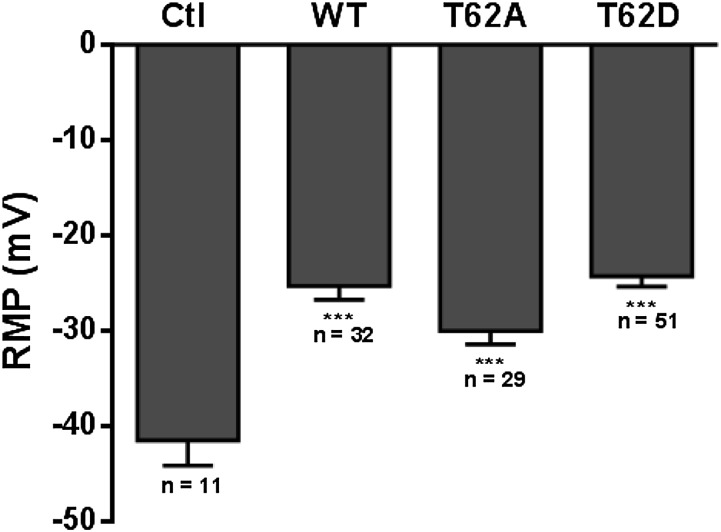
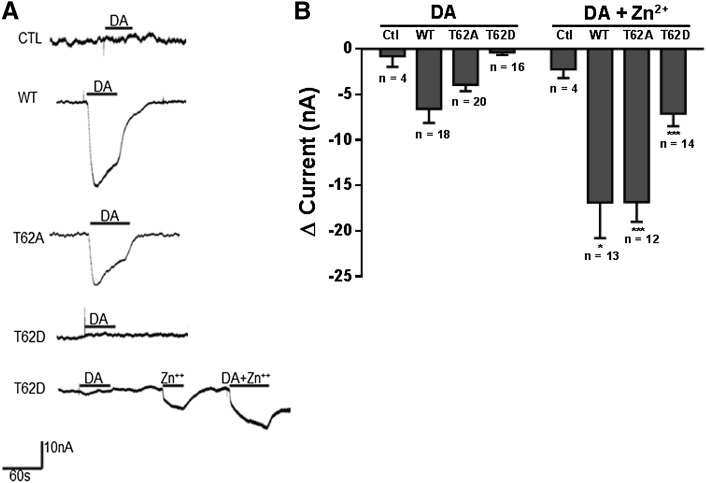
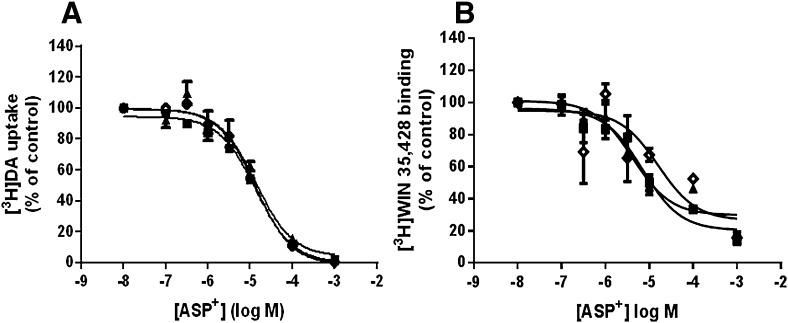
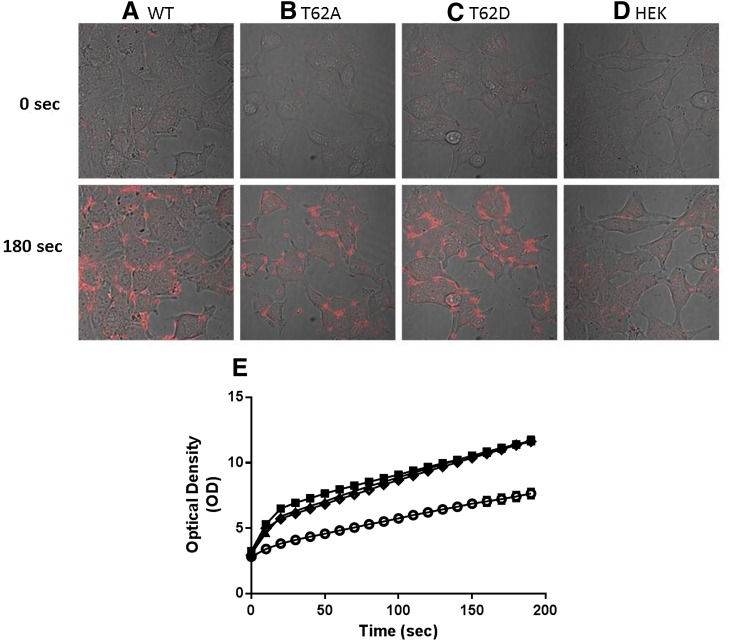
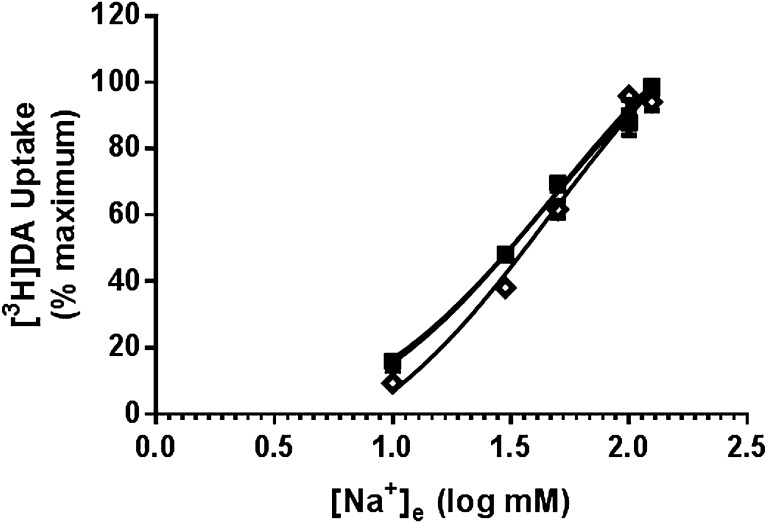
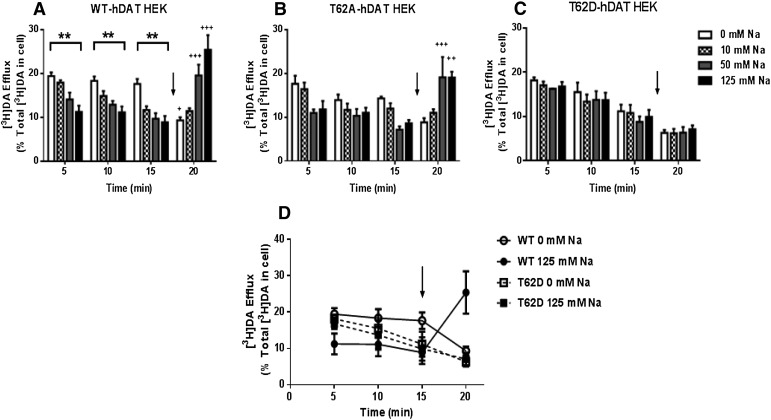
The dopamine transporter (DAT) reversibly transports dopamine (DA) through a series of conformational transitions. Alanine (T62A) or aspartate (T62D) mutagenesis of Thr62 revealed T62D-human (h)DAT partitions in a predominately efflux-preferring conformation. Compared with wild-type (WT), T62D-hDAT exhibits reduced [(3)H]DA uptake and enhanced baseline DA efflux, whereas T62A-hDAT and WT-hDAT function in an influx-preferring conformation. We now interrogate the basis of the mutants' altered function with respect to membrane conductance and Na(+) sensitivity. The hDAT constructs were expressed in Xenopus oocytes to investigate if heightened membrane potential would explain the efflux characteristics of T62D-hDAT. In the absence of substrate, all constructs displayed identical resting membrane potentials. Substrate-induced inward currents were present in oocytes expressing WT- and T62A-hDAT but not T62D-hDAT, suggesting equal bidirectional ion flow through T62D-hDAT. Utilization of the fluorescent DAT substrate ASP(+) [4-(4-(dimethylamino)styryl)-N-methylpyridinium] revealed that T62D-hDAT accumulates substrate in human embryonic kidney (HEK)-293 cells when the substrate is not subject to efflux. Extracellular sodium (Na(+) e) replacement was used to evaluate sodium gradient requirements for DAT transport functions. The EC50 for Na(+) e stimulation of [(3)H]DA uptake was identical in all constructs expressed in HEK-293 cells. As expected, decreasing [Na(+)]e stimulated [(3)H]DA efflux in WT- and T62A-hDAT cells. Conversely, the elevated [(3)H]DA efflux in T62D-hDAT cells was independent of Na(+) e and commensurate with [(3)H]DA efflux attained in WT-hDAT cells, either by removal of Na(+) e or by application of amphetamine. We conclude that T62D-hDAT represents an efflux-willing, Na(+)-primed orientation-possibly representing an experimental model of the conformational impact of amphetamine exposure to hDAT.
Copyright © 2014 by The American Society for Pharmacology and Experimental Therapeutics.
Figures

References
-
- Chen N, Rickey J, Berfield JL, Reith ME. (2004a) Aspartate 345 of the dopamine transporter is critical for conformational changes in substrate translocation and cocaine binding. J Biol Chem 279:5508–5519 - PubMed
-
- Chen, NH, Reith, ME, and Quick, MW (2004b). Synaptic uptake and beyond: the sodium- and chloride-dependent neurotransmitter transporter family SLC6. Pflugers Arch. 447:519–531. - PubMed
-
- DeFelice LJ, Goswami T. (2007) Transporters as channels. Annu Rev Physiol 69:87–112 - PubMed
Publication types
MeSH terms
Substances
Grants and funding
LinkOut - more resources
Full Text Sources
Other Literature Sources
Research Materials
Miscellaneous
