


aLFQ: an R-package for estimating absolute protein quantities from label-free LC-MS/MS proteomics data
- PMID: 24753486
- PMCID: PMC4147881
- DOI: 10.1093/bioinformatics/btu200
aLFQ: an R-package for estimating absolute protein quantities from label-free LC-MS/MS proteomics data
Abstract
Motivation: The determination of absolute quantities of proteins in biological samples is necessary for multiple types of scientific inquiry. While relative quantification has been commonly used in proteomics, few proteomic datasets measuring absolute protein quantities have been reported to date. Various technologies have been applied using different types of input data, e.g. ion intensities or spectral counts, as well as different absolute normalization strategies. To date, a user-friendly and transparent software supporting large-scale absolute protein quantification has been lacking.
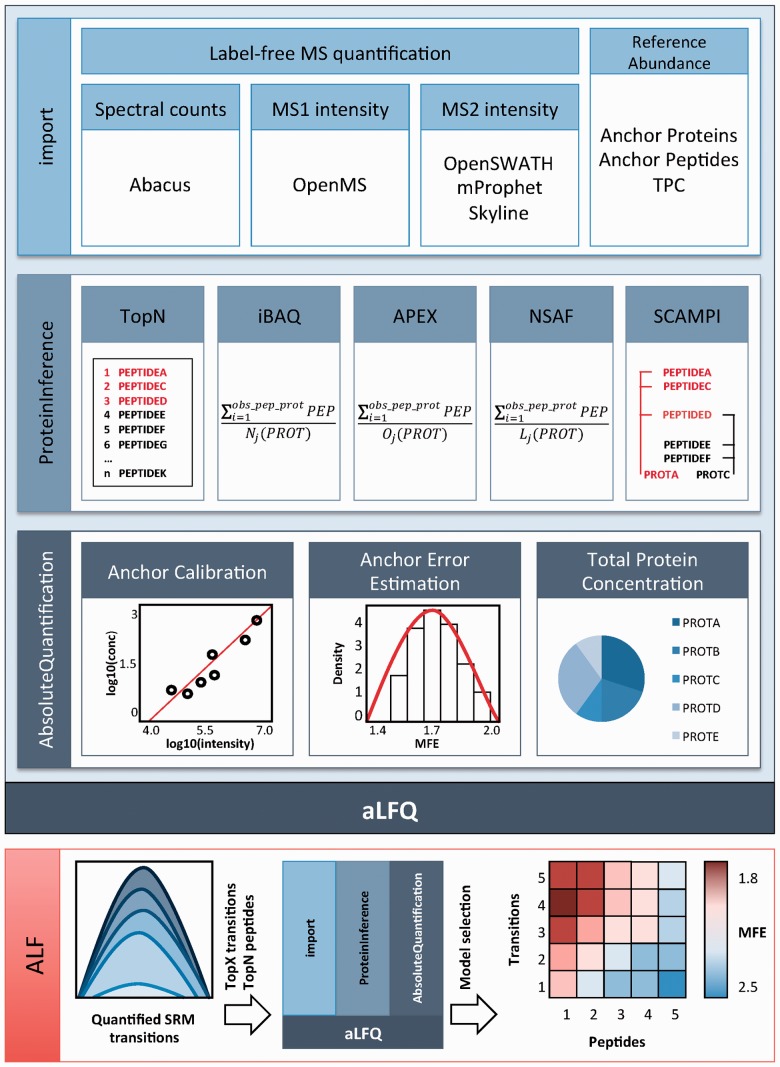
Results: We present a bioinformatics tool, termed aLFQ, which supports the commonly used absolute label-free protein abundance estimation methods (TopN, iBAQ, APEX, NSAF and SCAMPI) for LC-MS/MS proteomics data, together with validation algorithms enabling automated data analysis and error estimation.
Availability and implementation: aLFQ is written in R and freely available under the GPLv3 from CRAN (http://www.cran.r-project.org). Instructions and example data are provided in the R-package. The raw data can be obtained from the PeptideAtlas raw data repository (PASS00321).
Supplementary information: Supplementary data are available at Bioinformatics online.
© The Author 2014. Published by Oxford University Press.
Figures
References
-
- Ahrné E, et al. Critical assessment of proteome-wide label-free absolute abundance estimation strategies. Proteomics. 2013;13:2567–2578. - PubMed
-
- Brun V, et al. Isotope dilution strategies for absolute quantitative proteomics. J. Proteomics. 2009;72:740–749. - PubMed
-
- Lu P, et al. Absolute protein expression profiling estimates the relative contributions of transcriptional and translational regulation. Nat. Biotechnol. 2007;25:117–124. - PubMed
Publication types
MeSH terms
Substances
LinkOut - more resources
Full Text Sources
Other Literature Sources
Molecular Biology Databases
Miscellaneous
