


Archaeological and genetic insights into the origins of domesticated rice
- PMID: 24753573
- PMCID: PMC4035933
- DOI: 10.1073/pnas.1308942110
Archaeological and genetic insights into the origins of domesticated rice
Abstract
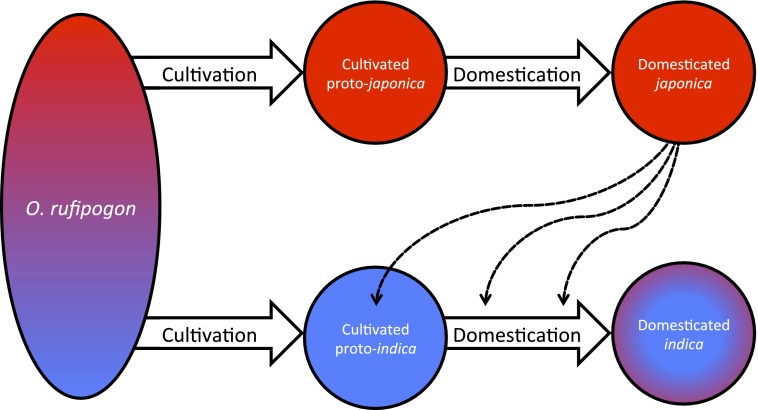
Rice (Oryza sativa) is one of the most important cereal grains in the world today and serves as a staple food source for more than half of the world's population. Research into when, where, and how rice was brought into cultivation and eventually domesticated, along with its development into a staple food source, is thus essential. These questions have been a point of nearly continuous research in both archaeology and genetics, and new information has continually come to light as theory, data acquisition, and analytical techniques have advanced over time. Here, we review the broad history of our scientific understanding of the rice domestication process from both an archaeological and genetic perspective and examine in detail the information that has come to light in both of these fields in the last 10 y. Current findings from genetics and archaeology are consistent with the domestication of O. sativa japonica in the Yangtze River valley of southern China. Interestingly, although it appears rice was cultivated in the area by as early 8000 BP, the key domestication trait of nonshattering was not fixed for another 1,000 y or perhaps longer. Rice was also cultivated in India as early as 5000 BP, but the domesticated indica subspecies currently appears to be a product of the introgression of favorable alleles from japonica. These findings are reshaping our understanding of rice domestication and also have implications for understanding the complex evolutionary process of plant domestication.
Keywords: Oryza nivara; Oryza rufipogon; domestication gene.
Conflict of interest statement
The authors declare no conflict of interest.
Figures

References
-
- Vavilov NI. Studies on the origin of cultivated plants. Bull Appl Biol. 1926;16:139–248.
-
- Ding Y. The origin and evolution of Chinese cultivated rice. J Agriculture. 1957;8(3):243–260.
-
- Yan W. Re-thinking the origin of rice agriculture in China. Nongye Kaogu. 1989;89(2):74–83.
-
- Chang T. Rice. In: Simmonds NW, editor. Evolution of Crop Plants. London: Longman; 1976. pp. 98–104.
-
- Higham C. The transition to rice cultivation in Southeast Asia. In: Price T, Gebauer A, editors. Last Hunters—First Farmers. Santa Fe, NM: School of American Research Press; 1995. pp. 127–155.
Publication types
MeSH terms
LinkOut - more resources
Full Text Sources
Other Literature Sources
