. 2014 May 6;111(18):6726-31.
doi: 10.1073/pnas.1405768111. Epub 2014 Apr 21.

Modulation of a voltage-gated Na+ channel by sevoflurane involves multiple sites and distinct mechanisms

Affiliations

Modulation of a voltage-gated Na+ channel by sevoflurane involves multiple sites and distinct mechanisms

Annika F Barber et al. Proc Natl Acad Sci U S A. .

Abstract

Halogenated inhaled general anesthetic agents modulate voltage-gated ion channels, but the underlying molecular mechanisms are not understood. Many general anesthetic agents regulate voltage-gated Na(+) (NaV) channels, including the commonly used drug sevoflurane. Here, we investigated the putative binding sites and molecular mechanisms of sevoflurane action on the bacterial NaV channel NaChBac by using a combination of molecular dynamics simulation, electrophysiology, and kinetic analysis. Structural modeling revealed multiple sevoflurane interaction sites possibly associated with NaChBac modulation. Electrophysiologically, sevoflurane favors activation and inactivation at low concentrations (0.2 mM), and additionally accelerates current decay at high concentrations (2 mM). Explaining these observations, kinetic modeling suggests concurrent destabilization of closed states and low-affinity open channel block. We propose that the multiple effects of sevoflurane on NaChBac result from simultaneous interactions at multiple sites with distinct affinities. This multiple-site, multiple-mode hypothesis offers a framework to study the structural basis of general anesthetic action.

Keywords: MD simulations; anesthesia; anesthetics; membrane proteins.


Conflict of interest statement

The authors declare no conflict of interest.

Figures
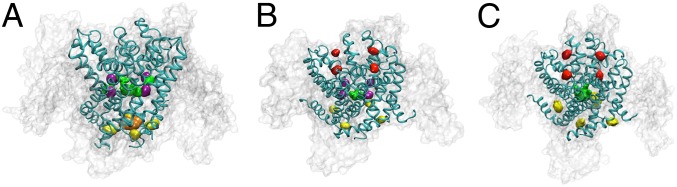
Fig. 1.
Fig. 1.
Putative sevoflurane binding sites in various states of NaChBac: (A) Resting/closed, (B) partially activated/closed and (C) activated/open. The three binding sites identified by clustering analysis are extracellular site (red), linker site (yellow), activation gate site (orange), and cavity/fenestration site (green/purple).
Fig. 2.
Fig. 2.
Zoom views of putative sevoflurane binding sites. (AC) Shown are top views of sevoflurane binding in the cavity and fenestrations of the resting/closed, partially activated/closed, and activated/open states, respectively. (D and E) Top view (Left) and zoom view (Right) of the extracellular site in the partially activated/closed state (D) and the activated/open state (E). (F and G) Top view (Left) and zoom view (Right) of the linker site in the partially activated/closed state (F) and the activated/open state (G).
Fig. 3.
Fig. 3.
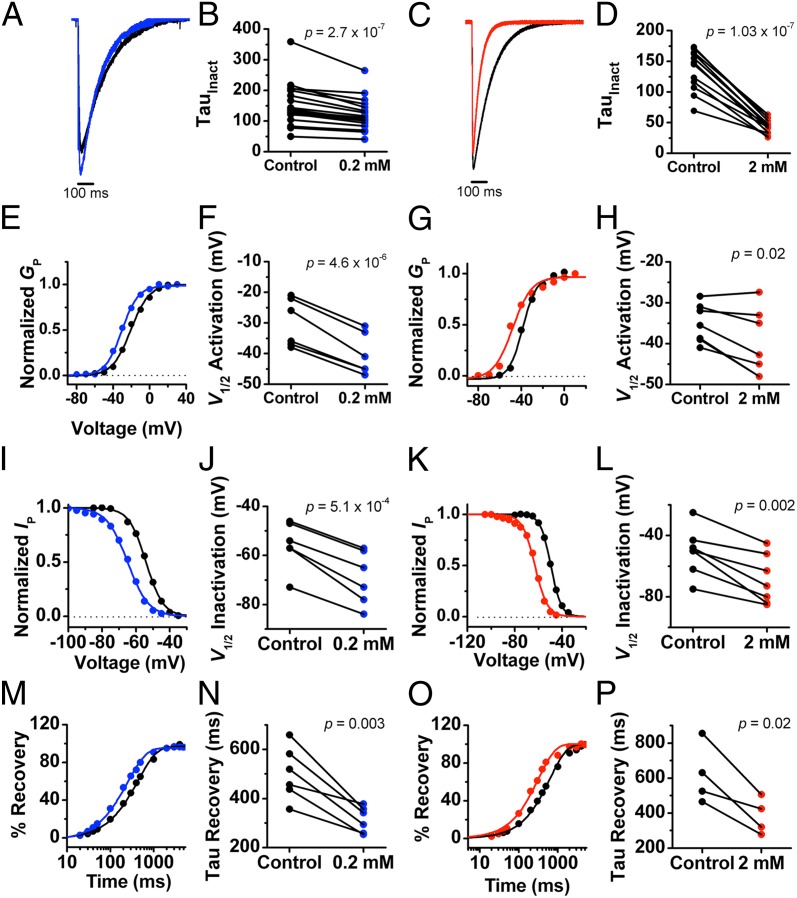
Electrophysiological effects of sevoflurane on NaChBac. (A and C) Representative currents evoked from a step from −100 to 0 mV, showing the effect of 0.2 mM (A) and 2 mM (C) sevoflurane on NaChBac current amplitude and rate of inactivation. (B and D) Scatter plot comparing paired measurements of the time constants (τ) of current decay before and after application of 0.2 mM (B) and 2 mM (D) sevoflurane. (E and G) Representative peak GpV relationships from paired experiments before and after application of 0.2 mM (E) and 2 mM (G) sevoflurane. (F and H) Scatter plot from paired data showing the effect of 0.2 mM (F) and 2 mM (H) sevoflurane on the V1/2 of activation. (I and K) Representative steady-state inactivation vs. voltage relationships from paired experiments before and after application of 0.2 mM (I) and 2 mM (K) sevoflurane. (J and L) Scatter plot from paired data showing the effect of 0.2 mM (J) and 2 mM (L) sevoflurane on V1/2 of inactivation. (M and O) Representative recovery from inactivation curves from paired experiments before and after application of 0.2 mM (M) and 2 mM (O) sevoflurane. (N and P) Scatter plot from paired data showing the effect of 0.2 mM (N) and 2 mM (P) sevoflurane on the time constant (τ) of recovery from inactivation.
Fig. 4.
Fig. 4.
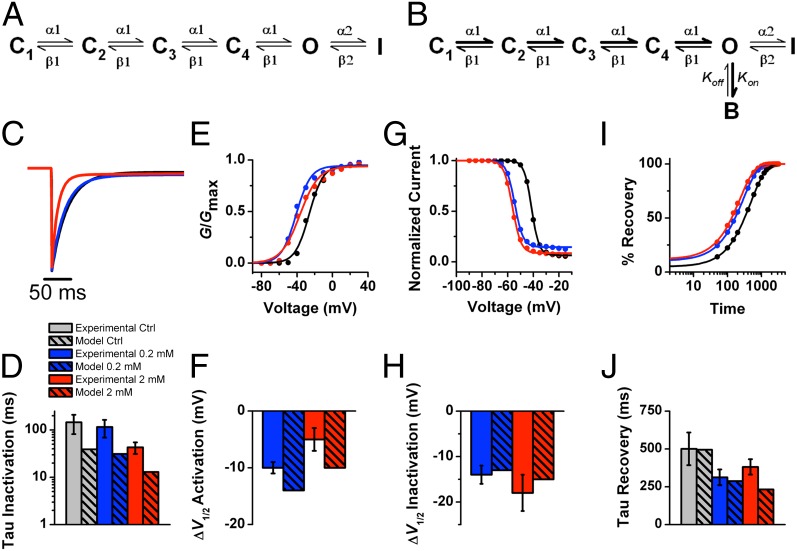
Kinetic modeling of NaChBac modulation by sevoflurane. (A and B) Kinetic schemes in the absence (A) and presence (B) of sevoflurane. Parameter values are summarized in Table S1. Note that the rate constants α1 and β1 are strongly voltage-dependent, whereas the rate constants α2 and β2 are only weakly voltage-dependent. Only the binding rate constant kon depends on the concentration of sevoflurane. (C) Simulated NaChBac currents in the absence (black) and presence of 0.2 mM (blue) and 2 mM (red). The depolarizing step is from −100 to 0 mV. (D) Comparison of observed vs. simulated time constants of current decay. Observed data are shown with hatch marks: control (gray), 0.2 mM (blue), and 2 mM (red). (E) Simulated GpV relations before (black) and after application of 0.2 mM (blue) and 2 mM (red) sevoflurane. (F) Comparison of observed vs. simulated V1/2 shifts estimated from the corresponding GpV relations. Color scheme is as in C. (G) Simulated steady-state inactivation vs. voltage relations before (black) and after application of 0.2 mM (blue) and 2 mM (red) sevoflurane. (H) Comparison of observed vs. simulated V1/2 shifts estimated from the corresponding steady-state inactivation curves. Color scheme is as in B. (I) Simulated trajectories of recovery from inactivation before (black) and after application of 0.2 mM (blue) and 2 mM (red) sevoflurane. (J) Comparison of observed vs. simulated time constants of recovery from inactivation estimated from the corresponding trajectories of recovery.

References

    1. Hemmings HC, Jr, et al. Emerging molecular mechanisms of general anesthetic action. Trends Pharmacol Sci. 2005;26(10):503–510. - PubMed
    1. Franks NP. Molecular targets underlying general anaesthesia. Br J Pharmacol. 2006;147(Suppl 1):S72–S81. - PMC - PubMed
    1. Franks NP. General anaesthesia: from molecular targets to neuronal pathways of sleep and arousal. Nat Rev Neurosci. 2008;9(5):370–386. - PubMed
    1. Urban BW. The site of anesthetic action. Handbook Exp Pharmacol. 2008;183(182):3–29. - PubMed
    1. Krasowski MD, Harrison NL. General anaesthetic actions on ligand-gated ion channels. Cell Mol Life Sci. 1999;55(10):1278–1303. - PMC - PubMed

Publication types

MeSH terms

LinkOut - more resources