


Conceptual dynamical models for turbulence
- PMID: 24753605
- PMCID: PMC4020109
- DOI: 10.1073/pnas.1404914111
Conceptual dynamical models for turbulence
Abstract
Understanding the complexity of anisotropic turbulent processes in engineering and environmental fluid flows is a formidable challenge with practical significance because energy often flows intermittently from the smaller scales to impact the largest scales in these flows. Conceptual dynamical models for anisotropic turbulence are introduced and developed here which, despite their simplicity, capture key features of vastly more complicated turbulent systems. These conceptual models involve a large-scale mean flow and turbulent fluctuations on a variety of spatial scales with energy-conserving wave-mean-flow interactions as well as stochastic forcing of the fluctuations. Numerical experiments with a six-dimensional conceptual dynamical model confirm that these models capture key statistical features of vastly more complex anisotropic turbulent systems in a qualitative fashion. These features include chaotic statistical behavior of the mean flow with a sub-Gaussian probability distribution function (pdf) for its fluctuations whereas the turbulent fluctuations have decreasing energy and correlation times at smaller scales, with nearly Gaussian pdfs for the large-scale fluctuations and fat-tailed non-Gaussian pdfs for the smaller-scale fluctuations. This last feature is a manifestation of intermittency of the small-scale fluctuations where turbulent modes with small variance have relatively frequent extreme events which directly impact the mean flow. The dynamical models introduced here potentially provide a useful test bed for algorithms for prediction, uncertainty quantification, and data assimilation for anisotropic turbulent systems.
Keywords: stochastic model; wave–mean interaction.
Conflict of interest statement
The authors declare no conflict of interest.
Figures
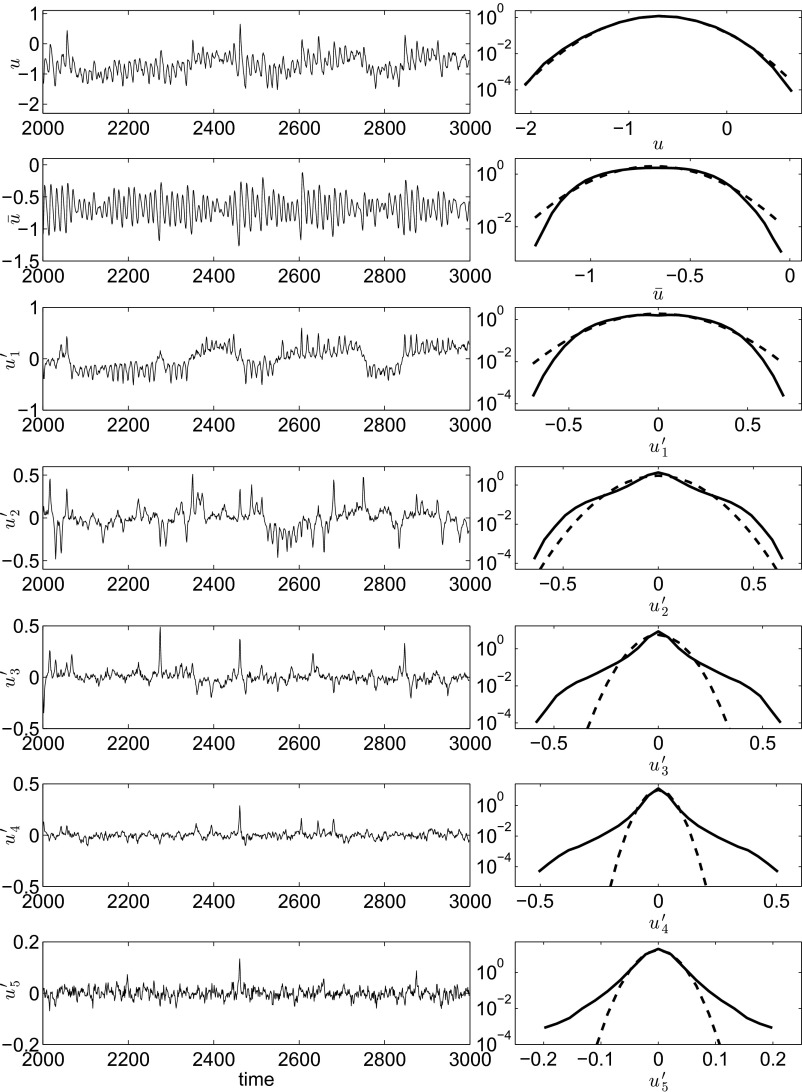
 and
and  with
with  . Note the logarithmic scale of pdfs in the y axis. Dashed lines are Gaussian distributions with the same mean and variance.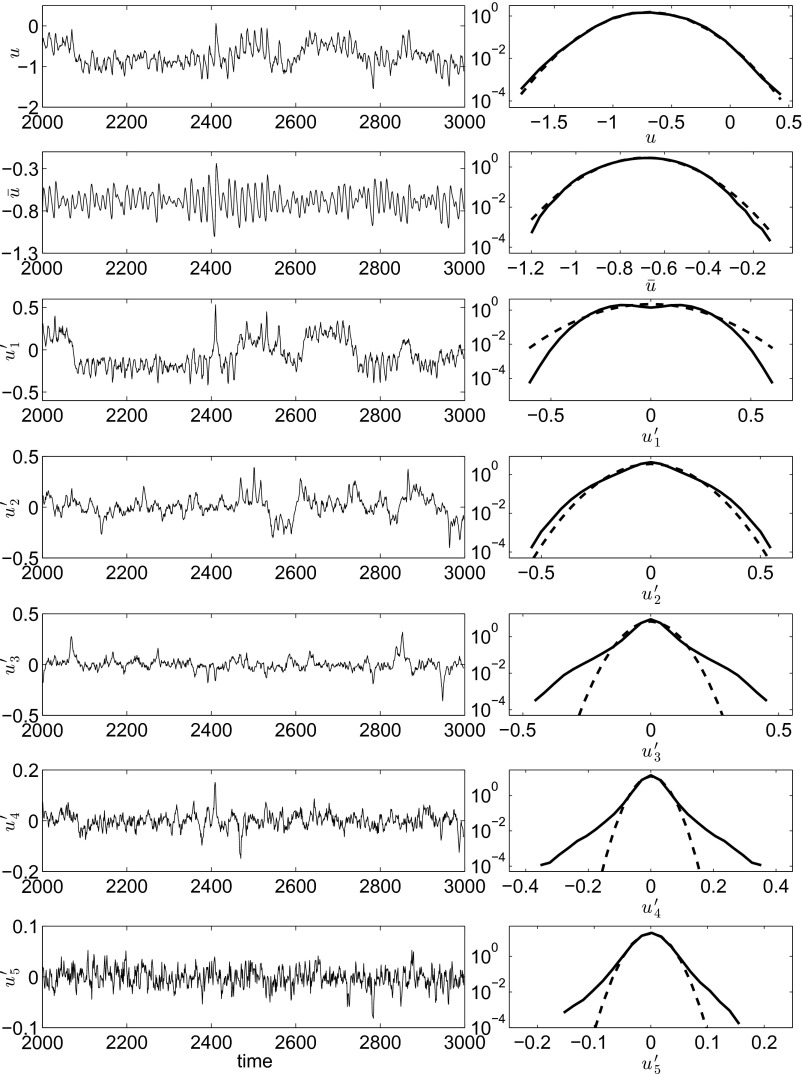
 and
and  with
with  . Note the logarithmic scale of pdfs in the y axis. Dashed lines are Gaussian distributions with the same mean and variance.
References
-
- Hinze J. Turbulence: An Introduction to Its Mechanisms and Theory. New York: McGraw-Hill; 1959.
-
- Townsend AA. The Structure of Turbulent Shear Flow. Cambridge, MA: Cambridge Univ Press; 1976.
-
- Frisch U. Turbulence. New York: Cambridge Univ Press; 1995.
-
- Vallis GK. Atmospheric and Oceanic Fluid Dynamics: Fundamentals and Large-Scale Circulation. Cambridge, MA: Cambridge Univ Press; 2006.
-
- Salmon R. Lectures on Geophysical Fluid Dynamics. New York: Oxford Univ Press; 1998.
Publication types
LinkOut - more resources
Full Text Sources
Other Literature Sources
