


A prospective randomised study comparing a GnRH-antagonist versus a GnRH-agonist short protocol for ovarian stimulation in patients referred for IVF
- PMID: 24753894
- PMCID: PMC3987498
A prospective randomised study comparing a GnRH-antagonist versus a GnRH-agonist short protocol for ovarian stimulation in patients referred for IVF
Abstract
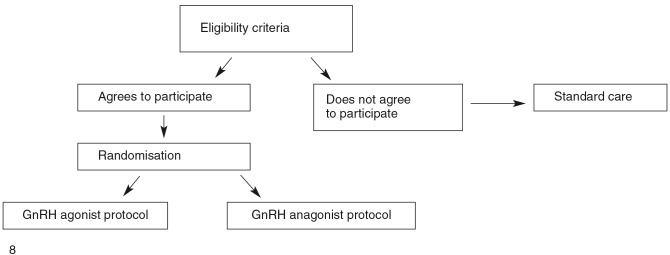
Objective: To compare two short protocols for ovarian stimulation in IVF cycles using an antagonist and an agonist short protocol. The outcomes studied were dosis rec FSH needed, days of stimulation, number of oocytes retrieved and pregnancy outcome.
Methods: A prospective randomised study design.
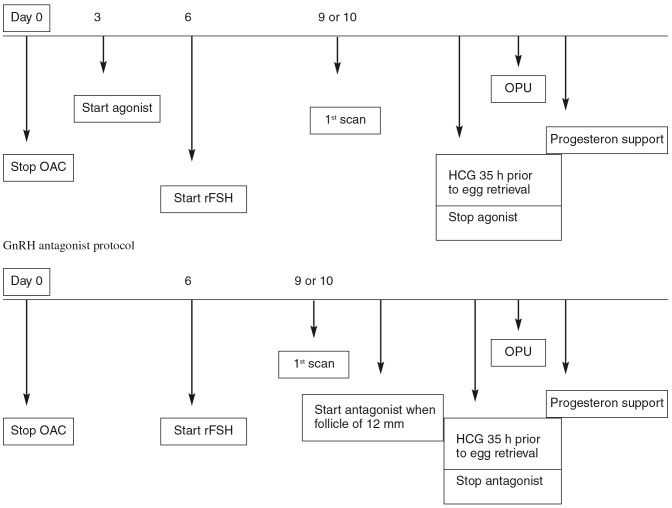
Inclusion criteria: first or second IVF attempt in women younger than 40 years. In the agonist protocol (Suprefact®) nasal spray was used. In the antagonist protocol (Orgalutran)® was started as soon as at least 1 follicle of 12 mm was visualized on ultrasound.
Results: 160 cycles were included in the study: 80 in the antagonist group and 80 in the agonist group. A higher dosis of recombinant FSH (rec FSH) was used for stimulation in the antagonist group (1897 IU versus 1655 IU). Pregnancy rate per ET in the antagonist group was 37% with an ongoing pregnancy rate of 21%/ET and an -implantation rate of 22%; versus respectively 39%, 20% and 22% in the agonist treated group. Live birth rate per started cylce was 19% in the antagonist group versus 20% in the agonist group.
Conclusion: This study shows that implantation rates, ongoing pregnancy rates and live birth rates are equal in both groups. An identical number of oocytes was retrieved, with no difference in duration of the stimulation although a higher dosis of rec FSH was needed in the antagonist group.
Keywords: GnRH-Agonist; GnRH-antagonist; IVF; infertility; live birth rate; ovarian stimulation; pregnancy outcome.
Figures
References
-
- Akman MA, Erden HF, Tosun SB, et al. Addition of GnRH antagonist in cycles of poor responders undergoing IVF.(2000) Hum Reprod. 2000;15(10):2145–2147. - PubMed
-
- Akman MA, Erden HF, Tosun SB, et al. Comparison of agonistic flare-up-protocol and antagonistic multiple dose protocol in ovarian stimulation of poor responders: results of a prospective randomized trial. Hum Reprod. 2001;16(5):868–870. - PubMed
-
- Al-Inany HY, Youssef MA, Aboulghar M, et al. Gonadotrophin-releasing hormone antagonists for assisted reproductive technology. Cochrane Database Syst Rev. 2011;5(CD001750) - PubMed
-
- Bodri D, Sunkara SK, Coomarasamy A. Gonadotropin-releasing hormone agonists versus antagonists for controlled ovarian hyperstimulation in oocyte donors: a systematic review and meta-analysis. Fertil Steril. 2011;95(1):164–169. - PubMed
-
- Bodri D, Vernaeve V, Guillen JJ, et al. Comparison between a GnRH antagonist and a GnRH agonist flare-up protocol in oocyte donors: a randomized clinical trial. Hum Reprod. 2006;(9):2246–2251. - PubMed
LinkOut - more resources
Full Text Sources