


Heritable GATA2 mutations associated with familial AML-MDS: a case report and review of literature
- PMID: 24754962
- PMCID: PMC4006458
- DOI: 10.1186/1756-8722-7-36
Heritable GATA2 mutations associated with familial AML-MDS: a case report and review of literature
Erratum in
-
Erratum: Heritable GATA2 mutations associated with familial AML-MDS: a case report and review of literature.J Hematol Oncol. 2015 Dec 29;8:131. doi: 10.1186/s13045-015-0228-z. J Hematol Oncol. 2015. PMID: 26715529 Free PMC article. No abstract available.
Abstract
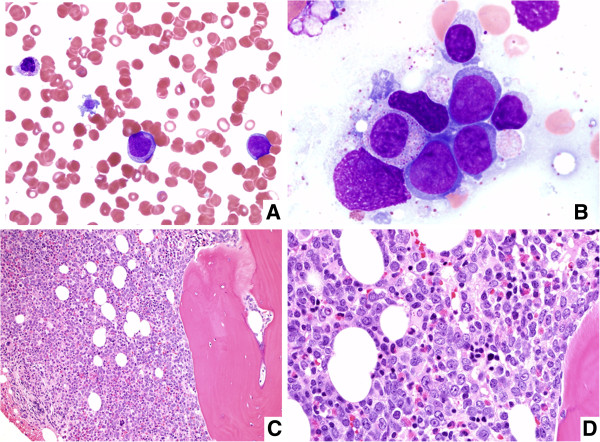
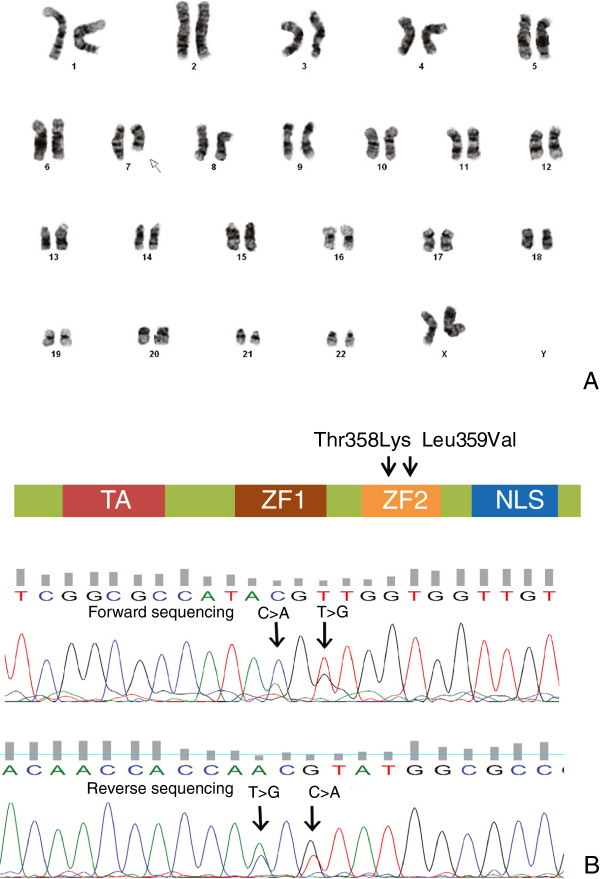
A 50-year-old woman was diagnosed with acute myeloid leukemia (AML). She has history of thrombocytopenia for 25 years and a significant family history of thrombocytopenia, affecting her mother, siblings and their children, as well as her own children. Both her mother and maternal aunt died from myelodysplastic syndrome (MDS). Additional genetic analysis was performed and identified two heterozygous missence mutations in the second zinc finger domain of GATA2 gene (p.Thr358Lys, and p.Leu359Val), occurring in cis on the same allele. Given the patient's family history and clinical manifestation, this was interpreted as an acute myeloid leukemia with heritable GATA2 mutations associated with familial AML-MDS. Germline GATA2 mutations are involved in a group of complex syndromes with overlapping clinical features of immune deficiency, lymphedema and propensity to acute myeloid leukemia or myelodysplastic syndrome (AML-MDS). Here we reported a case of familial AML-MDS with two novel GATA2 mutations. This case illustrates the importance of recognizing the clinical features for this rare category of AML-MDS and performing the appropriate molecular testing. The diagnosis of heritable gene mutations associated familial AML-MDS has significant clinical implication for the patients and affected families. Clinical trials are available to further investigate the role of allogeneic hematopoietic stem cell transplant in managing these patients.
Figures
References
-
- Murphy KM, Levis M, Hafez MJ, Geiger T, Cooper LC, Smith BD, Small D, Berg KD. Detection of FLT3 internal tandem duplication and D835 mutations by a multiplex polymerase chain reaction and capillary electrophoresis assay. J Mol Diagn. 2003;5:96–102. doi: 10.1016/S1525-1578(10)60458-8. - DOI - PMC - PubMed
-
- Gorello P, Cazzaniga G, Alberti F, Dell'Oro MG, Gottardi E, Specchia G, Roti G, Rosati R, Martelli MF, Diverio D, Lo Coco F, Biondi A, Saglio G, Mecucci C, Falini B. Quantitative assessment of minimal residual disease in acute myeloid leukemia carrying nucleophosmin (NPM1) gene mutations. Leukemia. 2006;20:1103–1108. doi: 10.1038/sj.leu.2404149. - DOI - PubMed
-
- Michaud J, Wu F, Osato M, Cottles GM, Yanagida M, Asou N, Shigesada K, Ito Y, Benson KF, Raskind WH, Rossier C, Antonarakis SE, Israels S, McNicol A, Weiss H, Horwitz M, Scott HS. In vitro analyses of known and novel RUNX1/AML1 mutations in dominant familial platelet disorder with predisposition to acute myelogenous leukemia: implications for mechanisms of pathogenesis. Blood. 2002;99:1364–1372. doi: 10.1182/blood.V99.4.1364. - DOI - PubMed
-
- Tsai FY, Orkin SH. Transcription factor GATA-2 is required for proliferation/survival of early hematopoietic cells and mast cell formation, but not for erythroid and myeloid terminal differentiation. Blood. 1997;89:3636–3643. - PubMed
Publication types
MeSH terms
Substances
LinkOut - more resources
Full Text Sources
Other Literature Sources
Medical
Research Materials
Miscellaneous
