


Small regulatory RNAs in Archaea
- PMID: 24755959
- PMCID: PMC4152357
- DOI: 10.4161/rna.28452
Small regulatory RNAs in Archaea
Abstract
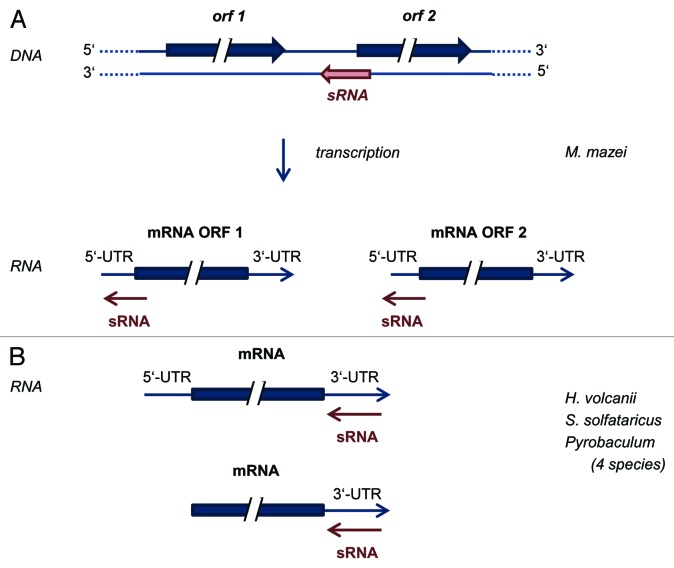
Small regulatory RNAs (sRNAs) are universally distributed in all three domains of life, Archaea, Bacteria, and Eukaryotes. In bacteria, sRNAs typically function by binding near the translation start site of their target mRNAs and thereby inhibit or activate translation. In eukaryotes, miRNAs and siRNAs typically bind to the 3'-untranslated region (3'-UTR) of their target mRNAs and influence translation efficiency and/or mRNA stability. In archaea, sRNAs have been identified in all species investigated using bioinformatic approaches, RNomics, and RNA-Seq. Their size can vary significantly between less than 50 to more than 500 nucleotides. Differential expression of sRNA genes has been studied using northern blot analysis, microarrays, and RNA-Seq. In addition, biological functions have been unraveled by genetic approaches, i.e., by characterization of designed mutants. As in bacteria, it was revealed that archaeal sRNAs are involved in many biological processes, including metabolic regulation, adaptation to extreme conditions, stress responses, and even in regulation of morphology and cellular behavior. Recently, the first target mRNAs were identified in archaea, including one sRNA that binds to the 5'-region of two mRNAs in Methanosarcina mazei Gö1 and a few sRNAs that bind to 3'-UTRs in Sulfolobus solfataricus, three Pyrobaculum species, and Haloferax volcanii, indicating that archaeal sRNAs appear to be able to target both the 5'-UTR or the 3'-UTRs of their respective target mRNAs. In addition, archaea contain tRNA-derived fragments (tRFs), and one tRF has been identified as a major ribosome-binding sRNA in H. volcanii, which downregulates translation in response to stress. Besides regulatory sRNAs, archaea contain further classes of sRNAs, e.g., CRISPR RNAs (crRNAs) and snoRNAs.
Keywords: Haloferax volcanii; Methanosarcina mazei; Nanoarchaeum equitans; Sulfolobus solfataricus; archaea; small regulatory RNAs; tRNA-derived fragments; translation.
Figures
References
Publication types
MeSH terms
Substances
LinkOut - more resources
Full Text Sources
Other Literature Sources
Research Materials
