. 2014 Aug;23(6):988-1003.
doi: 10.1007/s10646-014-1242-6. Epub 2014 Apr 23.

Ingestion and sublethal effects of physically and chemically dispersed crude oil on marine planktonic copepods

Affiliations

Ingestion and sublethal effects of physically and chemically dispersed crude oil on marine planktonic copepods

Rodrigo Almeda et al. Ecotoxicology. 2014 Aug.

Abstract

Planktonic copepods play a key function in marine ecosystems, however, little is known about the effects of dispersants and chemically dispersed crude oil on these important planktonic organisms. We examined the potential for the copepods Acartia tonsa, Temora turbinata and Parvocalanus crassirostris to ingest crude oil droplets and determined the acute toxicity of the dispersant Corexit(®) 9500A, and physically and chemically dispersed crude oil to these copepods. We detected ingestion of crude oil droplets by adults and nauplii of the three copepod species. Exposure to crude oil alone (1 µL L(-1), 48 h) caused a reduction of egg production rates (EPRs) by 26-39 %, fecal pellet production rates (PPRs) by 11-27 %, and egg hatching (EH) by 1-38 % compared to the controls, depending on the species. Dispersant alone (0.05 µL L(-1), 48 h) produced a reduction in EPR, PPR and EH by 20-35, 12-23 and 2-11 %, respectively. Dispersant-treated crude oil was the most toxic treatment, ~1.6 times more toxic than crude oil alone, causing a reduction in EPR, PPR and EH by 45-54, 28-41 and 11-31 %, respectively. Our results indicate that low concentrations of dispersant Corexit 9500A and chemically dispersed crude oil are toxic to marine zooplankton, and that the ingestion of crude oil droplets by copepods may be an important route by which crude oil pollution can enter marine food webs.


Figures
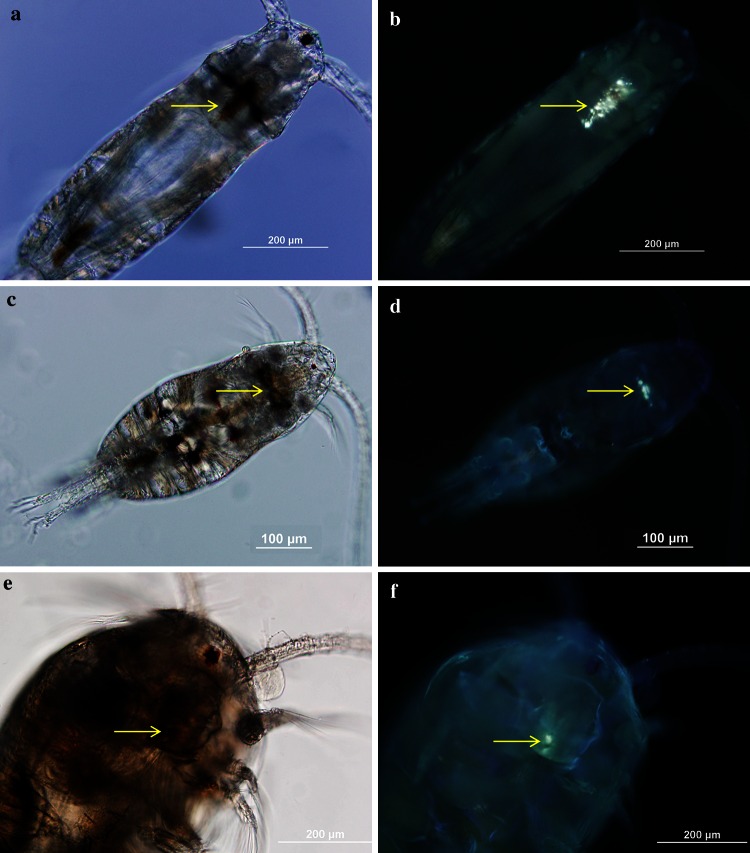
Fig. 1
Fig. 1
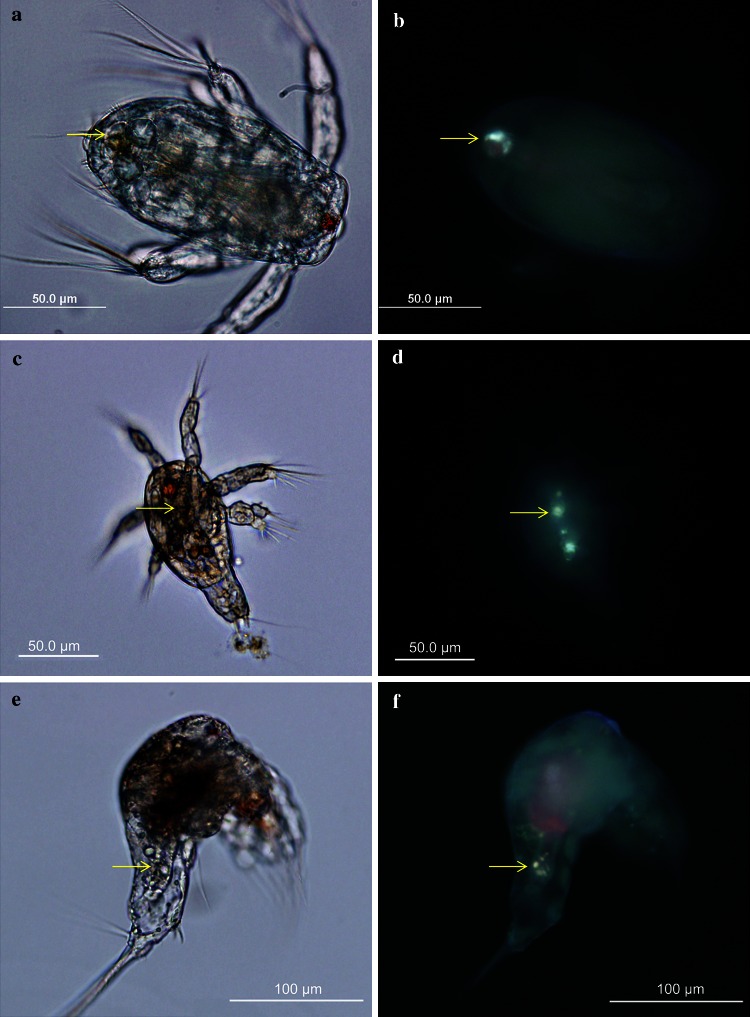
Microscope images of the studied copepods showing the presence of crude oil droplets inside the copepod digestive tracts after exposure to dispersed crude oil. The presence of crude oil droplets was confirmed by the observation of crude oil fluorescence under UV illumination (right panels). a, b Acartia tonsa, c, d Parvocalanus crassirostris, e, f Temora turbinata. The arrow indicates the position of crude oil droplets in the copepods
Fig. 2
Fig. 2
Microscope images of the copepod nauplii with crude oil droplets inside the guts. The presence of crude oil droplets was confirmed by the observation of crude oil fluorescence under UV illumination (right panels) a, b Acartia tonsa, c, d Parvocalanus crassirostris, e, f Temora turbinata. The arrow indicates the position of crude oil droplets in the copepods
Fig. 3
Fig. 3
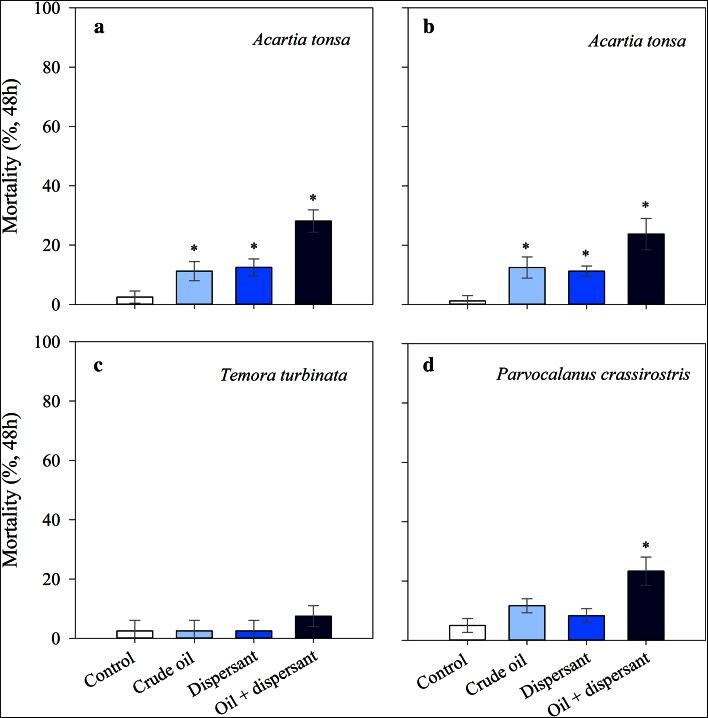
Lethal effects of crude oil alone, dispersant alone and dispersant-treated crude oil on copepods after 48 h of exposure. a Acartia tonsa (experiment conducted in July), b Acartia tonsa (experiment conducted in October), c Temora turbinata, and d Parvocalanus crassirostris. In all treatments n = 2, except in the experiments conducted with A. tonsa in July when n = 4. Error bars represent the standard deviations. Asterisk indicates significantly lower than the controls (p < 0.05)
Fig. 4
Fig. 4
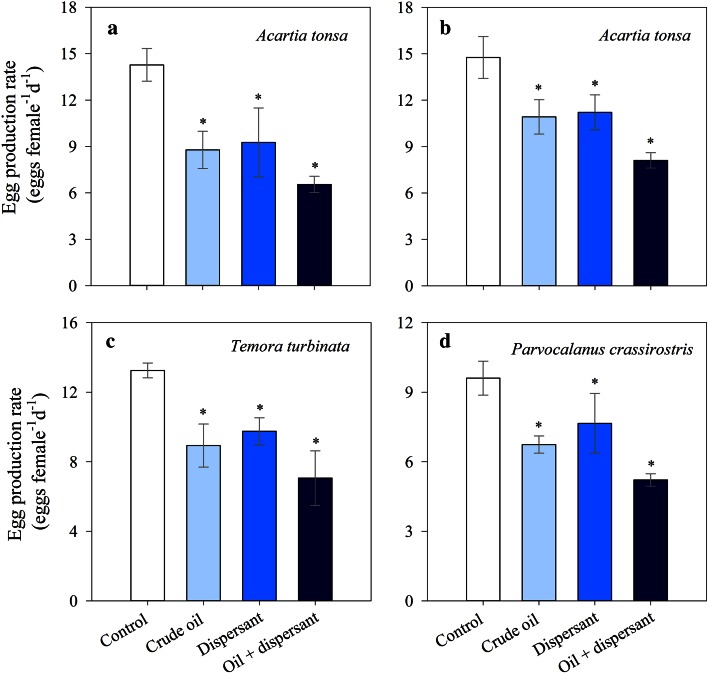
Effects of crude oil alone, dispersant alone and dispersant-treated crude oil on copepod egg production rates after 48 h of exposure. a Acartia tonsa (experiment conducted in July), b Acartia tonsa (experiment conducted in October), c Temora turbinata, and d Parvocalanus crassirostris. In all treatments n = 2, except in the experiments conducted with A. tonsa in July when n = 4. Error bars represent the standard deviations. Asterisk indicates significantly lower than the controls (p < 0.05)
Fig. 5
Fig. 5
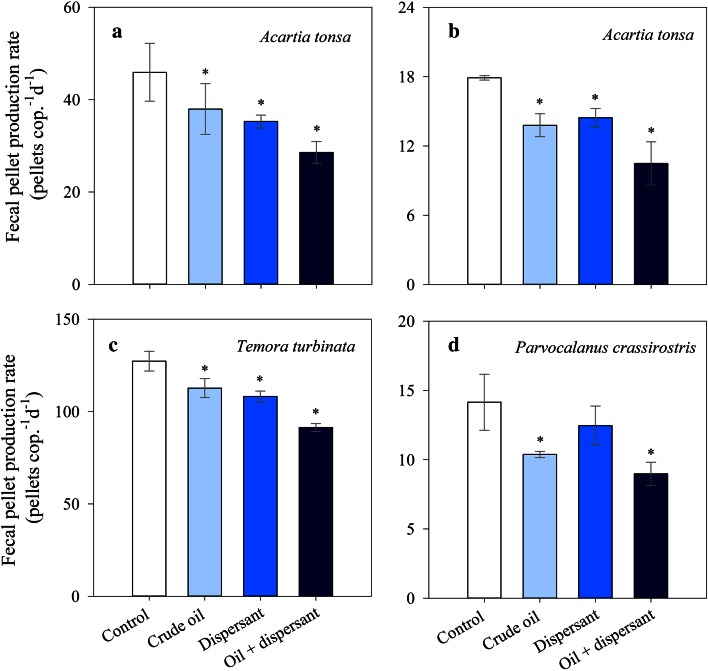
Effects of crude oil alone, dispersant alone and dispersant-treated crude oil on copepod fecal pellet production rates after 48 h of exposure. a Acartia tonsa (experiment conducted in July), b Acartia tonsa (experiment conducted in October), c Temora turbinata, and d Parvocalanus crassirostris. In all treatments n = 2, except in the experiments conducted with A. tonsa in July when n = 4. Error bars represent the standard deviations. Asterisk indicates significantly lower than the controls (p < 0.05)
Fig. 6
Fig. 6
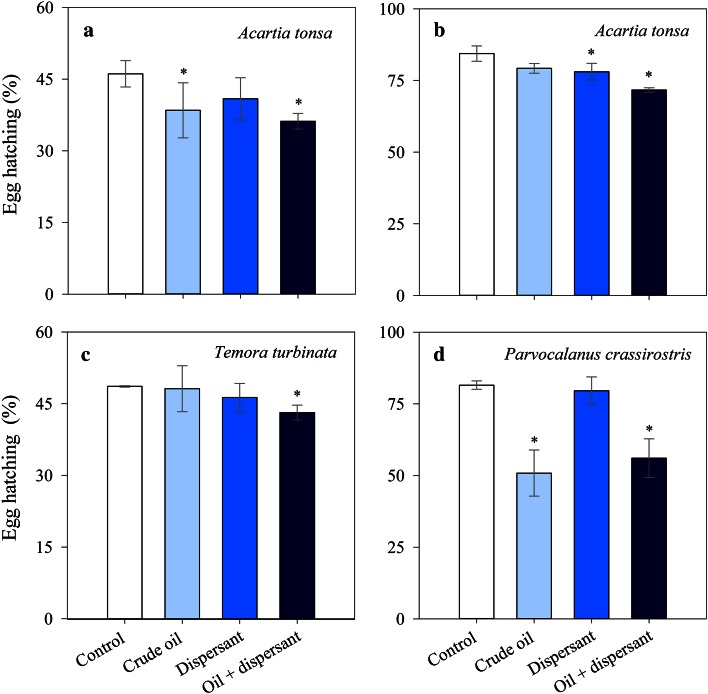
Effects of crude oil alone, dispersant alone and dispersant-treated crude oil on copepod egg hatching after 48 h of exposure. a Acartia tonsa (experiment conducted in July), b Acartia tonsa (experiment conducted in October), c Temora turbinata, and d Parvocalanus crassirostris. In all treatments n = 2, except in the experiments conducted with A. tonsa in July when n = 4. Error bars represent the standard deviations. Asterisk indicates significantly lower than the controls (p < 0.05)

References

    1. Almeda R, Wambaugh Z, Wang Z, Hyatt C, Liu Z, Buskey EJ. Interactions between zooplankton and crude oil: toxic effects and bioaccumulation of polycyclic aromatic hydrocarbons. PLoS ONE. 2013;8(6):e67212. doi: 10.1371/journal.pone.0067212. - DOI - PMC - PubMed
    1. Almeda R, Wambaugh Z, Chai C, Wang Z, Liu Z, et al. Effects of crude oil exposure on bioaccumulation of polycyclic aromatic hydrocarbons and survival of adult and larval stages of gelatinous zooplankton. PLoS ONE. 2013;8(10):e74476. doi: 10.1371/journal.pone.0074476. - DOI - PMC - PubMed
    1. Andrews AR, Floodgate GD. Some observations on the interactions of marine protozoa and crude oil residues. Mar Biol. 1974;25:7–12. doi: 10.1007/BF00395102. - DOI
    1. Avila TR, Bersano JGF, Fillmann G. Lethal and sub-lethal effects of the water soluble fraction of a light crude oil on the planktonic copepod Acartia tonsa. J Braz Soc Ecotoxicol. 2010;5:19–25. doi: 10.5132/jbse.2010.01.004. - DOI
    1. Banse K. Zooplankton: pivotal role in the control of ocean production. ICES J Mar Sci. 1995;52:265–277. doi: 10.1016/1054-3139(95)80043-3. - DOI

Publication types

LinkOut - more resources