


The microbiota-gut-brain axis in gastrointestinal disorders: stressed bugs, stressed brain or both?
- PMID: 24756641
- PMCID: PMC4214655
- DOI: 10.1113/jphysiol.2014.273995
The microbiota-gut-brain axis in gastrointestinal disorders: stressed bugs, stressed brain or both?
Abstract
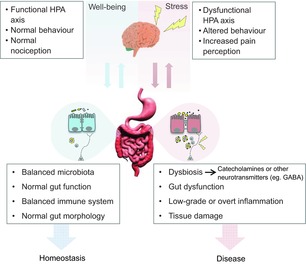
The gut-brain axis is the bidirectional communication between the gut and the brain, which occurs through multiple pathways that include hormonal, neural and immune mediators. The signals along this axis can originate in the gut, the brain or both, with the objective of maintaining normal gut function and appropriate behaviour. In recent years, the study of gut microbiota has become one of the most important areas in biomedical research. Attention has focused on the role of gut microbiota in determining normal gut physiology and immunity and, more recently, on its role as modulator of host behaviour ('microbiota-gut-brain axis'). We therefore review the literature on the role of gut microbiota in gut homeostasis and link it with mechanisms that could influence behaviour. We discuss the association of dysbiosis with disease, with particular focus on functional bowel disorders and their relationship to psychological stress. This is of particular interest because exposure to stressors has long been known to increase susceptibility to and severity of gastrointestinal diseases.
© 2014 The Authors. The Journal of Physiology © 2014 The Physiological Society.
Figures
References
-
- Abelaira HM, Réus GZ, Quevedo J. Animal models as tools to study the pathophysiology of depression. Rev Bras Psiquiatr. 2013;35(Suppl 2):S112–S120. - PubMed
-
- Abrams GD, Bishop JE. Effect of the normal microbial flora on gastrointestinal motility. Proc Soc Exp Biol Med. 1967;126:301–304. - PubMed
-
- Aisa B, Tordera R, Lasheras B, Del Río J, Ramírez MJ. Effects of maternal separation on hypothalamic–pituitary–adrenal responses, cognition and vulnerability to stress in adult female rats. Neuroscience. 2008;154:1218–1226. - PubMed
-
- Arumugam M, Raes J, Pelletier E, Le PD, Yamada T, Mende DR, Fernandes GR, Tap J, Bruls T, Batto JM, Bertalan M, Borruel N, Casellas F, Fernandez L, Gautier L, Hansen T, Hattori M, Hayashi T, Kleerebezem M, Kurokawa K, Leclerc M, Levenez F, Manichanh C, Nielsen HB, Nielsen T, Pons N, Poulain J, Qin J, Sicheritz-Ponten T, Tims S, Torrents D, Ugarte E, Zoetendal EG, Wang J, Guarner F, Pedersen O, de Vos WM, Brunak S, Doré J, Antolín M, Artiguenave F, Blottiere HM, Almeida M, Brechot C, Cara C, Chervaux C, Cultrone A, Delorme C, Denariaz G, Dervyn R, Foerstner KU, Friss C, van de Guchte M, Guedon E, Haimet F, Huber W, van Hylckama-Vlieg J, Jamet A, Juste C, Kaci G, Knol J, Lakhdari O, Layec S, Le RK, Maguin E, Mérieux A, Melo MR, M'rini C, Muller J, Oozeer R, Parkhill J, Renault P, Rescigno M, Sanchez N, Sunagawa S, Torrejon A, Turner K, Vandemeulebrouck G, Varela E, Winogradsky Y, Zeller G, Weissenbach J, Ehrlich SD, Bork P. Enterotypes of the human gut microbiome. Nature. 2011;473:174–180. - PMC - PubMed
Publication types
MeSH terms
LinkOut - more resources
Full Text Sources
Other Literature Sources
Medical
