Review
. 2014 Jan;2(1):10-31.
doi: 10.1177/2051013613508729.

A development that may evolve into a revolution in medicine: mRNA as the basis for novel, nucleotide-based vaccines and drugs

Affiliations
Review

A development that may evolve into a revolution in medicine: mRNA as the basis for novel, nucleotide-based vaccines and drugs

Karl-Josef Kallen et al. Ther Adv Vaccines. 2014 Jan.

Abstract

Recent advances strongly suggest that mRNA rather than DNA will be the nucleotide basis for a new class of vaccines and drugs. Therapeutic cancer vaccines against a variety of targets have been developed on this basis and initial clinical experience suggests that preclinical activity can be successfully translated to human application. Likewise, prophylactic vaccines against viral pathogens and allergens have demonstrated their activity in animal models. These successes could be extended preclinically to mRNA protein and gene replacement therapy as well as the induction of pluripotent stem cells by mRNA encoded transcription factors. The production of mRNA-based vaccines and drugs is highly flexible, scalable and cost competitive, and eliminates the requirement of a cold chain. mRNA-based drugs and vaccines offer all the advantages of a nucleotide-based approach at reduced costs and represent a truly disruptive technology that may start a revolution in medicine.

Keywords: RNActive vaccines; mRNA-based vaccines; replicons; therapeutic mRNA.


Conflict of interest statement

Conflict of interest statement: The authors declare no conflicts of interest in preparing this article.

Figures

Figure 1.
Figure 1.
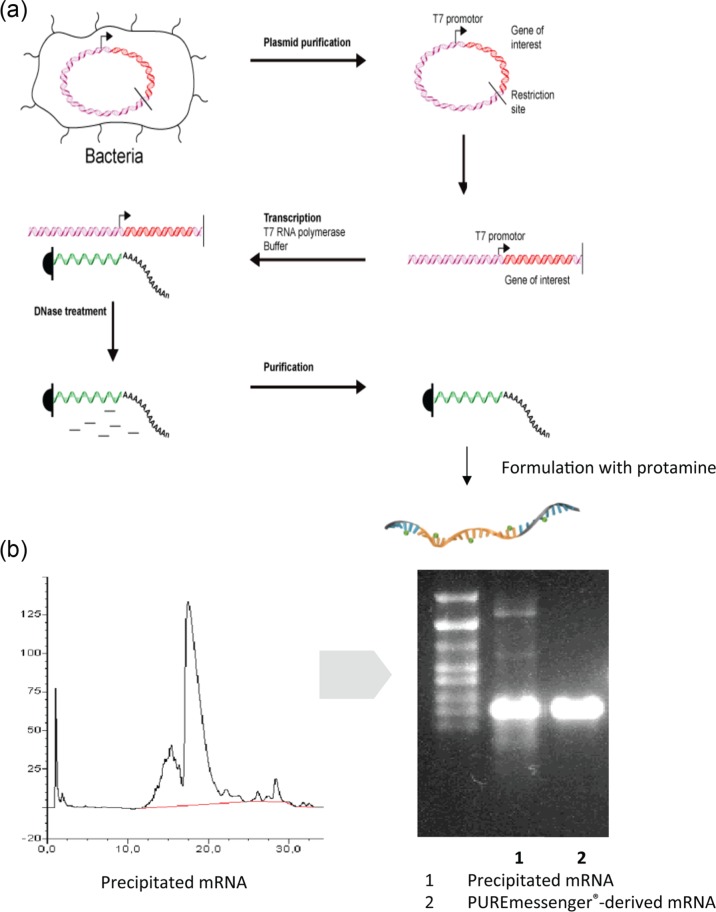
Production and thermal stability of messenger RNA (mRNA). (a) Basic structure of CureVac’s good manufacturing practice (GMP) production process of mRNA. All individual steps of the process are performed under GMP conditions. The production of a large number of vaccines in parallel is possible under these conditions. The process can be completed in a few weeks, including more than 39 quality controls demanded for GMP production. Importantly, the process is highly scalable and would allow production of a given vaccine either in one large facility or in several small ones. Costs would be a fraction of those required by a vaccine production site today and can be easily adapted to the production of a new vaccine within days (b) CureVac has developed a scalable, proprietary mRNA purification process (PUREmessenger). Impurities are removed by a chromatography procedure that results in notably purer mRNA than obtainable by standard methods. The highly purified mRNA has also enhanced expression capacity.
Figure 2.
Figure 2.
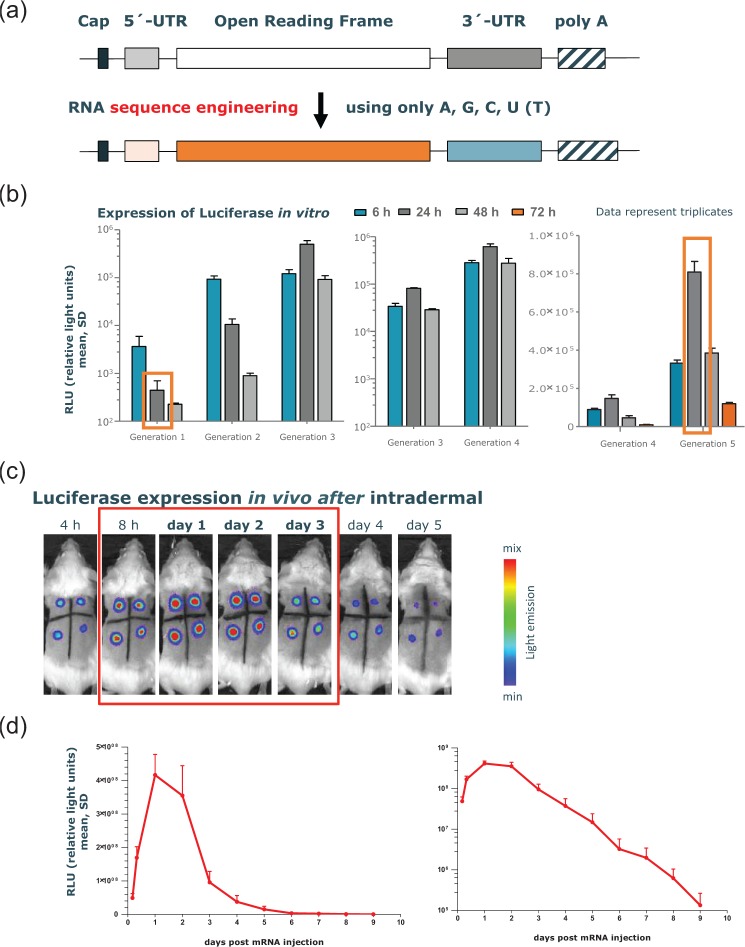
Effects on protein expression by sequence engineering of the principle messenger RNA (mRNA) structure. (a) The classical structure of an mRNA molecule consists of a cap region, followed by an (optional) 5’ untranslated region (UTR), the open reading frame (ORF), an (optional) 3’ UTR, and the poly(A)-tail. Sequence engineering of each subunit of an mRNA molecule with only the naturally occurring nucleotides A, G, C, U that do not affect the primary amino acid sequence encoded by the ORF are the basis of optimized mRNA molecules used in RNActive vaccines. (b) Effect of different generations of sequence-engineered mRNAs (e.g. generated by optimization of the nucleotide content of the ORF or incorporation of different 3’ or 5’ UTRs or combinations thereof) encoding PpLuc produced over the last few years on in vitro expression of luciferase. The mRNA generations encoding Firefly luciferase were electroporated into HeLa cells (generation 1–4) or transfected into human dermal fibroblasts by lipofection (generation 4 and 5) and compared for their in vitro expression of luciferase. The luciferase level was determined at 6, 24 and 48 h, or 72 h post transfection. The dynamic range of the assay does not allow us to compare all mRNA molecules in one experiment. (c) Firefly luciferase encoding mRNA, optimized for translation and stability, was injected intradermally into a BALB/c mouse (four injection sites). The luciferase expression was visualized in the living animal by optical imaging at various time points after mRNA injection and showed maximal protein levels 24–48 h after mRNA injection. (d) Quantitative expression of luciferase over time until 9 days after mRNA injection. Results are shown on a linear scale (left-hand panel) or on a semi-logarithmic scale (right-hand panel). The figure is adapted from Schlake and colleagues [Schlake et al. 2012], details therein.

References

    1. Anderson B., Muramatsu H., Nallagatla S., Bevilacqua P., Sansing L., Weissman D., et al. (2010) Incorporation of pseudouridine into mRNA enhances translation by diminishing PKR activation. Nucleic Acids Res 38: 5884–5892 - PMC - PubMed
    1. Anraku I., Harvey T., Linedale R., Gardner J., Harrich D., Suhrbier A., et al. (2002) Kunjin virus replicon vaccine vectors induce protective CD8+ T-cell immunity. J Virol 76: 3791–3799 - PMC - PubMed
    1. Aoshi T., Koyama S., Kobiyama K., Akira S., Ishii K.J. (2011) Innate and adaptive immune responses to viral infection and vaccination. Curr Opin Virol 1: 226–232 - PubMed
    1. Bagarazzi M., Yan J., Morrow M., Shen X., Parker R., Lee J., et al. (2012) Immunotherapy against HPV16/18 generates potent TH1 and cytotoxic cellular immune responses. Sci Transl Med 4: 155ra138. - PMC - PubMed
    1. Banerjee A. (1980) 5′-terminal cap structure in eucaryotic messenger ribonucleic acids. Microbiol Rev 44: 175–205 - PMC - PubMed