


International study on inter-reader variability for circulating tumor cells in breast cancer
- PMID: 24758318
- PMCID: PMC4052944
- DOI: 10.1186/bcr3647
International study on inter-reader variability for circulating tumor cells in breast cancer
Abstract
Introduction: Circulating tumor cells (CTCs) have been studied in breast cancer with the CellSearch® system. Given the low CTC counts in non-metastatic breast cancer, it is important to evaluate the inter-reader agreement.
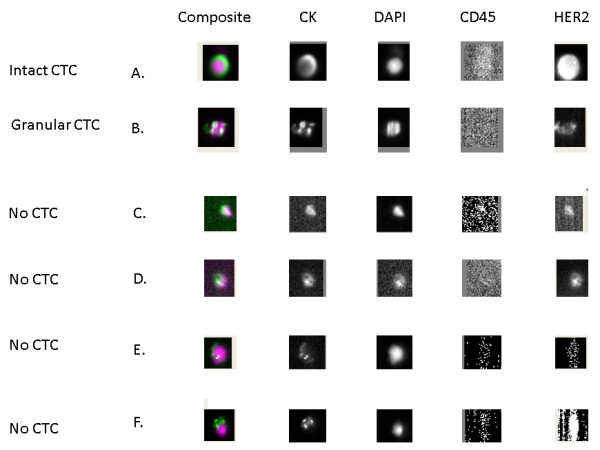
Methods: CellSearch® images (N = 272) of either CTCs or white blood cells or artifacts from 109 non-metastatic (M0) and 22 metastatic (M1) breast cancer patients from reported studies were sent to 22 readers from 15 academic laboratories and 8 readers from two Veridex laboratories. Each image was scored as No CTC vs CTC HER2- vs CTC HER2+. The 8 Veridex readers were summarized to a Veridex Consensus (VC) to compare each academic reader using % agreement and kappa (κ) statistics. Agreement was compared according to disease stage and CTC counts using the Wilcoxon signed rank test.
Results: For CTC definition (No CTC vs CTC), the median agreement between academic readers and VC was 92% (range 69 to 97%) with a median κ of 0.83 (range 0.37 to 0.93). Lower agreement was observed in images from M0 (median 91%, range 70 to 96%) compared to M1 (median 98%, range 64 to 100%) patients (P < 0.001) and from M0 and <3CTCs (median 87%, range 66 to 95%) compared to M0 and ≥3CTCs samples (median 95%, range 77 to 99%), (P < 0.001). For CTC HER2 expression (HER2- vs HER2+), the median agreement was 87% (range 51 to 95%) with a median κ of 0.74 (range 0.25 to 0.90).
Conclusions: The inter-reader agreement for CTC definition was high. Reduced agreement was observed in M0 patients with low CTC counts. Continuous training and independent image review are required.
Figures
References
Publication types
MeSH terms
Substances
Grants and funding
LinkOut - more resources
Full Text Sources
Other Literature Sources
Medical
Research Materials
Miscellaneous
