


Assessment of the quality of measures of child oral health-related quality of life
- PMID: 24758535
- PMCID: PMC4021173
- DOI: 10.1186/1472-6831-14-40
Assessment of the quality of measures of child oral health-related quality of life
Abstract
Background: Several measures of oral health-related quality of life have been developed for children. The most frequently used are the Child Perceptions Questionnaire (CPQ), the Child Oral Impacts on Daily Performances (C-OIDP) and the Child Oral Health Impact Profile (COHIP). The aim of this study was to assess the methodological quality of the development and testing of these three measures.
Methods: A systematic search strategy was used to identify eligible studies published up to December 2012, using both MEDLINE and Web of Science. Titles and abstracts were read independently by two investigators and full papers retrieved where the inclusion criteria were met. Data were extracted by two teams of two investigators using a piloted protocol. The data were used to describe the development of the measures and their use against existing criteria. The methodological quality and measurement properties of the measures were assessed using standards proposed by the Consensus-based Standards for the Selection of Health Measurement Instruments (COSMIN) group.
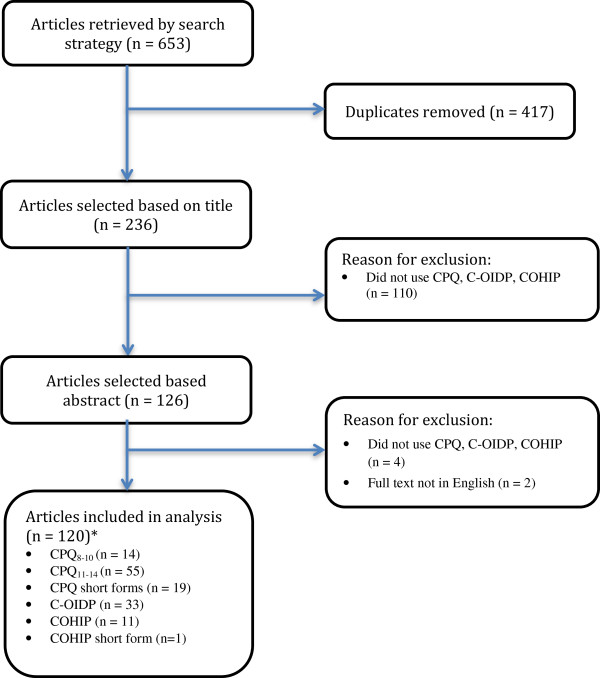
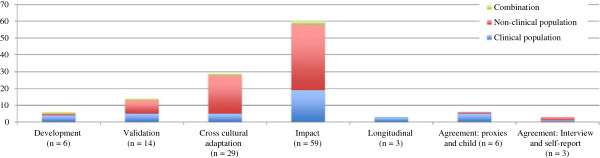
Results: The search strategy yielded 653 papers, of which 417 were duplicates. Following analysis of the abstracts, 119 papers met the inclusion criteria. The majority of papers reported cross-sectional studies (n = 117) with three of longitudinal design. Fifteen studies which had used the original version of the measures in their original language were included in the COSMIN analysis. The most frequently used measure was the CPQ. Reliability and construct validity appear to be adequate for all three measures. Children were not fully involved in item generation which may compromise their content validity. Internal consistency was measured using classic test theory with no evidence of modern psychometric techniques being used to test unidimensionality of the measures included in the COSMIN analysis.
Conclusion: The three measures evaluated appear to be able to discriminate between groups. CPQ has been most widely tested and several versions are available. COHIP employed a rigorous development strategy but has been tested in fewer populations. C-OIDP is shorter and has been used successfully in epidemiological studies. Further testing using modern psychometric techniques such as item response theory is recommended. Future developments should also focus on the development of measures which can evaluate longitudinal change.
Figures
References
-
- Patrick D, Guyatt G, Acquadro C. In: Cochrane Handbook for Systematic Reviews of Interventions. Version 5.0.1 (updated March 2011) Higgins J, Green S, editor. The Cochrane Collaboration; 2011. Chapter 17: Patient reported outcomes. Available from http://www.cochrane-handbook.org (Accessed on 8th April 2014)
-
- Engel GL. The need for a new medical model: a challenge for biomedicine. Science. 1977;196(4286):129–136. - PubMed
-
- Black N. Patient reported outcome measures could help transform healthcare. BMJ. 2013;346:f167. - PubMed
-
- Cushing AM, Sheiham A, Maizels J. Developing socio-dental indicators–the social impact of dental disease. Community Dent Health. 1986;3(1):3–17. - PubMed
Publication types
MeSH terms
Grants and funding
LinkOut - more resources
Full Text Sources
Other Literature Sources
Medical
Molecular Biology Databases
Miscellaneous
