


STI patients are effective recruiters of undiagnosed cases of HIV: results of a social contact recruitment study in Malawi
- PMID: 24759065
- PMCID: PMC3999477
- DOI: 10.1097/QAI.0000000000000066
STI patients are effective recruiters of undiagnosed cases of HIV: results of a social contact recruitment study in Malawi
Abstract
Background: Patients with newly diagnosed HIV may be part of social networks with elevated prevalence of undiagnosed HIV infection. Social network recruitment by persons with newly diagnosed HIV may efficiently identify undiagnosed cases of HIV infection. We assessed social network recruitment as a strategy for identifying undiagnosed cases of HIV infection.
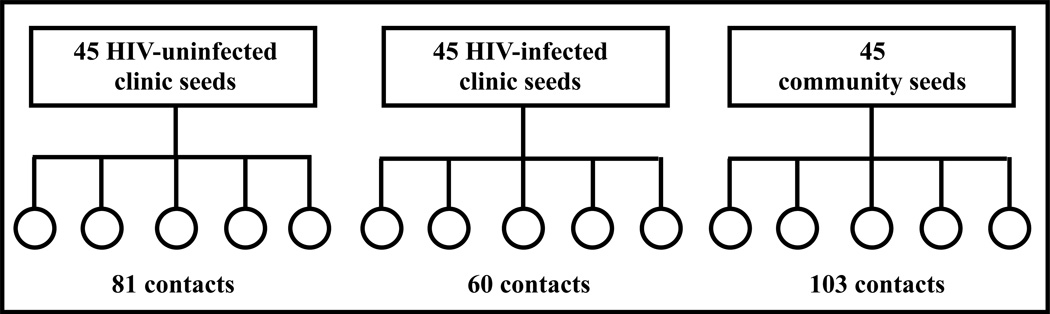
Methods: In a sexually transmitted infection (STI) clinic in Lilongwe, Malawi, 3 groups of 45 "seeds" were enrolled: STI patients with newly diagnosed HIV, STI patients who were HIV-uninfected, and community controls. Seeds were asked to recruit up to 5 social "contacts" (sexual or nonsexual). Mean number of contacts recruited per group was calculated. HIV prevalence ratios (PRs) and number of contacts needed to test to identify 1 new case of HIV were compared between groups using generalized estimating equations with exchangeable correlation matrices.
Results: Mean number of contacts recruited was 1.3 for HIV-infected clinic seeds, 1.8 for HIV-uninfected clinic seeds, and 2.3 for community seeds. Contacts of HIV-infected clinic seeds had a higher HIV prevalence (PR: 3.2, 95% confidence interval: 1.3 to 7.8) than contacts of community seeds, but contacts of HIV-uninfected clinic seeds did not (PR: 1.1, 95% confidence interval: 0.4 to 3.3). Results were similar when restricted to nonsexual contacts. To identify 1 new case of HIV, it was necessary to test 8 contacts of HIV-infected clinic seeds, 10 contacts of HIV-uninfected clinic seeds, and 18 contacts of community seeds.
Conclusions: Social contact recruitment by newly diagnosed STI patients efficiently led to new HIV diagnoses. Research to replicate findings and guide implementation is needed.
Figures
References
-
- Granich RM, Gilks CF, Dye C, et al. Universal voluntary HIV testing with immediate antiretroviral therapy as a strategy for elimination of HIV transmission: a mathematical model. Lancet. 2009 Jan 3;373(9657):48–57. - PubMed
-
- WHO, UNAIDS, UNICEF. HIV Testing and Counseling. Towards Universal Access: Scaling up Priority HIV/AIDS Interventions in the Health Sector, Progress Report 2010
-
- Macro International. Malawi Demographic and Health Survey 2010. Zomba, Malawi and Calverton, Maryland, USA: 2011.
-
- Marks G, Crepaz N, Senterfitt JW, et al. Meta-analysis of high-risk sexual behavior in persons aware and unaware they are infected with HIV in the United States: implications for HIV prevention programs. J Acquir Immune Defic Syndr. 2005 Aug 1;39(4):446–453. - PubMed
Publication types
MeSH terms
Grants and funding
- T32 AI007001-34/AI/NIAID NIH HHS/United States
- T32 AI007001/AI/NIAID NIH HHS/United States
- R25 TW009340/TW/FIC NIH HHS/United States
- P30 AI50410/AI/NIAID NIH HHS/United States
- F30 MH098731-01/MH/NIMH NIH HHS/United States
- R24 TW007988/TW/FIC NIH HHS/United States
- R01 AI083059/AI/NIAID NIH HHS/United States
- T32 GM008719/GM/NIGMS NIH HHS/United States
- 5-R01 AI083059-03/AI/NIAID NIH HHS/United States
- P30 AI050410/AI/NIAID NIH HHS/United States
- R24 HD050924/HD/NICHD NIH HHS/United States
- F30 MH098731/MH/NIMH NIH HHS/United States
LinkOut - more resources
Full Text Sources
Other Literature Sources
Medical
Research Materials
