


The cognitive mechanisms of the SNARC effect: an individual differences approach
- PMID: 24760048
- PMCID: PMC3997411
- DOI: 10.1371/journal.pone.0095756
The cognitive mechanisms of the SNARC effect: an individual differences approach
Abstract
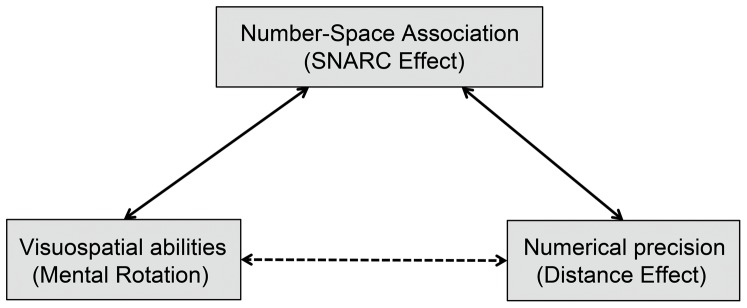
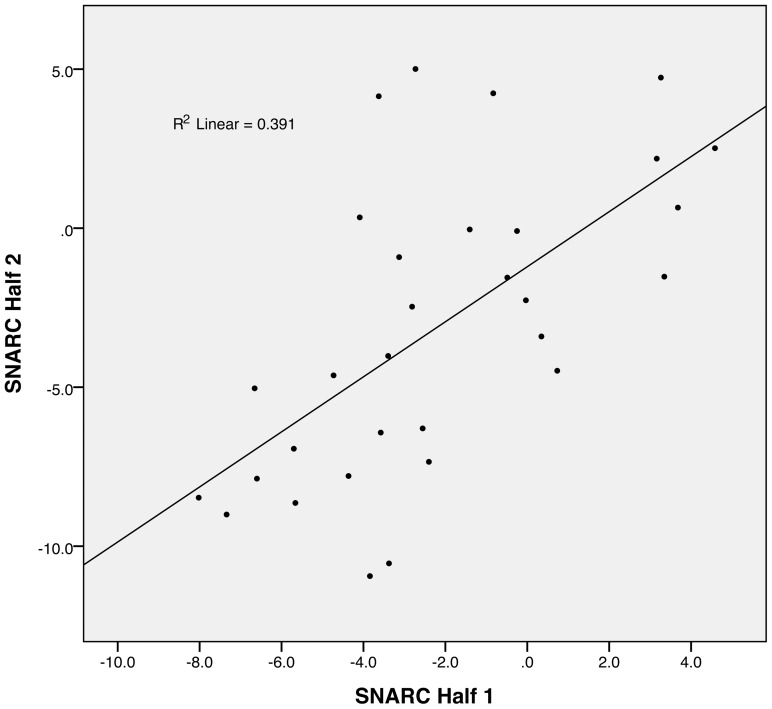
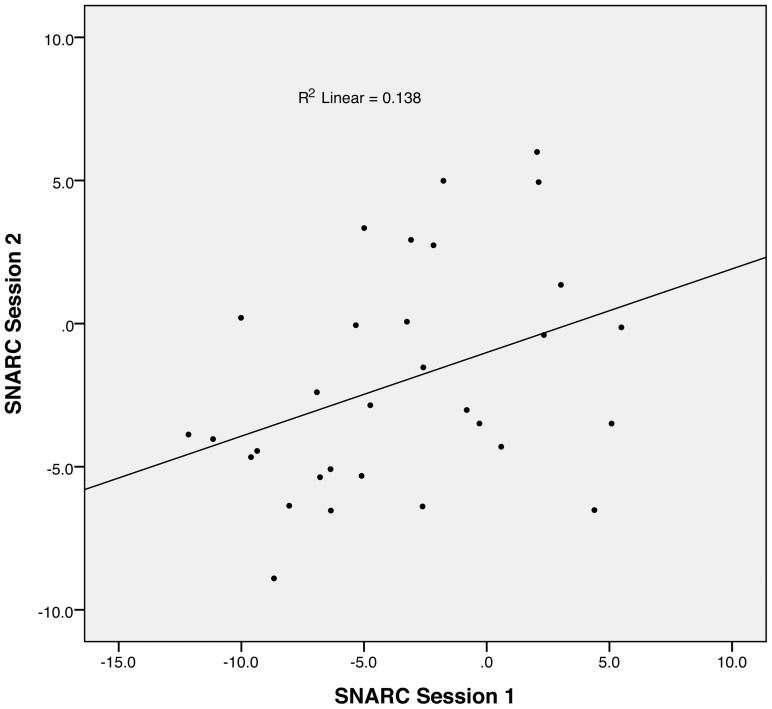
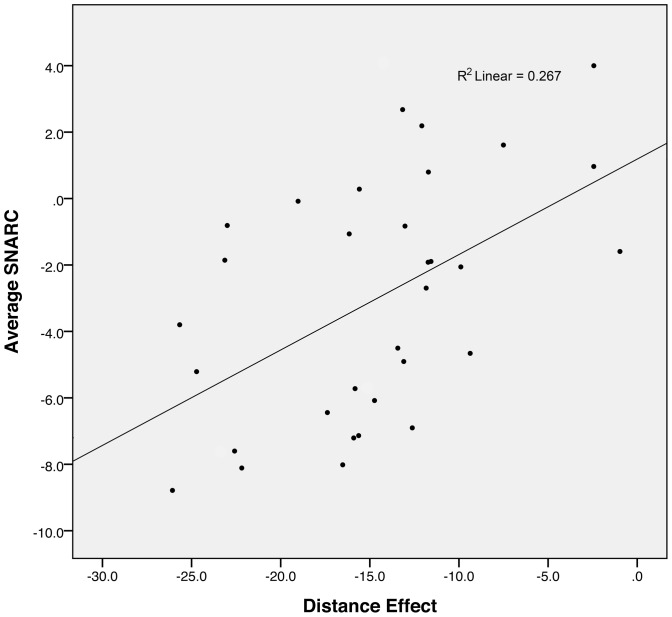
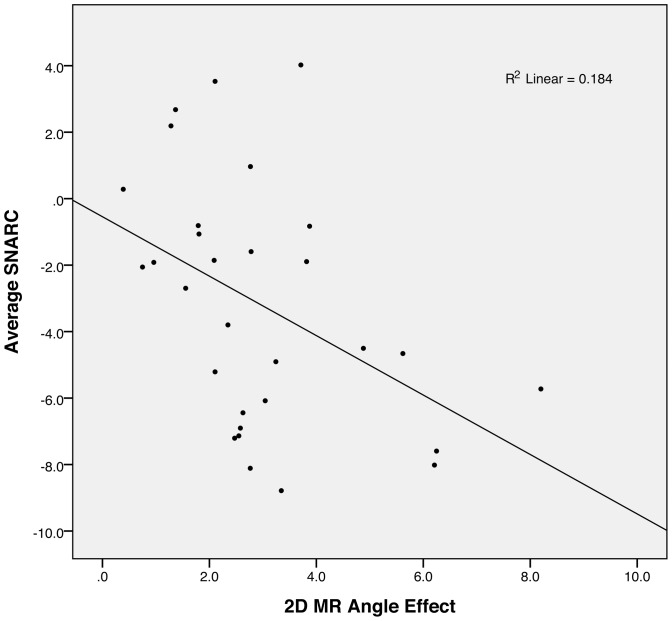
Access to mental representations of smaller vs. larger number symbols is associated with leftward vs. rightward spatial locations, as represented on a number line. The well-replicated SNARC effect (Spatial-Numerical Association of Response Codes) reveals that simple decisions about small numbers are facilitated when stimuli are presented on the left, and large numbers facilitated when on the right. We present novel evidence that the size of the SNARC effect is relatively stable within individuals over time. This enables us to take an individual differences approach to investigate how the SNARC effect is modulated by spatial and numerical cognition. Are number-space associations linked to spatial operations, such that those who have greater facility in spatial computations show the stronger SNARC effects, or are they linked to number semantics, such that those showing stronger influence of magnitude associations on number symbol decisions show stronger SNARC effects? Our results indicate a significant correlation between the SNARC effect and a 2D mental rotation task, suggesting that spatial operations are at play in the expression of this effect. We also uncover a significant correlation between the SNARC effect and the distance effect, suggesting that the SNARC is also related to access to number semantics. A multiple regression analysis reveals that the relative contributions of spatial cognition and distance effects represent significant, yet distinct, contributions in explaining variation in the size of the SNARC effect from one individual to the next. Overall, these results shed new light on how the spatial-numerical associations of response codes are influenced by both number semantics and spatial operations.
Conflict of interest statement
Figures
References
-
- Dehaene S, Bossini S, Giraux P (1993) The mental representation of parity and number magnitude. Journal of Experimental Psychology: General 122: 371–396.
-
- Zebian S (2005) Linkages between number concepts, spatial thinking, and directionality of writing: The SNARC Effect and the REVERSE SNARC Effect in English and Arabic Monoliterates, Biliterates, and Illiterate Arabic Speakers. Journal of Cognition & Culture 5(1–2): 165–190.
-
- Shaki S, Fischer MH, Petrusic WM (2009) Reading habits for both words and numbers contribute to the SNARC effect. Psychonomic Bulletin & Review 16(2): 328–331. - PubMed
-
- Fias W, Fischer MH (2005) Spatial representation of numbers. In J.I.D. Campbell (Ed.) Handbook of Mathematical Cognition. Hove: Psychology Press43–54.
-
- Hubbard EM, Piazza M, Pinel P, Dehaene S (2005) Interactions between number and space in parietal cortex. Nature Reviews Neuroscience 6(6): 435–448. - PubMed
Publication types
MeSH terms
LinkOut - more resources
Full Text Sources
Other Literature Sources
