. 2013 Dec;9(4):324-332.
doi: 10.2174/157340720904140404151439.

Comparison of Artemisia annua Bioactivities between Traditional Medicine and Chemical Extracts

Affiliations
Free PMC article

Comparison of Artemisia annua Bioactivities between Traditional Medicine and Chemical Extracts

Ahmed Nageeb et al. Curr Bioact Compd. 2013 Dec.
Free PMC article

Abstract

The present work investigates the efficacy of using Artemisia annua in traditional medicine in comparison with chemical extracts of its bioactive molecules. In addition, the effects of location (Egypt and Jericho) on the bioactivities of the plant were investigated. The results showed that water extracts of Artemisia annua from Jericho have stronger antibacterial activities than organic solvent extracts. In contrast, water and organic solvent extracts of the Artemisia annua from Egypt do not have anti-bacterial activity. Furthermore, while the methanol extract of EA displayed high anticancer affects, the water extract of Egypt and the extracts of Jericho did not show significant anticancer activity. Finally, the results showed that the methanol and water extracts of Jericho had the highest antioxidant activity, while the extracts of Egypt had none. The current results validate the scientific bases for the use of Artemisia annua in traditional medicine. In addition, our results suggest that the collection location of the Artemisia annua has an effect on its chemical composition and bioactivities.

Keywords: Artemisia; NMR; antibacterial; anticancer.; bioactivities.


Figures
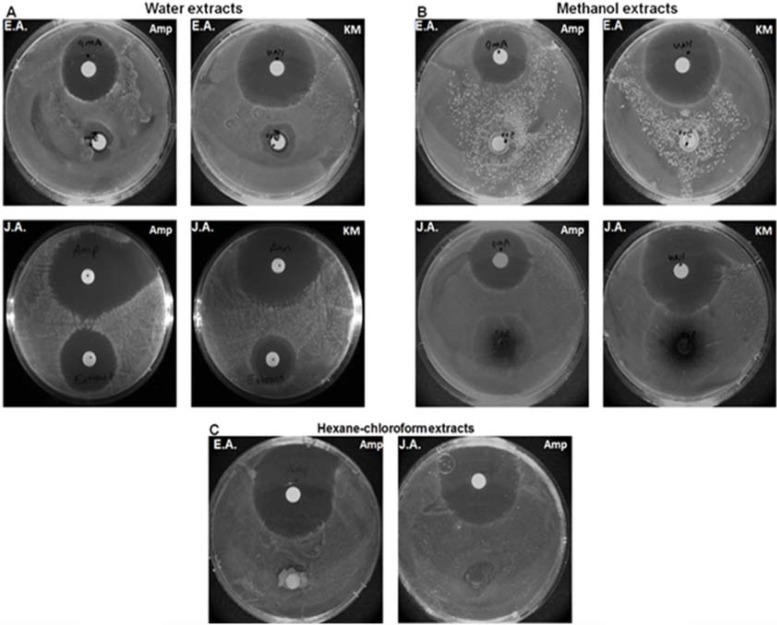
Fig. (1)
Fig. (1)
A disk diffusion assay to test the Antibacterial Activity of Egyptian Artemisia, EA and Jericho Artemisia, JA extracts. Filter paper (Whatman) disks were soaked in A. EA and JA leaves’ water extracts (500mg/ml), B. EA and JA leaves’ methanol extracts (500mg/ ml), C. EA and JA leaves’ Hexane-chloroform extracts (500mg/ml), and in Ampicillin (100 mg/ml) and Kanamycin (25 ug/ ml) as positive controls for 12 hours. In all cases, disks were applied separately, each extract with a positive control, to Escherichia coli agar plates and incubated for 24 hours at 37C°.
Fig. (2)
Fig. (2)
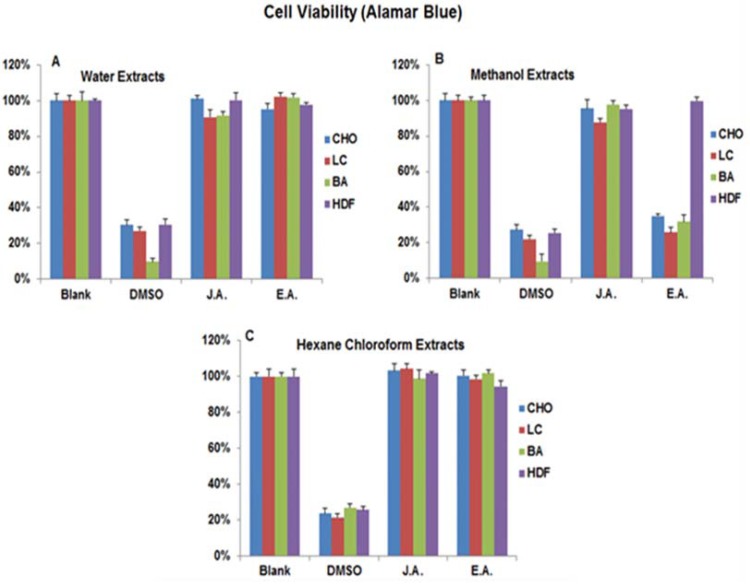
Cell viability assay to test the Anti-cancer Activity of Egyptian Artemisia, EA and Jericho Artemisia, JA extracts. Human Breast Adenocarcinoma MCF7 (BA), Human Lung Carcinoma (LC) and Chinese Hamster Ovary (CHO) cell lines and Primary Human Dermal Fibroblasts isolated from adult skin (HDFa) cells were used. 104 cells /ml of each cell type was incubated separately with A. EA and JA leaves’ water extracts (500mg/ml), B. EA and JA leaves’ methanol extracts (500mg/ ml), C. EA and JA leaves’ hexane-chloroform extracts (500mg/ml), and 70% DMSO in the growth media as positive control. Alamar Blue® reagent was used to determine the cell viability percentages. Readings were taken using the micro plate spectrophotometer (Absorbance at 570 nm and 600 nm wavelengths).
Fig. (3)
Fig. (3)
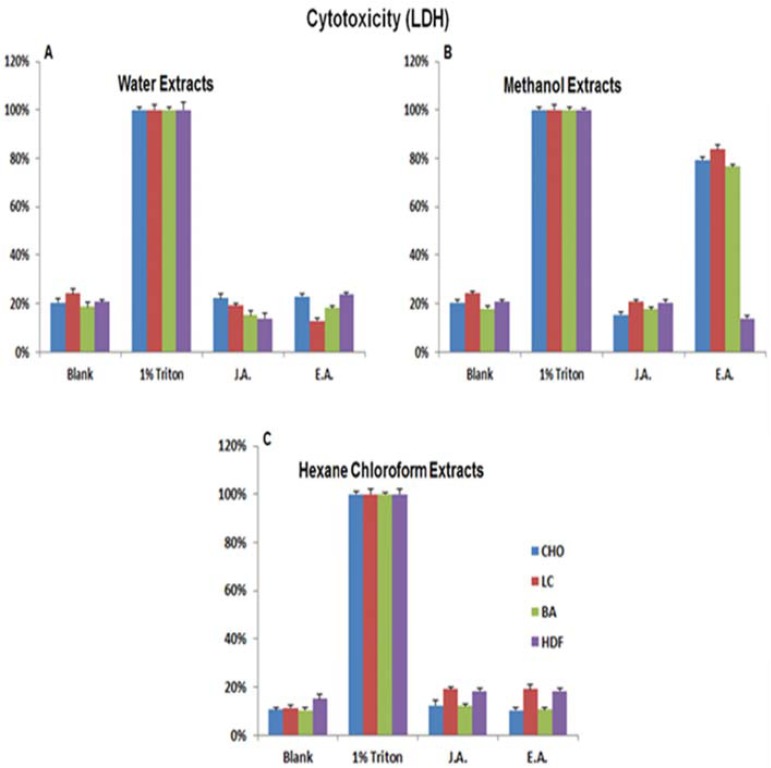
Cytotoxicity Assay (LDH) to test the Anti-cancer Activity of Egyptian Artemisia, EA and Jericho Artemisia, JA extracts. Human Breast Adenocarcinoma MCF7 (BA), Human Lung Carcinoma (LC) and Chinese Hamster Ovary (CHO) cell lines and Primary Human Dermal Fibroblasts isolated from adult skin (HDFa) cells were used. 104 cells /ml of each cell type was incubated separately with A. EA and JA leaves’ water extracts (500mg/ml), B. EA and JA leaves’ methanol extracts (500mg/ ml), C. EA and JA leaves’ Hexane-chloroform extracts (500mg/ml), and 1% Triton X-100 in growth media as positive control. LDH Cytotoxicity Detection Kit was used to determine the cell viability percentages. Readings were taken using the micro plate spectrophotometer (Absorbance at 492 nm wavelengths).
Fig. (4)
Fig. (4)
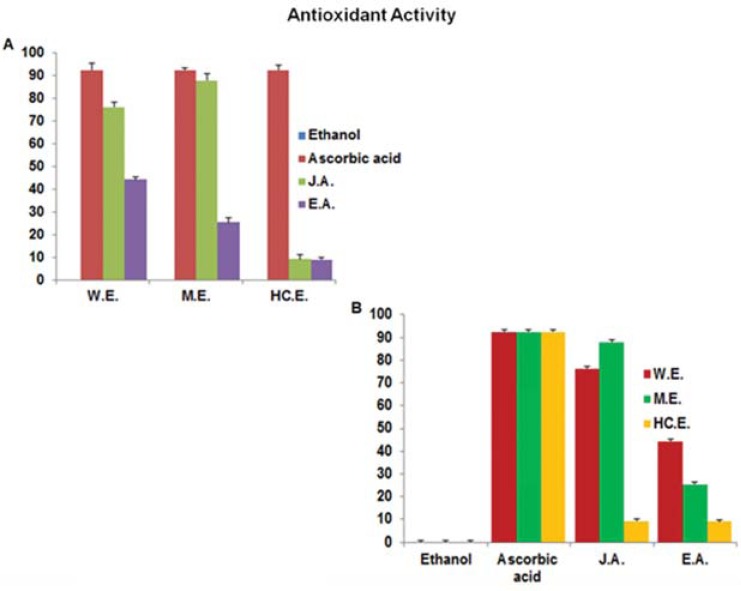
Antioxidant Activity to test the Anti-Inflammation Activity of Egyptian Artemisia, EA and Jericho Artemisia, JA extracts. Dry residues of EA and JA leaves’ water, methanol and hexane-chloroform extracts were resolved in absolute ethanol to a final concentration of (500mg/ml). A concentration of 50 µg/ml of ascorbic acid in absolute ethanol was used as a positive control. Absolute ethanol was used as negative control. Particles of 1, 1-diphenyl-2-picryl-hydrazyl (DPPH) was used to test for the antioxidant activity of the extracts. Readings were taken using the micro plate spectrophotometer (Absorbance at 517 nm wavelengths). Results were blotted according to A. Type of extract, B. Type of plant and controls.
Fig. (5)
Fig. (5)
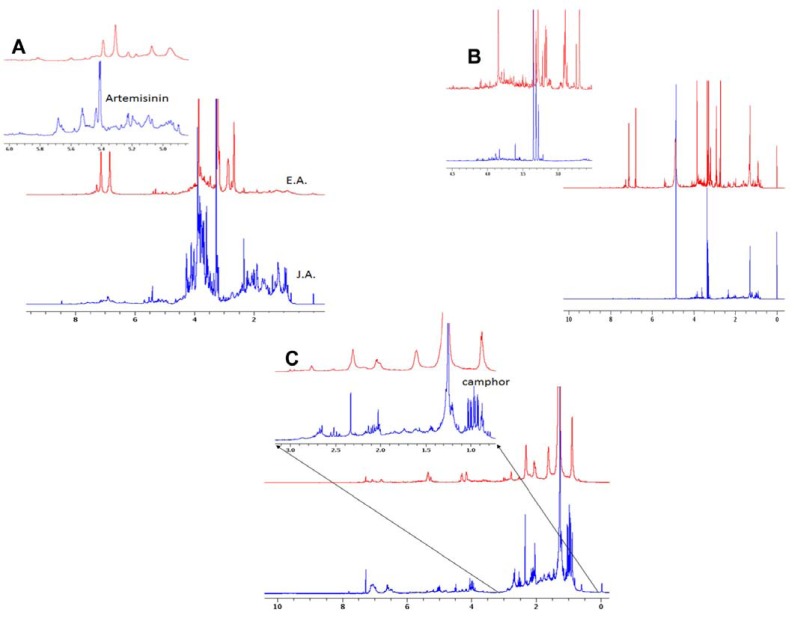
NMR analyses of the chemical compositions of the Hexane-chloroform, Methanol and Water extracts of both JA and EA A. The NMR spectrum of the JA and EA water extracts. B. The NMR spectrum of the JA and EA Hexane-chloroform extracts. C. The NMR spectrum of the JA and EA Methanol extracts.

References

    1. Bora K S, Sharma A. The genus Artemisia: a comprehensive review. Pharmaceutical Biology. 2011;49(1):101–109. - PubMed
    1. Tan R, Zheng W, Tang H. Biologically active substances from the genus Artemisia. Planta Medica-Natural Products and Medicinal Plant Research. 1998;64 (4):295–302. - PubMed
    1. Genovese R F, Newman D B. Understanding artemisinin-induced brainstem neurotoxicity. Archives of toxicology. 2008;82(6):379–385. - PubMed
    1. Bora K S, Sharma A. Neuroprotective effect of Artemisia absinthium L.on focal ischemia and reperfusion-induced cerebral injury. Journal of ethnopharmacology. 2010;129 (3):403–409. - PubMed
    1. Obanda DN, Hernandez A, Ribnicky D, Yu Y, Zhang XH, Wang ZQ, Cefalu WT. Bioactives of Artemisia dracunculus L.Mitigate the Role of Ceramides in Attenuating Insulin Signaling in Rat Skeletal Muscle Cells. Diabetes. 2012;61(3):597–605. - PMC - PubMed

LinkOut - more resources