Clinical significance of type I endoleak on completion angiography
- PMID: 24761415
- PMCID: PMC3994602
- DOI: 10.4174/astr.2014.86.2.95
Clinical significance of type I endoleak on completion angiography
Abstract
Purpose: Type I endoleak is known to be associated with sac enlargement and occasional rupture, therefore, the treatment of type I endoleak is recommended at the time of diagnosis. The aim of this study was to identify the significance of early type I endoleak found on completion angiography.
Methods: Between January 2000 and December 2012, a total of 86 patients underwent endovascular abdominal aortic aneurysm repair (EVAR) and 10 patients (11.6%) were diagnosed with type Ia endoleak on completion angiography. Clinical and radiologic data were reviewed retrospectively.
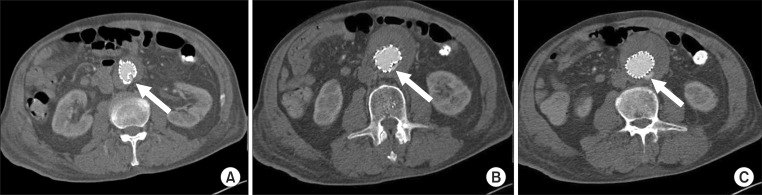
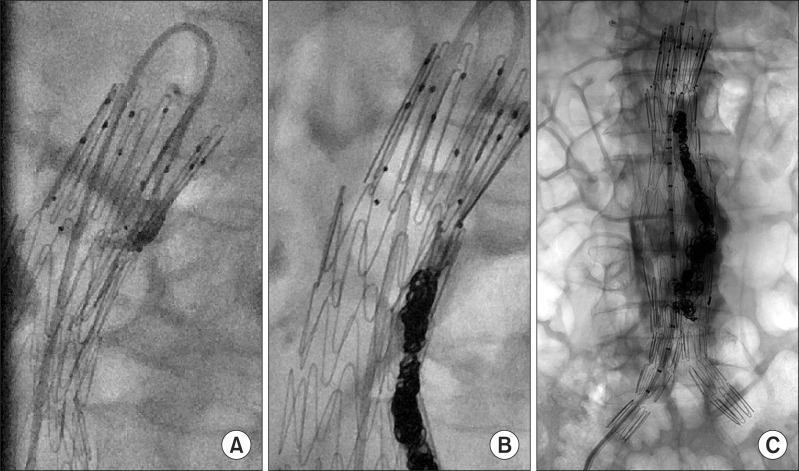
Results: Of the 10 patients, two underwent EVAR with custom-made stent-grafts in the initial stage and both of them needed immediate treatment: one case involved open repair while the other involved insertion of an additional stent-graft. In 8 patients, the amount of leakage decreased after repeated balloon molding. They were managed conservatively and followed up with computed tomography angiography within 2 weeks after EVAR. In 7 of the 8 cases, type Ia endoleaks disappeared. In one patient with a persistent endoleak and a folded posterior wall of the stent-graft, coil embolization was performed 1 week after EVAR. With a median follow-up of 12 months (range, 1-61 months), no patients showed recurrence of type I endoleak or sac expansion.
Conclusion: Type I endoleaks diagnosed on completion angiography sealed spontaneously in 7 of 10 patients (70.0%). In cases of decreased amounts of leakage after balloon molding, simple observation may be an alternative to repetitive procedures. The long-term follow-up of patients with self-sealed type I endoleaks is mandatory.
Keywords: Abdominal aortic aneurysm; Endoleak; Endovascular aneurysm repair.
Conflict of interest statement
No potential conflict of interest relevant to this article was reported.
Figures
References
-
- Patel VI, Lancaster RT, Mukhopadhyay S, Aranson NJ, Conrad MF, LaMuraglia GM, et al. Impact of chronic kidney disease on outcomes after abdominal aortic aneurysm repair. J Vasc Surg. 2012;56:1206–1213. - PubMed
-
- EVAR trial participants. Endovascular aneurysm repair versus open repair in patients with abdominal aortic aneurysm (EVAR trial 1): randomised controlled trial. Lancet. 2005;365:2179–2186. - PubMed
-
- EVAR trial participants. Endovascular aneurysm repair and outcome in patients unfit for open repair of abdominal aortic aneurysm (EVAR trial 2): randomised controlled trial. Lancet. 2005;365:2187–2192. - PubMed
-
- Pitoulias GA, Schulte S, Donas KP, Horsch S. Secondary endovascular and conversion procedures for failed endovascular abdominal aortic aneurysm repair: can we still be optimistic? Vascular. 2009;17:15–22. - PubMed
-
- Mehta M, Sternbach Y, Taggert JB, Kreienberg PB, Roddy SP, Paty PS, et al. Long-term outcomes of secondary procedures after endovascular aneurysm repair. J Vasc Surg. 2010;52:1442–1449. - PubMed
LinkOut - more resources
Full Text Sources
Other Literature Sources