


Vascular calcification in patients with type 2 diabetes: the involvement of matrix Gla protein
- PMID: 24762216
- PMCID: PMC4017083
- DOI: 10.1186/1475-2840-13-85
Vascular calcification in patients with type 2 diabetes: the involvement of matrix Gla protein
Erratum in
-
Erratum: Vascular calcification in patients with type 2 diabetes: the involvement of matrix Gla protein.Cardiovasc Diabetol. 2015 Jan 24;14:9. doi: 10.1186/s12933-014-0164-1. Cardiovasc Diabetol. 2015. PMID: 25645444 Free PMC article. No abstract available.
Abstract
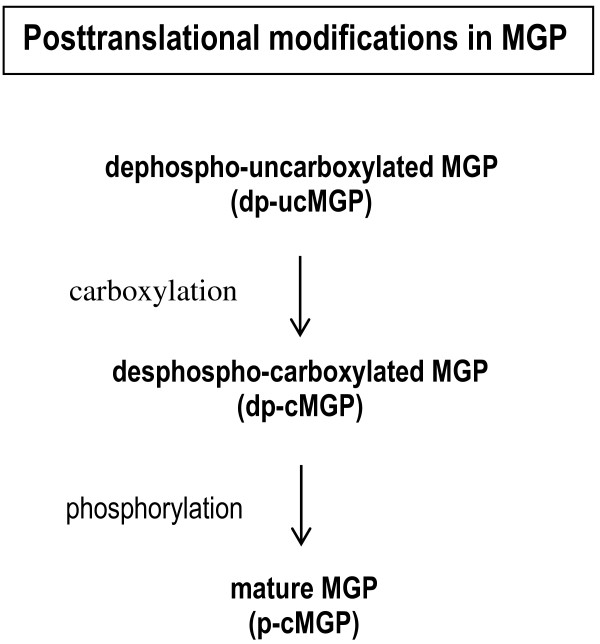
Background: Matrix Gla protein (MGP) is an important inhibitor of calcification. The objective of the present study of patients with type 2 diabetes and normal or slightly altered kidney function was to evaluate levels of inactive, dephospho-uncarboxylated MGP(dp-ucMGP) and total uncarboxylated MGP(t-ucMGP) and assess their links with biological and clinical parameters (including peripheral vascular calcification).
Methods: The DIACART study is a cross-sectional cohort study of 198 patients with type 2 diabetes and normal or slightly altered kidney function. Matrix Gla protein levels were measured with an ELISA and all patients underwent multislice spiral computed tomography scans to score below-knee arterial calcification.
Results: In the study population as a whole, the mean dp-ucMGP and t-ucMGP levels were 627 ± 451 pM and 4868 ± 1613 nM, respectively. Glomerular filtration rate, age and current vitamin K antagonist use were independently associated with dp-ucMGP levels. When the study population was divided according to the median peripheral arterial calcification score, patients with the higher score displayed significantly lower t-ucMGP and significantly higher dp-ucMGP levels. Furthermore, plasma dp-ucMGP was positively associated with the peripheral arterial calcification score (independently of age, gender, previous cardiovascular disease and t-ucMGP levels).
Conclusions: High dp-ucMGP levels were independently associated with below-knee arterial calcification score in patients with type 2 diabetes and normal or slightly altered kidney function. The reversibility of the elevation of dp-ucMGP levels and the latter's relationship with clinical events merit further investigation.
Figures
Comment in
-
Erratum: Vascular calcification in patients with type 2 diabetes: the involvement of matrix Gla protein.Cardiovasc Diabetol. 2015 Jan 24;14:9. doi: 10.1186/s12933-014-0164-1. Cardiovasc Diabetol. 2015. PMID: 25645444 Free PMC article. No abstract available.
References
-
- Kronmal RA, McClelland RL, Detrano R, Shea S, Lima JA, Cushman M, Bild DE, Burke GL. Risk factors for the progression of coronary artery calcification in asymptomatic subjects: results from the Multi-Ethnic Study of Atherosclerosis (MESA) Circulation. 2007;115(21):2722–2730. doi: 10.1161/CIRCULATIONAHA.106.674143. - DOI - PubMed
-
- Rossi A, Targher G, Zoppini G, Cicoira M, Bonapace S, Negri C, Stoico V, Faggiano P, Vassanelli C, Bonora E. Aortic and mitral annular calcifications are predictive of all-cause and cardiovascular mortality in patients with type 2 diabetes. Diabetes Care. 2012;35(8):1781–1786. doi: 10.2337/dc12-0134. - DOI - PMC - PubMed
Publication types
MeSH terms
Substances
LinkOut - more resources
Full Text Sources
Other Literature Sources
Medical
Miscellaneous
