Adherence barriers to chronic dialysis in the United States
- PMID: 24762400
- PMCID: PMC4214530
- DOI: 10.1681/ASN.2013111160
Adherence barriers to chronic dialysis in the United States
Abstract
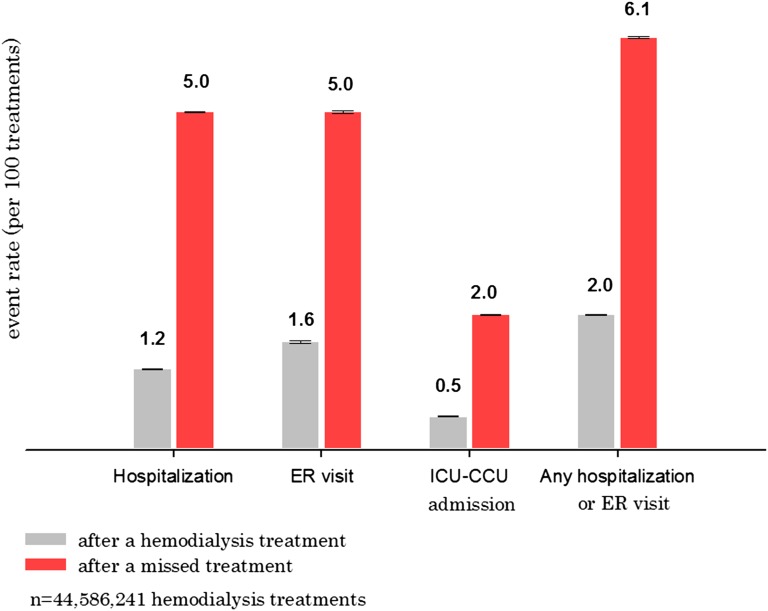
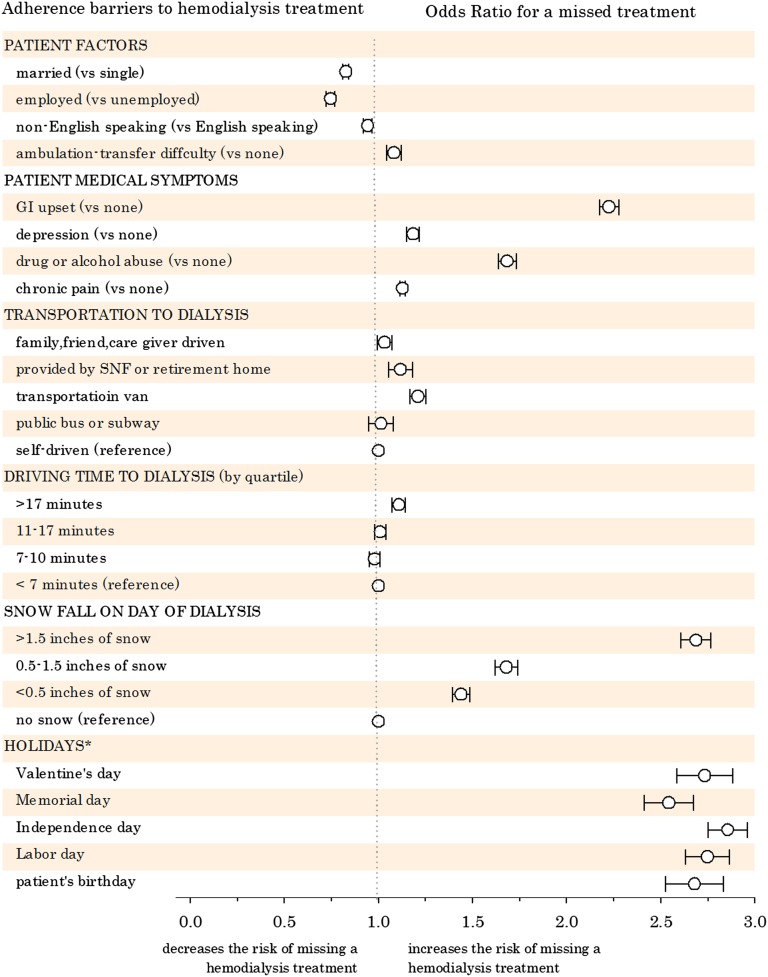
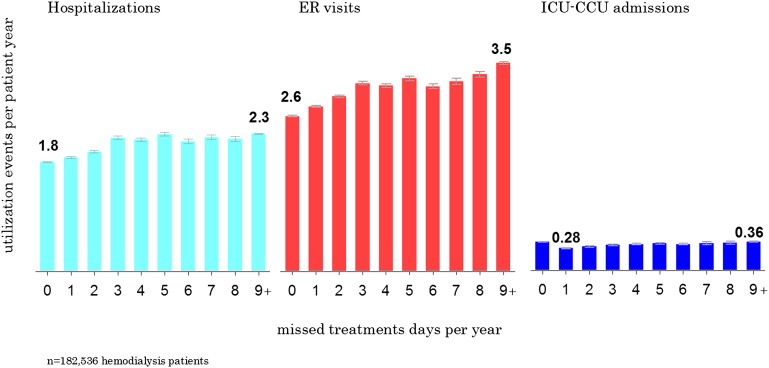
Hemodialysis patients often do not attend their scheduled treatment session. We investigated factors associated with missed appointments and whether such nonadherence poses significant harm to patients and increases overall health care utilization in an observational analysis of 44 million hemodialysis treatments for 182,536 patients with ESRD in the United States. We assessed the risk of hospitalization, emergency room visit, or intensive-coronary care unit (ICU-CCU) admission in the 2 days after a missed treatment relative to the risk for patients who received hemodialysis. Over the 5-year study period, the average missed treatment rate was 7.1 days per patient-year. In covariate adjusted logistic regression, the risk of hospitalization (odds ratio [OR], 3.98; 95% confidence interval [95% CI], 3.93 to 4.04), emergency room visit (OR, 2.00; 95% CI, 1.87 to 2.14), or ICU-CCU admission (OR, 3.89; 95% CI, 3.81 to 3.96) increased significantly after a missed treatment. Overall, 0.9 missed treatment days per year associated with suboptimal transportation to dialysis, inclement weather, holidays, psychiatric illness, pain, and gastrointestinal upset. These barriers also associated with excess hospitalization (5.6 more events per patient-year), emergency room visits (1.1 more visits), and ICU-CCU admissions (0.8 more admissions). In conclusion, poor adherence to hemodialysis treatments may be a substantial roadblock to achieving better patient outcomes. Addressing systemic and patient barriers that impede access to hemodialysis care may decrease missed appointments and reduce patient morbidity.
Copyright © 2014 by the American Society of Nephrology.
Figures
References
-
- Weissman JS, Gatsonis C, Epstein AM: Rates of avoidable hospitalization by insurance status in Massachusetts and Maryland. JAMA 268: 2388–2394, 1992 - PubMed
-
- Saran R, Bragg-Gresham JL, Rayner HC, Goodkin DA, Keen ML, Van Dijk PC, Kurokawa K, Piera L, Saito A, Fukuhara S, Young EW, Held PJ, Port FK: Nonadherence in hemodialysis: Associations with mortality, hospitalization, and practice patterns in the DOPPS. Kidney Int 64: 254–262, 2003 - PubMed
-
- National Weather Service: National Weather Service website. Available at: http://www.ncdc.noaa.gov/oa/climate/ghcn-daily/. Accessed May 31, 2013
Publication types
MeSH terms
LinkOut - more resources
Full Text Sources
Other Literature Sources
Medical