


Interleukin 33: a switch-hitting cytokine
- PMID: 24762410
- PMCID: PMC4118594
- DOI: 10.1016/j.coi.2014.03.004
Interleukin 33: a switch-hitting cytokine
Abstract
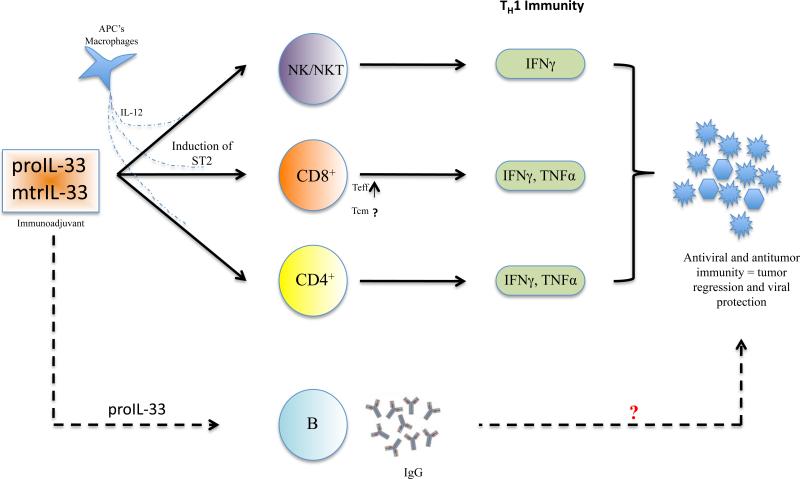
For many years IL-33 has been widely studied in the context of T helper type 2 (Th2)-driven inflammatory disorders. Interestingly, IL-33 has now emerged as a cytokine with a plethora of pleiotropic properties. Depending on the immune cells targeted by IL-33, it is reported to not only promote Th2 immunity, but also to induce T helper type 1 (Th1) immunity. Furthermore, recent studies have revealed that IL-33 can activate CD8(+) T cells. These new studies provide evidence for its beneficial role in antiviral and antitumor immunity. Here we review the evidence of IL-33 to drive protective T cell immunity plus its potential use as an adjuvant in vaccination and tumor therapy.
Copyright © 2014 Elsevier Ltd. All rights reserved.
Figures
References
-
- Onda H, Kasuya H, Takakura K, Hori T, Imaizumi T, Takeuchi T, Inoue I, Takeda J. Identification of genes differentially expressed in canine vasospastic cerebral arteries after subarachnoid hemorrhage. J Cereb Blood Flow Metab. 1999;19:1279–1288. - PubMed
-
- Schmitz J, Owyang A, Oldham E, Song Y, Murphy E, McClanahan TK, Zurawski G, Moshrefi M, Qin J, Li X, et al. IL-33, an interleukin-1-like cytokine that signals via the IL-1 receptor-related protein ST2 and induces T helper type 2-associated cytokines. Immunity. 2005;23:479–490. [The first study that identified IL-33.] - PubMed
-
- Xu D, Chan WL, Leung BP, Huang Fp, Wheeler R, Piedrafita D, Robinson JH, Liew FY. Selective expression of a stable cell surface molecule on type 2 but not type 1 helper T cells. J Exp Med. 1998;187:787–94. [The first study to show that selective expression of ST2 on TH2, but not TH1 cells.] - PMC - PubMed
Publication types
MeSH terms
Substances
Grants and funding
LinkOut - more resources
Full Text Sources
Other Literature Sources
Research Materials
