


Review
doi: 10.1038/nn.3693.
Epub 2014 Apr 25.
More than a rhythm of life: breathing as a binder of orofacial sensation
Affiliations
- PMID: 24762718
- PMCID: PMC4140942
- DOI: 10.1038/nn.3693
Item in Clipboard
Review
More than a rhythm of life: breathing as a binder of orofacial sensation
Nat Neurosci.
2014 May.
Abstract
When rodents engage in the exploration of novel stimuli, breathing occurs at an accelerated rate that is synchronous with whisking. We review the recently observed relationships between breathing and the sensations of smell and vibrissa-based touch. We consider the hypothesis that the breathing rhythm serves not only as a motor drive signal, but also as a common clock that binds these two senses into a common percept. This possibility may be extended to include taste through the coordination of licking with breathing. Here we evaluate the status of experimental evidence that pertains to this hypothesis.
Figures
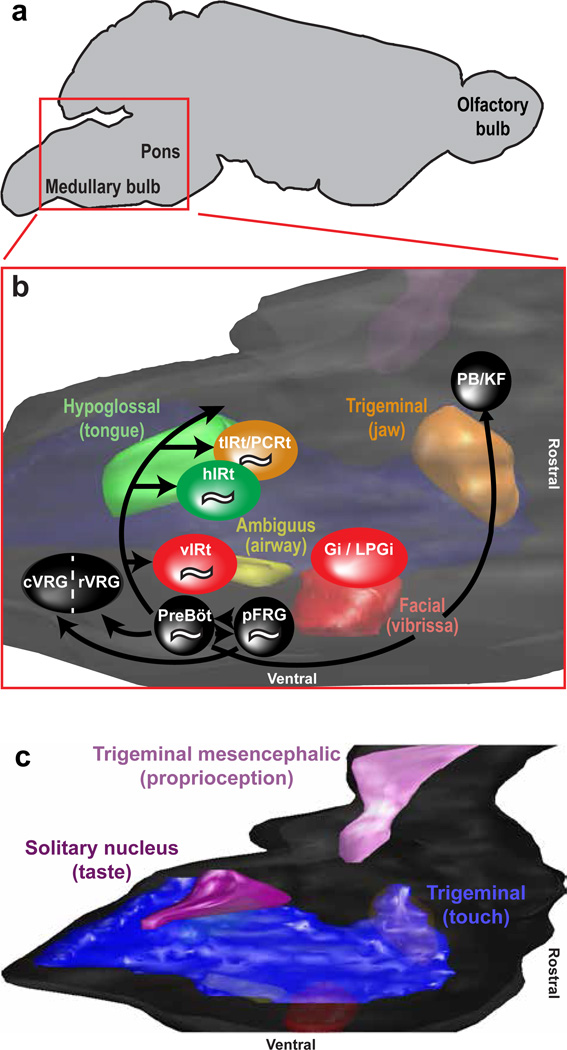
(a) Sagittal view that shows the locus of olfactory input through the olfactory bulb at the rostral role and the locus of touch, texture, and taste orofacial input though the pons and medullary bulb. The motor areas for all of these active senses are located in the medulla. (b) Three-dimensional reconstruction of the medulla and pons that shows the pools of cranial motoneurons that control the jaws (orange), face and vibrissa (red), airway (yellow), and tongue (green) as background, while the approximate locations of known premotor nuclei to each of the motoneuron pools are color coded according to the primary motor nucleus that they innervate. Breathing-related regions are shown in black. The putative neuronal oscillators that generate breathing (black), whisking (red), licking (green), and chewing (orange) are marked with a “~”. Summarized from references , –, and –. Abbreviations: parvocellular reticular formation (PCRt), caudal and rostral ventral respiratory groups (cVRG and rVRG, respectively), trigeminal, hypoglossal and vibrissa intermediate reticular formation (tIRt, hIRt, and vIRt, respectively), preBötzinger complex (PreBöt), parafacial respiratory group (pFRG), gigantocellular reticular formation (Gi), lateral paragigantocellular reticular formation (LPGi), and parabrachial and Kölliker-Fuse (PB and KF, respectively). (c) Three-dimensional reconstruction of the medulla and pons to highlight nuclei that receive primary sensory inputs. Cutaneous inputs from the face innervate the trigeminal sensory nuclei (blue), proprioceptive innervation of the jaw muscles arises from cells in the trigeminal mesencephalic nucleus (pink), and gustatory inputs from the tongue innervate the solitary nucleus (magenta).
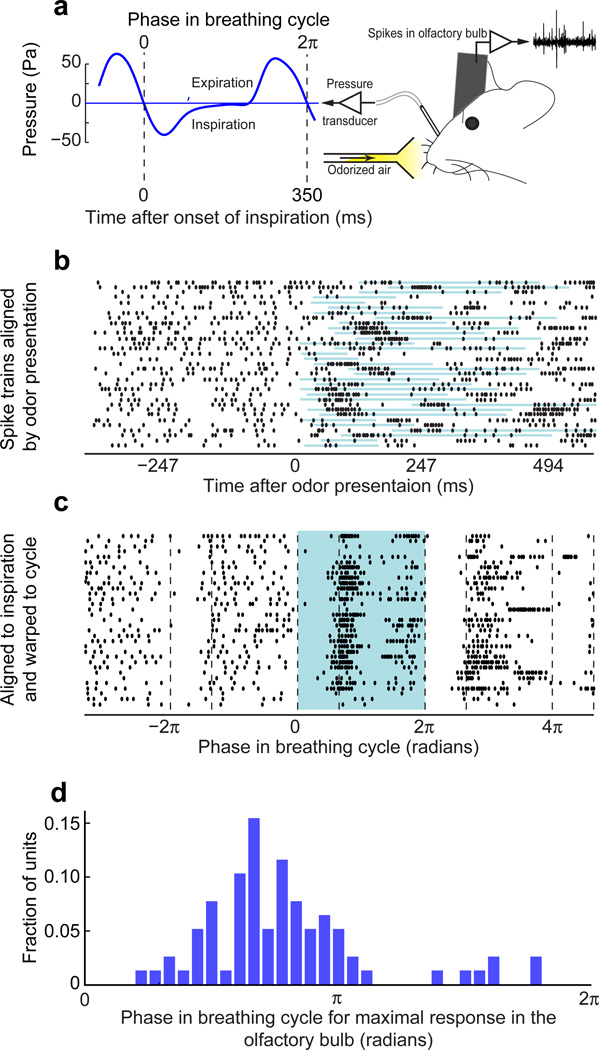
(a) An odor delivery port was positioned in front of the nose of a head-fixed mouse. The animal was implanted with an intranasal cannula to log pressure and infer breathing and a multi-wire electrode head-stage to log mitral cell extracellular spiking. The pressure waveform of a typical breathing cycle indicates the onset of inspiration. (b) Raster plots of spiking for an example mitral cell in response to an odor stimulus. The light blue lines underlying the raster plots indicate the duration of the first breath after odor onset (c) Same raster plots as in panel b, but aligned by inspiration onset and temporally warped. The light blue lines indicate the temporally warped duration of the first sniff after odor onset and the vertical dashed lines indicate the beginning and end of inspiration intervals. (d) Distribution of the peak of the neuronal responses phase-shifts relative to the onset of inspiration (panel a) for a set of high signal-to-noise responses (78 out of 467 responses across 66 units in 7 mice). All panels adapted from reference .
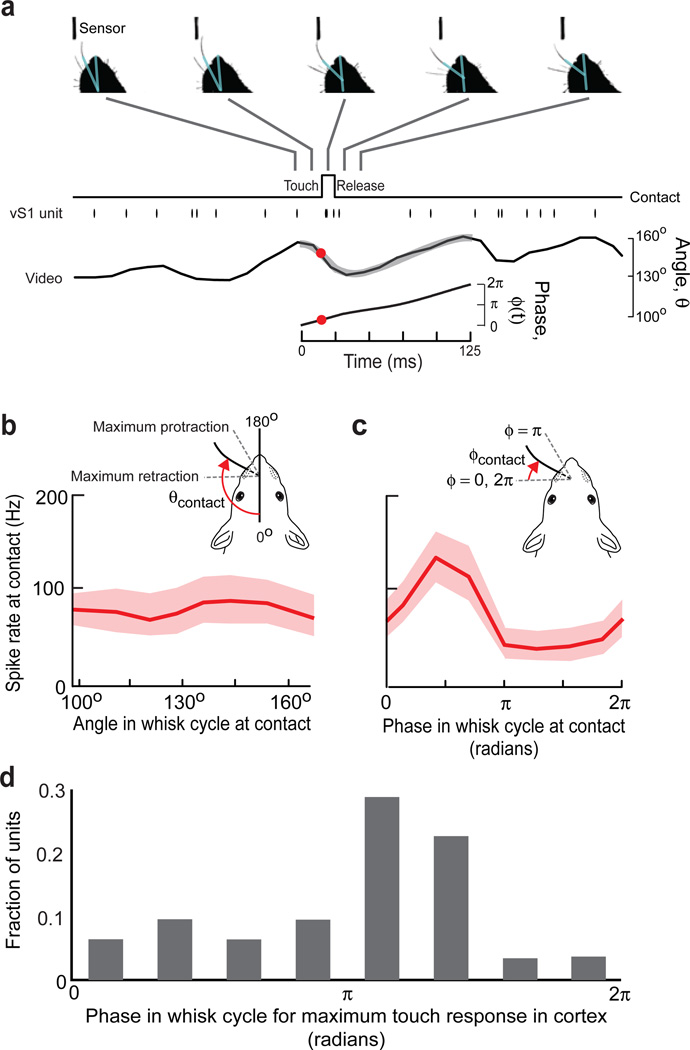
(a) The rat, trimmed to single vibrissa, is held in a sock that lines a plastic tube, cranes from a perch to contact a piezoelectric touch sensor. Spike signals from multiwire-electrodes in primary vibrissa cortex, along with contact and video data on vibrissa position are logged. Example data surrounding a contact event is shown and includes vibrissa position, the fitted touch signal and accompanying video frames, and the spike times from a single units. The angle, θ(t), for the cycle with a contact event is decomposed into phase, ϕ(t), with θ(t) = θMidpoint + θAmplitude
cos[ϕ(t) − ϕPreferred]. (b) Plot of the touch response parsed according to the angular position of the vibrissa upon contact. The angle is relative to the midline of the animal’s head. (c) Plot of the touch response parsed according to the phase in the whisk cycle upon contact; phase interval is π/4 radians. (d) Distribution of phase-shifts relative to the peak of protraction (panel a) for the set of units with both rapid and statistically significant responses to touch (28 out of 152 units in 9 rats) in addition to a phase preference for spiking while whisking in air. All panels adapted from reference .
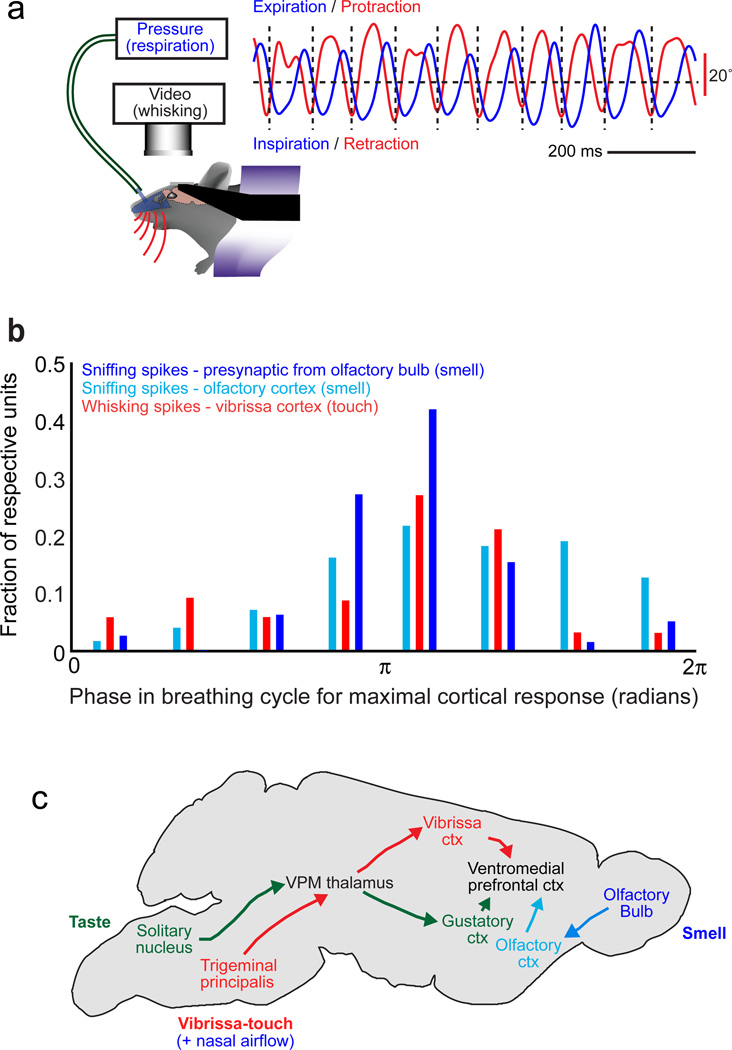
(a) Head-restrained mice, trimmed to a single vibrissa, were implanted with a pressure transducer in the nasal cavity and vibrissae were monitored with videography. The traces are simultaneous measurements of whisking and breathing. The dashed vertical lines highlight the simultaneous onset of protraction with that of inspiration. Adapted from reference . (b) Histograms of the preferred phases in the breathing cycle for smell for different units in the olfactory cortex (teal; Fig. 1d), smell for different units in the olfactory bulb (green; 312 responses from 87 units in 3 rats), and vibrissa-touch for different units in vibrissa cortex (red; Fig. 2). A phase shift to compensate for the time for output from the olfactory bulb to induce spikes in olfactory cortex, computed as (10 Hz)(0.018 s)(2 π) = 1.1 radians, where 10 Hz is a typical sniffing frequency for mice (7 Hz for rats) and 0.018 s is the delay, was used to shift the olfactory bulb responses (Fig. 2d). The olfactory data sets were binned to the resolution of the vibrissa data (Fig. 3d). (c) Schematic of convergent anatomical pathways of sensory input to the ventromedial prefrontal cortex. the abbreviation "VPM thalamus" refers to the dorsomedial aspect of the ventroposterior medial thalamic nucleus for vibrissa-touch and the parvocellular portion of the ventroposterior medial nucleus for gustatory input.
References
-
- Travers JB, Dinardo LA, Karimnamazi H. Motor and premotor mechanisms of licking. Neuroscience and Biobehavioral Reviews. 1997;21:631–647. - PubMed
Publication types
MeSH terms
Grants and funding
LinkOut - more resources
Full Text Sources
Other Literature Sources
