Meta-Analysis
. 2014 Aug:57:22-37.
doi: 10.1016/j.cortex.2014.02.022. Epub 2014 Mar 21.

Conceptualizing neuropsychiatric diseases with multimodal data-driven meta-analyses - the case of behavioral variant frontotemporal dementia

Affiliations
Meta-Analysis

Conceptualizing neuropsychiatric diseases with multimodal data-driven meta-analyses - the case of behavioral variant frontotemporal dementia

Matthias L Schroeter et al. Cortex. 2014 Aug.

Abstract

Introduction: Uniform coordinate systems in neuroimaging research have enabled comprehensive systematic and quantitative meta-analyses. Such approaches are particularly relevant for neuropsychiatric diseases, the understanding of their symptoms, prediction and treatment. Behavioral variant frontotemporal dementia (bvFTD), a common neurodegenerative syndrome, is characterized by deep alterations in behavior and personality. Investigating this 'nexopathy' elucidates the healthy social and emotional brain.

Methods: Here, we combine three multimodal meta-analyses approaches - anatomical and activation likelihood estimates and behavioral domain profiles - to identify neural correlates of bvFTD in 417 patients and 406 control subjects and to extract mental functions associated with this disease by meta-analyzing functional activation studies in the comprehensive probabilistic functional brain atlas of the BrainMap database.

Results: The analyses identify the frontomedian cortex, basal ganglia, anterior insulae and thalamus as most relevant hubs, with a regional dissociation between atrophy and hypometabolism. Neural networks affected by bvFTD were associated with emotion and reward processing, empathy and executive functions (mainly inhibition), suggesting these functions as core domains affected by the disease and finally leading to its clinical symptoms. In contrast, changes in theory of mind or mentalizing abilities seem to be secondary phenomena of executive dysfunctions.

Conclusions: The study creates a novel conceptual framework to understand neuropsychiatric diseases by powerful data-driven meta-analytic approaches that shall be extended to the whole neuropsychiatric spectrum in the future.

Keywords: Behavioral variant frontotemporal dementia; Cognitive neuropsychiatry; FDG-PET; MRI; Meta-analysis.


Figures

Figure 1
Figure 1
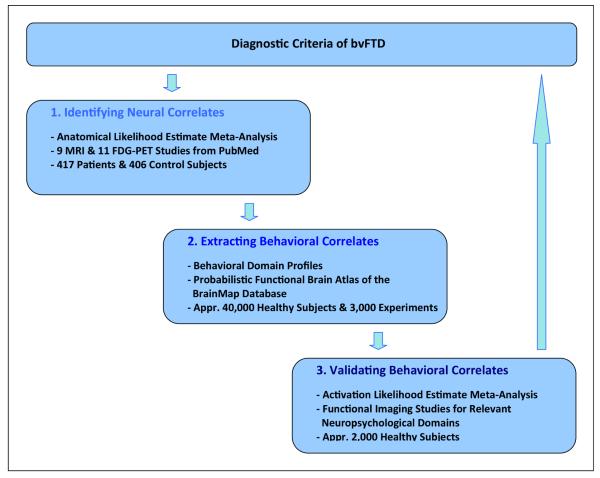
Understanding and validating diagnostic criteria for neuropsychiatric diseases with powerful meta-analyses – Rationale of the study. bvFTD behavioral variant frontotemporal dementia, FDG-PET 18F-fluorodeoxyglucose-positron emission tomography, MRI magnetic resonance imaging.
Figure 2
Figure 2
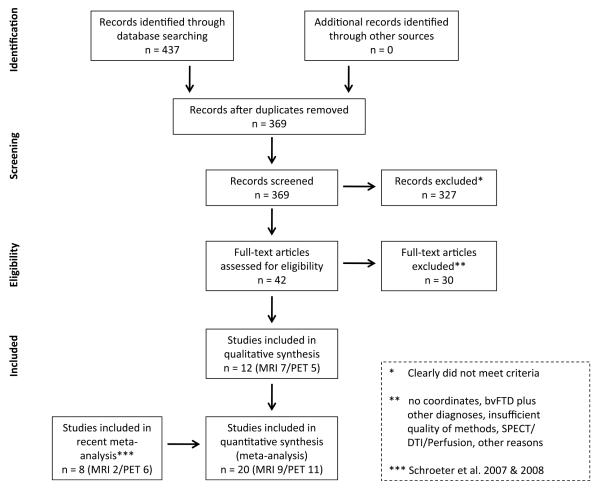
Flow of information through the different phases of the systematic review identifying the neural correlates of behavioral variant frontotemporal dementia (bvFTD) according to the PRISMA statement (Moher et al., 2009). DTI diffusion tensor imaging, MRI magnetic resonance imaging, PET 18F-fluorodeoxyglucose-positron emission tomography, SPECT single photon emission computed tomography.
Figure 3
Figure 3
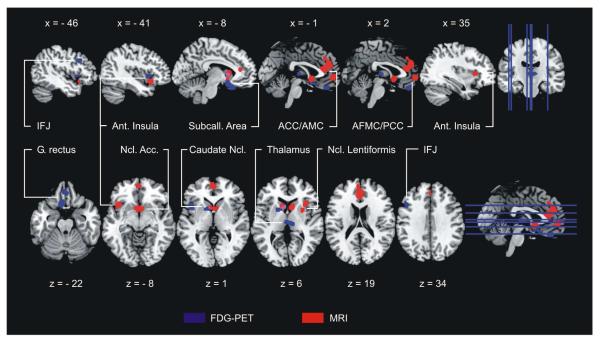
Impaired brain regions in behavioral variant frontotemporal dementia in comparison with healthy control subjects – Anatomical likelihood estimates. Atrophy as measured by MRI red, hypometabolism as measured by FDG-PET blue, overlap pink. Nine MRI and 11 FDGPET studies including 417 patients and 406 control subjects. Left is left. MNI coordinates. Acc. accumbens, ACC/AMC anterior cingulate & midcingulate cortex, AFMC/PCC anterior frontomedian/paracingulate cortex, Ant. anterior, FDG-PET 18F-fluorodeoxyglucose positron emission tomography, G. gyrus, IFJ inferior frontal junction, MNI Montreal Neurological Institute, MRI magnetic resonance imaging, Ncl. nucleus, Subcall. subcallosal.
Figure 4
Figure 4
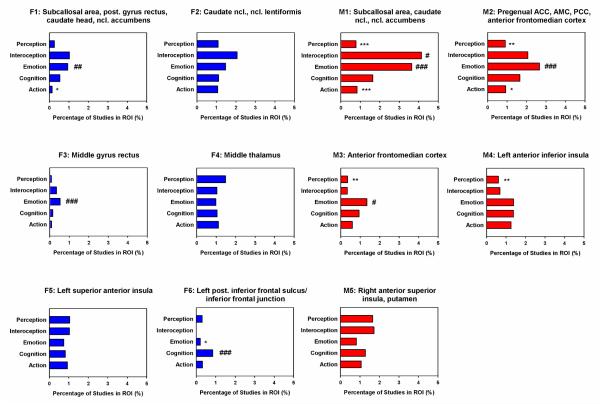
Behavioral domain profiles associated with each hypometabolic (blue) or atrophic (red) brain region in behavioral variant frontotemporal dementia. Data are expressed as percentage of specific studies in the region of interest in comparison with the whole brain. Probability higher than expected ###p<0.001, ##p<0.01, #p<0.05; lower than expected ***p<0.001, **p<0.01, *p<0.05. ACC/AMC anterior cingulate & midcingulate cortex, AFMC/PCC anterior frontomedian/paracingulate cortex, Ncl. nucleus, Post. Posterior, ROI region of interest.
Figure 5
Figure 5
Conjunction between impaired brain regions in behavioral variant frontotemporal dementia (FDG-PET blue, MRI red) and neural correlates of empathy (green) and theory of mind (cyan). Anatomical and functional activation likelihood estimate meta-analyses. Left is left. MNI coordinates. Overlap yellow and light-blue for empathy and white for theory of mind. ACC/AMC/PCC anterior cingulate & midcingulate cortex/paracingulate cortex, AFMC anterior frontomedian cortex, Ant. anterior, FDG-PET 18F-fluorodeoxyglucose positron emission tomography, MNI Montreal Neurological Institute, MRI magnetic resonance imaging.
Figure 6
Figure 6
Conceptualizing behavioral variant frontotemporal dementia with combined meta-analyses. The figure illustrates brain regions involved in the disease (light blue), their related cognitive & behavioral correlates (orange, purple and red) and clinical symptoms (dark blue). ACC/AMC anterior cingulate & midcingulate cortex, Ant. anterior, IFJ inferior frontal junction, PCC paracingulate cortex.

References

    1. Adenzato M, Cavallo M, Enrici I. Theory of mind ability in the behavioural variant of frontotemporal dementia: An analysis of the neural, cognitive, and social levels. Neuropsychologia. 2010;48:2–12. - PubMed
    1. Adolphs R. Conceptual challenges and directions for social neuroscience. Neuron. 2010;65:752–767. - PMC - PubMed
    1. American Psychiatric Association . Diagnostic and statistical manual of mental disorders, fifth edition. DSM-5. American Psychiatric Publishing, DC; Washington: 2013.
    1. Amodio DM, Frith CD. Meeting of minds: The medial frontal cortex and social cognition. Nature Reviews Neuroscience. 2006;7:268–277. - PubMed
    1. Bzdok D, Schilbach L, Vogeley K, Schneider K, Laird AR, Langner R, et al. Parsing the neural correlates of moral cognition: ALE meta-analysis on morality, theory of mind, and empathy. Brain Structure and Function. 2012;217:783–796. - PMC - PubMed

Publication types

LinkOut - more resources