Review
. 2014 May;23(6):518-26.
doi: 10.1177/0961203313501401.

Diet, microbiota and autoimmune diseases

Affiliations
Review

Diet, microbiota and autoimmune diseases

S M Vieira et al. Lupus. 2014 May.

Abstract

There is growing evidence that the commensal bacteria in the gastrointestinal tract (the gut microbiota) influence the development of autoimmunity in rodent models. Since humans have co-evolved with commensals for millennia, it is likely that people, who are genetically predisposed to autoimmunity, harbor gut microbial communities that similarly influence the onset and/or severity of disease. Beyond the current efforts to identify such disease-promoting or -preventing commensals ("pathobionts" or "symbionts"), it will be important to determine what factors modulate them. Dietary changes are known to affect both the composition and function of the gut microbial communities, which in turn can alter the innate and adaptive immune system. In this review, we focus on the relationships between diet, microbiota, and autoimmune diseases. We hypothesize that the beneficial and life-prolonging effects of caloric restriction on a variety of autoimmune models including lupus might partly be mediated by its effects on the gut microbiome and associated virome, the collection of all viruses in the gut. We give recent examples of the immunomodulatory potential of select gut commensals and their products or diet-derived metabolites in murine models of arthritis, multiple sclerosis, and type 1 diabetes. Lastly, we summarize the published phenotypes of germ-free mouse models of lupus and speculate on any role of the diet-sensitive microbiome and virome in systemic lupus and the related antiphospholipid syndrome.

Keywords: Microbiome; autoimmunity; caloric restriction; molecular mimicry; virome.


Figures
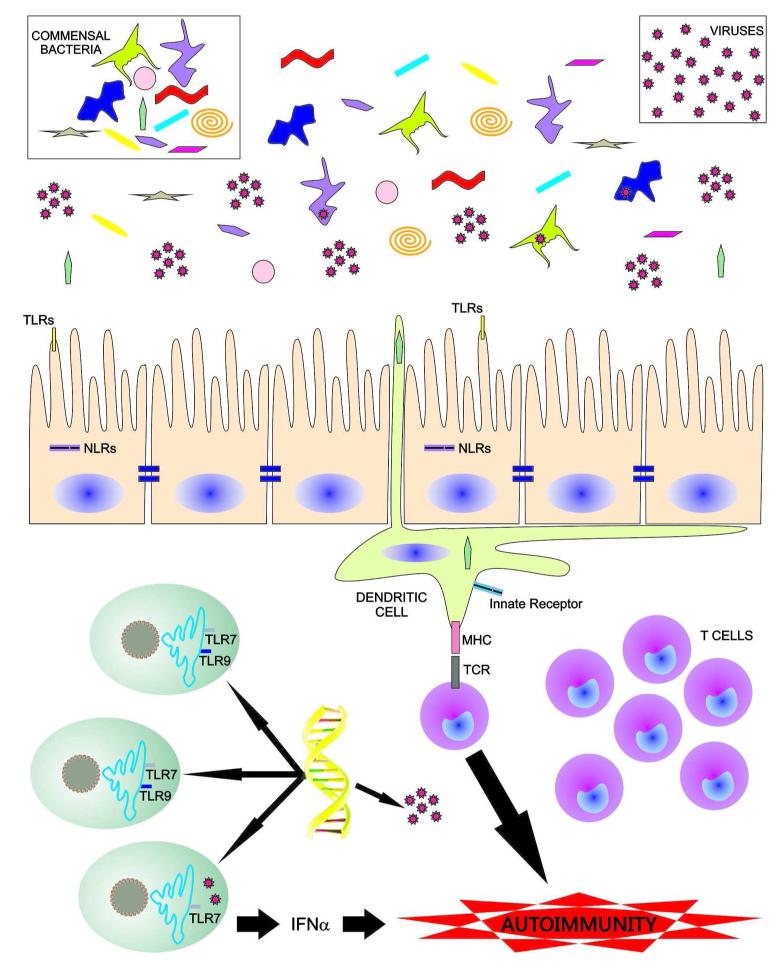
Fig. 1
Fig. 1. Putative gut microbiome and virome interactions with an autoimune-prone host immune system
This cartoon illustrates a hypothetical model for potential mechanisms how the gut microbiota, the gut virome and endogenous retroviruses can contribute to the pathogenesis of systemic autoimmunity. Gut commensals and viruses within the lumen of the gastrointestinal tract are influenced by diet and micronutrients (not shown). Bacteriophages within commensal bacteria are able to modify the bacteria that then affect the host by various mechanisms. Commensals are sensed by specific pattern recognition receptors on the surface or intracellular compartment of epithelial cells and resident antigen-presenting cells, e.g. toll-like receptors (TLRs) or nucleotide-binding oligomerization domain (NOD)-like receptors (NLRs). Dendritic cells can sample commensals within the lumen and present antigens via major histocompatibility complexes (MHC) to T cell subsets that are potentially cross-reactive with self-antigens in a genetically predisposed host. Similarly, genetic predisposition to hypersensitive innate immune receptors or signaling cascades can promote an adaptive immune response to commensal and self antigens. Cross-reactive CD4+ T cells provide subsequently help to inherently autoreactive B cells (not shown) that then produce autoantibodies, leading to systemic autoimmunity. Lastly, endogenous retroviruses that have inserted into the host’s genome (shown in yellow) are also influenced by the gut microbiota and produce nucleic acids that trigger IFNα production via nucleic acid sensors like the endosomally localized TLR7. In addition, commensal DNA triggers a TLR9-mediated response in lamina propria dendritic cells (not depicted). These innate immune events may support an adaptive (auto)immune response to self structures initiated by cross-reactive commensals. See main text for references supporting several of these aspects in non-autoimmune hosts.

References

    1. Nussbaum JC, Locksley RM. Infectious (Non)tolerance--frustrated commensalism gone awry? Cold Spring Harbor perspectives in biology. 2012:4. - PMC - PubMed
    1. Relman DA. Microbiology: Learning about who we are. Nature. 2012;486:194–5. - PubMed
    1. Kau AL, Ahern PP, Griffin NW, Goodman AL, Gordon JI. Human nutrition, the gut microbiome and the immune system. Nature. 2011;474:327–36. - PMC - PubMed
    1. Goodman AL, Kallstrom G, Faith JJ, et al. Extensive personal human gut microbiota culture collections characterized and manipulated in gnotobiotic mice. Proc Natl Acad Sci U S A. 2011;108:6252–7. - PMC - PubMed
    1. Muegge BD, Kuczynski J, Knights D, et al. Diet drives convergence in gut microbiome functions across mammalian phylogeny and within humans. Science. 2011;332:970–4. - PMC - PubMed

Publication types

MeSH terms
