Meta-Analysis
. 2014 Apr 24;9(4):e95923.
doi: 10.1371/journal.pone.0095923. eCollection 2014.

A comparison of multivariate genome-wide association methods

Affiliations
Meta-Analysis

A comparison of multivariate genome-wide association methods

Tessel E Galesloot et al. PLoS One. .

Abstract

Joint association analysis of multiple traits in a genome-wide association study (GWAS), i.e. a multivariate GWAS, offers several advantages over analyzing each trait in a separate GWAS. In this study we directly compared a number of multivariate GWAS methods using simulated data. We focused on six methods that are implemented in the software packages PLINK, SNPTEST, MultiPhen, BIMBAM, PCHAT and TATES, and also compared them to standard univariate GWAS, analysis of the first principal component of the traits, and meta-analysis of univariate results. We simulated data (N = 1000) for three quantitative traits and one bi-allelic quantitative trait locus (QTL), and varied the number of traits associated with the QTL (explained variance 0.1%), minor allele frequency of the QTL, residual correlation between the traits, and the sign of the correlation induced by the QTL relative to the residual correlation. We compared the power of the methods using empirically fixed significance thresholds (α = 0.05). Our results showed that the multivariate methods implemented in PLINK, SNPTEST, MultiPhen and BIMBAM performed best for the majority of the tested scenarios, with a notable increase in power for scenarios with an opposite sign of genetic and residual correlation. All multivariate analyses resulted in a higher power than univariate analyses, even when only one of the traits was associated with the QTL. Hence, use of multivariate GWAS methods can be recommended, even when genetic correlations between traits are weak.


Conflict of interest statement

Competing Interests: The authors have declared that no competing interests exist.

Figures

Figure 1
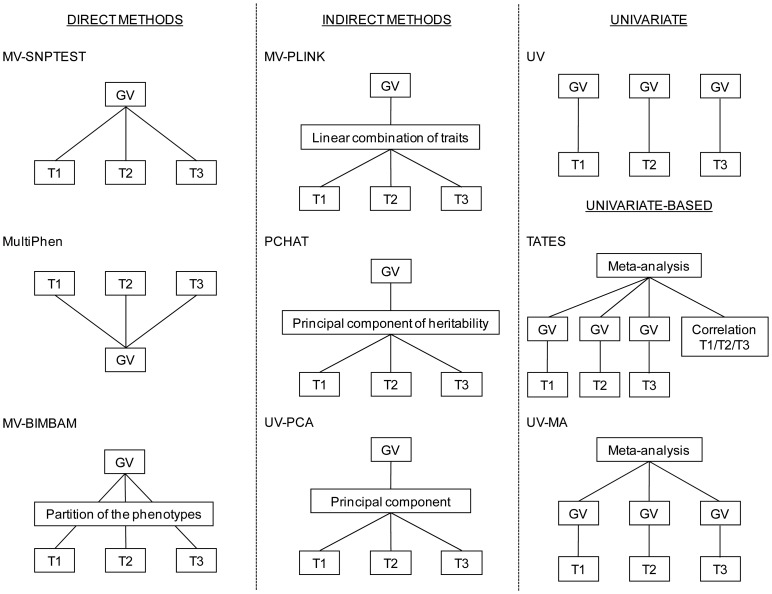
Figure 1. Schematic representation of the included methods.
GV indicates genetic variant; MV, multivariate; PCHAT, Principal Component of Heritability Association Test; T1, trait 1; T2, trait 2; T3, trait 3; TATES, Trait-based Association Test that uses Extended Simes procedure; UV-MA, meta-analysis of univariate results; UV-PCA, univariate analysis of first principal component.
Figure 2
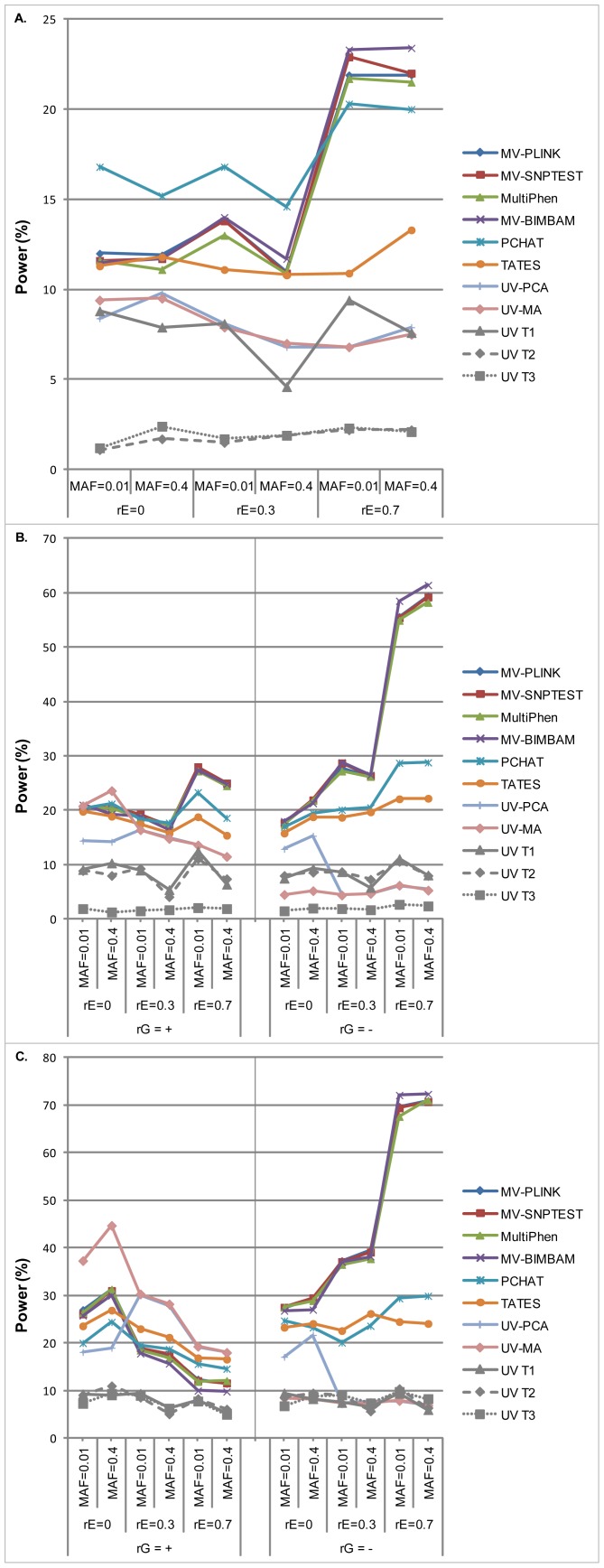
Figure 2. Power of the methods for scenarios with one of three traits associated with the QTL (A), two of three traits associated with the QTL (B) and with all three traits associated with the QTL (C).
The explained variance of the QTL was fixed at 0.1%. For clarity reasons, we have not provided errors bars. Confidence ranges for the power estimates are all between 1 and 5%; exact values are provided in Tables S3–S5. MAF, minor allele frequency; MV, multivariate; PCHAT, Principal Component of Heritability Association Test; QTL, quantitative trait locus; rE, residual correlation; rG, genetic correlation induced by the QTL; TATES, Trait-based Association Test that uses Extended Simes procedure; UV-MA, meta-analysis of univariate results; UV-PCA, univariate analysis of first principal component; UV T1, univariate analysis of trait 1; UV T2, univariate analysis of trait 2; UV T3, univariate analysis of trait 3.

References

    1. Willer CJ, Sanna S, Jackson AU, Scuteri A, Bonnycastle LL, et al. (2008) Newly identified loci that influence lipid concentrations and risk of coronary artery disease. Nat Genet 40: 161–169. - PMC - PubMed
    1. Zhu W, Zhang H (2009) Why Do We Test Multiple Traits in Genetic Association Studies? J Korean Stat Soc 38: 1–10. - PMC - PubMed
    1. Allison DB, Thiel B, St Jean P, Elston RC, Infante MC, et al. (1998) Multiple phenotype modeling in gene-mapping studies of quantitative traits: power advantages. Am J Hum Genet 63: 1190–1201. - PMC - PubMed
    1. Klei L, Luca D, Devlin B, Roeder K (2008) Pleiotropy and principal components of heritability combine to increase power for association analysis. Genet Epidemiol 32: 9–19. - PubMed
    1. Chavali S, Barrenas F, Kanduri K, Benson M (2010) Network properties of human disease genes with pleiotropic effects. BMC Syst Biol 4: 78. - PMC - PubMed

Publication types