Expression of fibroblast growth factor 23, vitamin D receptor, and sclerostin in bone tissue from hypercalciuric stone formers
- PMID: 24763863
- PMCID: PMC4078962
- DOI: 10.2215/CJN.10030913
Expression of fibroblast growth factor 23, vitamin D receptor, and sclerostin in bone tissue from hypercalciuric stone formers
Abstract
Background and objectives: Increased bone resorption, low bone formation, and abnormal mineralization have been described in stone formers with idiopathic hypercalciuria. It has been previously shown that the receptor activator of NF-κB ligand mediates bone resorption in idiopathic hypercalciuria (IH). The present study aimed to determine the expression of fibroblast growth factor 23 (FGF-23), vitamin D receptor (VDR), and sclerostin in bone tissue from IH stone formers.
Design, setting, participants, & measurements: Immunohistochemical analysis was performed in undecalcified bone samples previously obtained for histomorphometry from 30 transiliac bone biopsies of idiopathic hypercalciuria stone-forming patients between 1992 and 2002 and 33 healthy individuals (controls). Serum parameters were obtained from their medical records.
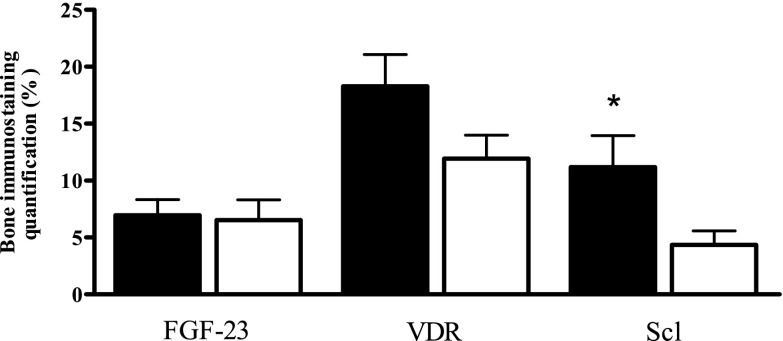
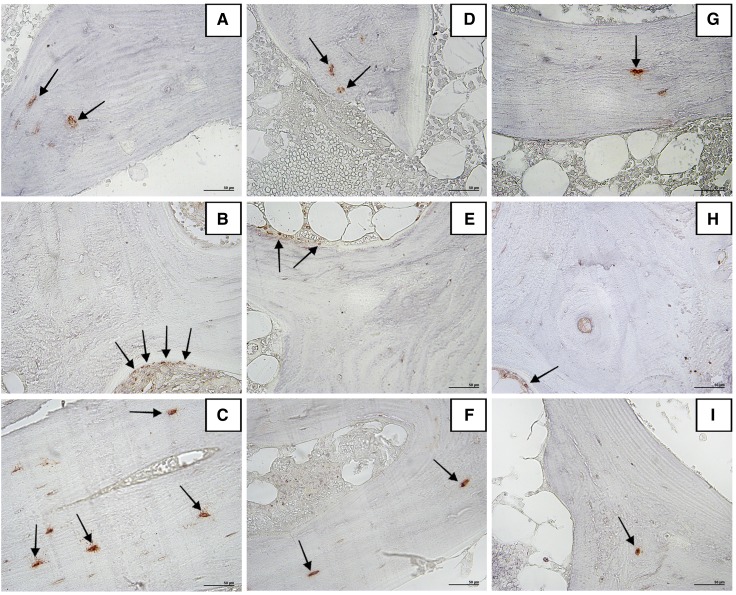
Results: Histomorphometry disclosed 21 IH patients with high and 9 IH patients with normal bone resorption. Importantly, eroded surfaces (ES/BS) from IH patients but not controls were significantly correlated with VDR immunostaining in osteoblasts (r=0.51; P=0.004), sclerostin immunostaining in osteocytes (r=0.41; P=0.02), and serum 1,25-dihydroxyvitamin D (r=0.55; P<0.01). Of note, both VDR and sclerostin immunostaining were significantly correlated with serum 1,25-dihydroxyvitamin D in IH patients (r=0.52; P=0.01 and r=0.53; P=0.02, respectively), although VDR and sclerostin expression did not differ between IH and controls. IH patients with high bone resorption exhibited a significantly stronger sclerostin immunostaining than IH patients with normal bone resorption. FGF-23 expression in osteocytes from IH patients did not differ from controls and was not correlated with any histomorphometric parameter.
Conclusions: These findings suggest the contribution of VDR and sclerostin, as well as 1,25-dihydroxyvitamin D, to increase bone resorption in idiopathic hypercalciuria but do not implicate FGF-23 in the bone alterations seen in these patients.
Keywords: FGF-23; VDR; hypercalciuria; immunohistochemistry; sclerostin.
Copyright © 2014 by the American Society of Nephrology.
Figures
References
-
- Heilberg IP, Martini LA, Szejnfeld VL, Carvalho AB, Draibe SA, Ajzen H, Ramos OL, Schor N: Bone disease in calcium stone forming patients. Clin Nephrol 42: 175–182, 1994 - PubMed
-
- Heilberg IP, Martini LA, Teixeira SH, Szejnfeld VL, Carvalho AB, Lobão R, Draibe SA: Effect of etidronate treatment on bone mass of male nephrolithiasis patients with idiopathic hypercalciuria and osteopenia. Nephron 79: 430–437, 1998 - PubMed
-
- Misael da Silva AM, dos Reis LM, Pereira RC, Futata E, Branco-Martins CT, Noronha IL, Wajchemberg BL, Jorgetti V: Bone involvement in idiopathic hypercalciuria. Clin Nephrol 57: 183–191, 2002 - PubMed
Publication types
MeSH terms
Substances
LinkOut - more resources
Full Text Sources
Other Literature Sources