. 2014 Jun 21;14(12):2023-32.
doi: 10.1039/c4lc00171k. Epub 2014 Apr 25.

3D printed microfluidic devices with integrated versatile and reusable electrodes

Affiliations

3D printed microfluidic devices with integrated versatile and reusable electrodes

Jayda L Erkal et al. Lab Chip. .

Abstract

We report two 3D printed devices that can be used for electrochemical detection. In both cases, the electrode is housed in commercially available, polymer-based fittings so that the various electrode materials (platinum, platinum black, carbon, gold, silver) can be easily added to a threaded receiving port printed on the device; this enables a module-like approach to the experimental design, where the electrodes are removable and can be easily repolished for reuse after exposure to biological samples. The first printed device represents a microfluidic platform with a 500 × 500 μm channel and a threaded receiving port to allow integration of either polyetheretherketone (PEEK) nut-encased glassy carbon or platinum black (Pt-black) electrodes for dopamine and nitric oxide (NO) detection, respectively. The embedded 1 mm glassy carbon electrode had a limit of detection (LOD) of 500 nM for dopamine and a linear response (R(2) = 0.99) for concentrations between 25-500 μM. When the glassy carbon electrode was coated with 0.05% Nafion, significant exclusion of nitrite was observed when compared to signal obtained from equimolar injections of dopamine. When using flow injection analysis with a Pt/Pt-black electrode and standards derived from NO gas, a linear correlation (R(2) = 0.99) over a wide range of concentrations (7.6-190 μM) was obtained, with the LOD for NO being 1 μM. The second application showcases a 3D printed fluidic device that allows collection of the biologically relevant analyte adenosine triphosphate (ATP) while simultaneously measuring the release stimulus (reduced oxygen concentration). The hypoxic sample (4.8 ± 0.5 ppm oxygen) released 2.4 ± 0.4 times more ATP than the normoxic sample (8.4 ± 0.6 ppm oxygen). Importantly, the results reported here verify the reproducible and transferable nature of using 3D printing as a fabrication technique, as devices and electrodes were moved between labs multiple times during completion of the study.


Figures

Figure 1
Figure 1
3D device used for electrochemical detection. A-B) 3D renderings of the device in Autodesk software; C-D) Printed 0.5 mm-wide channel device in VeroClear material. The Pt-electrode is screwed into the electrode port, showing alignment of both Pt wires with the 0.5 mm channel (panel C). In panel D, the device is shown with the Pt-electrode, electrode leads, and the fittings used to integrate the device with a syringe pump.
Figure 2
Figure 2
Glassy carbon working electrode for the detection of dopamine. A) Image showing the flangeless fitting with a 2 mm palladium pseudo-reference and a 1 mm glassy carbon working electrode; B) flow injection analysis to show selectivity of a Nafion-coated glassy carbon electrode; i) Response for dopamine [100 μM] using the Nafion-coated glassy carbon electrode; ii) Response for nitrite [100 μM] using the Nafion-coated glassy carbon electrode; iii) Response for nitrite [100 μM] using a non-modified glassy carbon electrode.
Figure 3
Figure 3
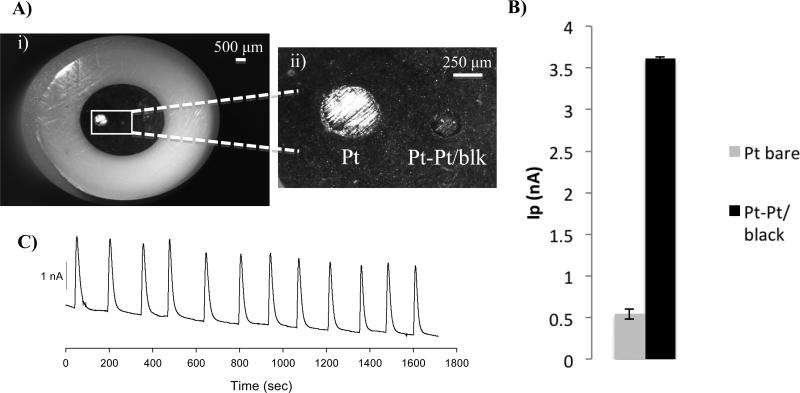
Platinum electrodes for NO detection. A) i) Platinum pseudo-electrode (500 μm) and platinum working electrode [250 μm] encapsulated with epoxy in a flangeless fitting; ii) Zoomed micrograph of the platinum black modified platinum working electrode; B) Bar graph comparing the signal for NO [190 μM] with a bare Pt electrode verses the Pt/Pt-black modified electrode; C) Amperogram of reproducible 190 μM NO injections over the Pt/Pt-black electrode.
Figure 4
Figure 4
Measuring O2 tension in a flowing stream of buffer (HBSS) and in HBSS with RBCs. Measurements were made with a Nafion-coated gold electrode and Ag/AgCl quasi-reference electrode. A) Micrographs of the electrode containing gold and silver wire secured with C-7 epoxy. In both micrographs, the silver wire is coated with AgCl; B) Calibration curve data for oxygen standards in HBSS [y=1.13×10⁻⁷x+1.26×10⁻⁷; R2 = 0.98] and in the presence of RBCs [y=8.15×10⁻⁸x+2.50×10⁻⁷; R2 = 0.93]. N = 1 electrode with triplicate measurement. Error = standard deviation.
Figure 5
Figure 5
Fabrication of 3D device to measure oxygen and ATP from flowing RBCs. The left side of the figure shows the rendering of the device in the Autodesk software. A) Side profile of device detailing the threaded inlet, electrode port, and well insert ports; B) Top view of device; C) Solid body view of device; D) 3D printed device in VeroClear material, detailing the inlet and electrode port; E) Transwell membrane inserted into the device via the well insert port; F) 3D printed device with electrode inserted fully into the port, showing the working and quasi-reference electrodes for oxygen sensing.
Figure 6
Figure 6
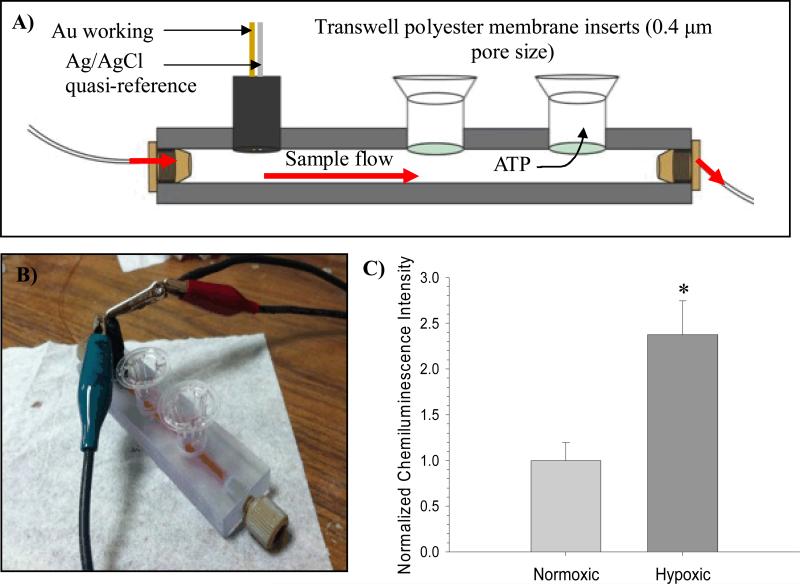
Fluidic device for correlation of oxygen tension and ATP release. A) Schematic of device; B) Picture of the assembled device with RBCs being pumped through the system; C) Comparison of RBC ATP release from a normoxic sample (8.22 ± 0.60 ppm oxygen) to a moderately hypoxic sample (4.76 ± 0.53 ppm oxygen). N = 3 donors; error = s.e.m., * p < 0.05.

References

    1. Martin RS, Gawron AJ, Lunte SM, Henry CS. Anal Chem. 2000;72:3196–3202. - PubMed
    1. Woolley AT, Lao K, Glazer AN, Mathies RA. Anal. Chem. 1998;70:684–688. - PubMed
    1. Vickers JA, Henry CS. Electrophoresis. 2005;26:4641–4647. - PubMed
    1. Gawron AJ, Martin RS, Lunte SM. Electrophoresis. 2001;22:242–248. - PubMed
    1. Kovarik ML, Li MW, Martin RS. Electrophoresis. 2005;26:202–210. - PubMed

Publication types

MeSH terms