Review
. 2014 Apr 2:8:46.
doi: 10.3389/fnsys.2014.00046. eCollection 2014.

Sleep for cognitive enhancement

Affiliations
Review

Sleep for cognitive enhancement

Susanne Diekelmann. Front Syst Neurosci. .

Abstract

Sleep is essential for effective cognitive functioning. Loosing even a few hours of sleep can have detrimental effects on a wide variety of cognitive processes such as attention, language, reasoning, decision making, learning and memory. While sleep is necessary to ensure normal healthy cognitive functioning, it can also enhance performance beyond the boundaries of the normal condition. This article discusses the enhancing potential of sleep, mainly focusing on the domain of learning and memory. Sleep is known to facilitate the consolidation of memories learned before sleep as well as the acquisition of new memories to be learned after sleep. According to a widely held model this beneficial effect of sleep relies on the neuronal reactivation of memories during sleep that is associated with sleep-specific brain oscillations (slow oscillations, spindles, ripples) as well as a characteristic neurotransmitter milieu. Recent research indicates that memory processing during sleep can be boosted by (i) cueing memory reactivation during sleep; (ii) stimulating sleep-specific brain oscillations; and (iii) targeting specific neurotransmitter systems pharmacologically. Olfactory and auditory cues can be used, for example, to increase reactivation of associated memories during post-learning sleep. Intensifying neocortical slow oscillations (the hallmark of slow wave sleep (SWS)) by electrical or auditory stimulation and modulating specific neurotransmitters such as noradrenaline and glutamate likewise facilitates memory processing during sleep. With this evidence in mind, this article concludes by discussing different methodological caveats and ethical issues that should be considered when thinking about using sleep for cognitive enhancement in everyday applications.

Keywords: brain stimulation; cognitive enhancement; ethics; learning; memory; pharmacology; reactivation; sleep.


Figures
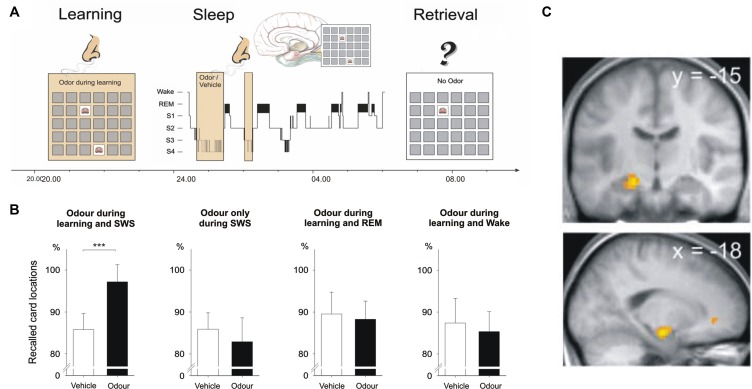
Figure 1
Figure 1
Cueing reactivation during sleep by odors enhances memory. (A) Subjects learned card pair locations in the presence of an odor. The same odor or an odor-less vehicle was then presented during subsequent slow wave sleep (SWS). (B) Recall of card pair locations in the next morning was significantly better when subjects had received the odor during SWS. Odor presentation during REM sleep and during wakefulness remained ineffective. Memory was also not enhanced when the odor was omitted during learning. (C) Presentation of the learning-associated odor during SWS activated hippocampal regions (activation in the left anterior hippocampus shown here). From Rasch et al. (2007). Reprinted with permission from the American Association for the Advancement of Science.
Figure 2
Figure 2
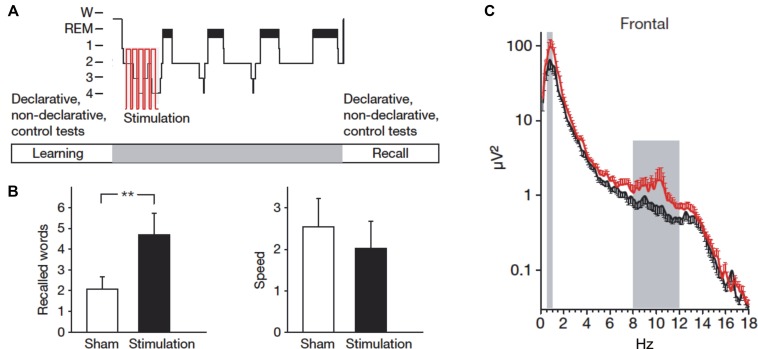
Stimulating slow oscillations during sleep enhances memory. (A) Following learning of word pairs and finger sequence tapping, subjects received electrical stimulation of slow oscillations (tDCS at 0.75 Hz) during ensuing sleep. (B) Compared to a sham condition, subjects remembered more word pairs after slow oscillation stimulation. Speed in finger sequence tapping was not affected by the stimulation. (C) The stimulation increased activity in the slow oscillation (0.5–1 Hz) and the slow spindle frequency band (8–12 Hz) at frontal sites. Reprinted by permission from Macmillan Publishers Ltd.: Marshall et al. (2006).

References

    1. Ackermann S., Rasch B. (2014). Differential effects of non-REM and REM sleep on memory consolidation? Curr. Neurol. Neurosci. Rep. 14:430 10.1007/s11910-013-0430-8 - DOI - PubMed
    1. Alberini C. M., Chen D. Y. (2012). Memory enhancement: consolidation, reconsolidation and insulin-like growth factor 2. Trends Neurosci. 35, 274–283 10.1016/j.tins.2011.12.007 - DOI - PMC - PubMed
    1. Antonenko D., Diekelmann S., Olsen C., Born J., Molle M. (2013). Napping to renew learning capacity: enhanced encoding after stimulation of sleep slow oscillations. Eur. J. Neurosci. 37, 1142–1151 10.1111/ejn.12118 - DOI - PubMed
    1. Antony J. W., Gobel E. W., O’Hare J. K., Reber P. J., Paller K. A. (2012). Cued memory reactivation during sleep influences skill learning. Nat. Neurosci. 15, 1114–1116 10.1038/nn.3152 - DOI - PMC - PubMed
    1. Arzi A., Shedlesky L., Ben-Shaul M., Nasser K., Oksenberg A., Hairston I. S., et al. (2012). Humans can learn new information during sleep. Nat. Neurosci. 15, 1460–1465 10.1038/nn.3193 - DOI - PubMed

LinkOut - more resources