


Circulating tumor cells as a prognostic factor in patients with small cell lung cancer
- PMID: 24765158
- PMCID: PMC3997694
- DOI: 10.3892/ol.2014.1940
Circulating tumor cells as a prognostic factor in patients with small cell lung cancer
Abstract
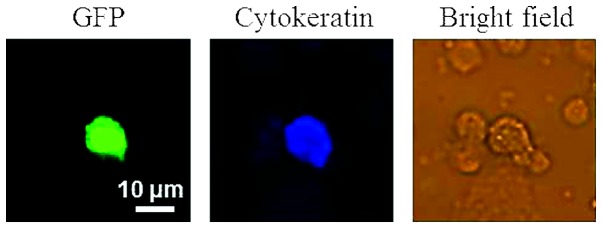
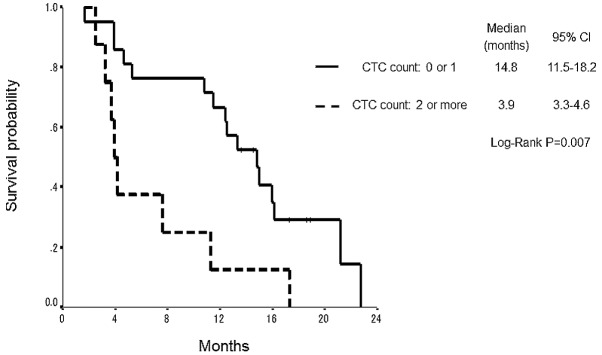
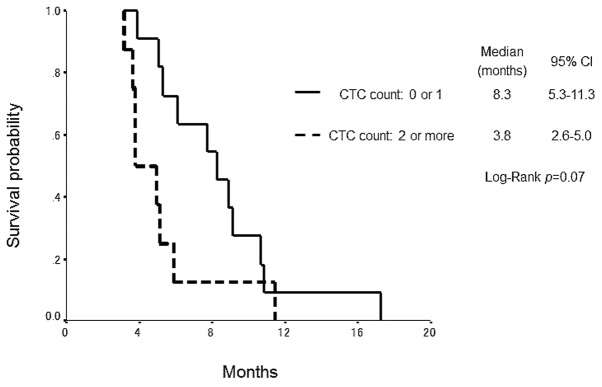
The detection of circulating tumor cells (CTCs) in peripheral blood is currently an important field of study. Detection of CTCs by the OBP-401 assay (TelomeScan®) has previously been reported to be useful in the diagnosis, prognosis and evaluation of therapeutic efficacy in breast and gastric cancer. The aim of the present study was to evaluate the OBP-401 assay as a novel method of detecting CTCs of small cell lung cancer (SCLC) patients and to evaluate whether CTC count is associated with prognosis. Prospectively, 30 consecutively diagnosed SCLC patients who had commenced chemotherapy or chemoradiotherapy were enrolled as subjects of the current study. Peripheral blood specimens were collected from the SCLC patients prior to and following the initiation of treatment and the viable CTCs were detected in the specimens following incubation with a telomerase-specific, replication-selective, oncolytic adenoviral agent, which was carrying the green fluorescent protein gene. CTCs were detected in 29 patients (96%). The group of 21 patients with a CTC count of <2 cells/7.5 ml prior to treatment (baseline) had a significantly longer median survival time than the group of eight patients with a CTC count of ≥2 cells/7.5 ml prior to treatment (14.8 and 3.9 months, respectively; P=0.007). The results of a multivariate analysis showed that the baseline CTC count was an independent prognostic factor for survival time (hazard ratio, 3.91; P=0.026). Among the patients that achieved a partial response to treatment, patients who had a CTC count of <2 cells/7.5 ml following two cycles of chemotherapy tended to have a longer median progression-free survival compared with patients who had a CTC count of ≥2 cell/7.5 ml (8.3 and 3.8 months, respectively; P=0.07). Therefore, CTCs may be detected via OBP-401 assay in SCLC patients and the CTC count prior to treatment appears to be a strong prognostic factor.
Keywords: OBP-401 assay; circulating tumor cells; prognostic factor; small cell lung cancer.
Figures
References
-
- Jackman DM, Johnson BE. Small-cell lung cancer. Lancet. 2005;366:1385–1396. - PubMed
-
- Govindan R, Page N, Morgensztern D, et al. Changing epidemiology of small-cell lung cancer in the United States over the last 30 years: analysis of the surveillance, epidemiologic, and end results database. J Clin Oncol. 2006;24:4539–4544. - PubMed
-
- Turrisi AT, III, Kim K, Blum R, et al. Twice-daily compared with once-daily thoracic radiotherapy in limited small-cell lung cancer treated concurrently with cisplatin and etoposide. N Engl J Med. 1999;340:265–271. - PubMed
-
- Takada M, Fukuoka M, Kawahara M, et al. Phase III study of concurrent versus sequential thoracic radiotherapy in combination with cisplatin and etoposide for limited-stage small-cell lung cancer: results of the Japan Clinical Oncology Group Study 9104. J Clin Oncol. 2002;20:3054–3060. - PubMed
-
- Alix-Panabières C, Riethdorf S, Pantel K. Circulating tumor cells and bone marrow micrometastasis. Clin Cancer Res. 2008;14:5013–5021. - PubMed
LinkOut - more resources
Full Text Sources
Other Literature Sources