. 2014;2(4):269-278.
doi: 10.2174/2213235X01666131203230512.

Metabolic Evidence of Diminished Lipid Oxidation in Women With Polycystic Ovary Syndrome

Affiliations

Metabolic Evidence of Diminished Lipid Oxidation in Women With Polycystic Ovary Syndrome

Leah D Whigham et al. Curr Metabolomics. 2014.

Abstract

Polycystic ovary syndrome (PCOS), a common female endocrinopathy, is a complex metabolic syndrome of enhanced weight gain. The goal of this pilot study was to evaluate metabolic differences between normal (n=10) and PCOS (n=10) women via breath carbon isotope ratio, urinary nitrogen and nuclear magnetic resonance (NMR)-determined serum metabolites. Breath carbon stable isotopes measured by cavity ring down spectroscopy (CRDS) indicated diminished (p<0.030) lipid use as a metabolic substrate during overnight fasting in PCOS compared to normal women. Accompanying urinary analyses showed a trending correlation (p<0.057) between overnight total nitrogen and circulating testosterone in PCOS women, alone. Serum analyzed by NMR spectroscopy following overnight, fast and at 2 h following an oral glucose tolerance test showed that a transient elevation in blood glucose levels decreased circulating levels of lipid, glucose and amino acid metabolic intermediates (acetone, 2-oxocaporate, 2-aminobutyrate, pyruvate, formate, and sarcosine) in PCOS women, whereas the 2 h glucose challenge led to increases in the same intermediates in normal women. These pilot data suggest that PCOS-related inflexibility in fasting-related switching between lipid and carbohydrate/protein utilization for carbon metabolism may contribute to enhanced weight gain.

Keywords: Cavity ring down; NMR-metabolomics; glucose elevation; lipid metabolism; polycystic ovary syndrome (PCOS).


Conflict of interest statement

Conflict Of Interest: The authors have no financial conflict of interest. Authors FAP, DB, HE, MC, WPP, MT are cofounders of Isomark LLC.

Figures

Fig. (1)
Fig. (1)
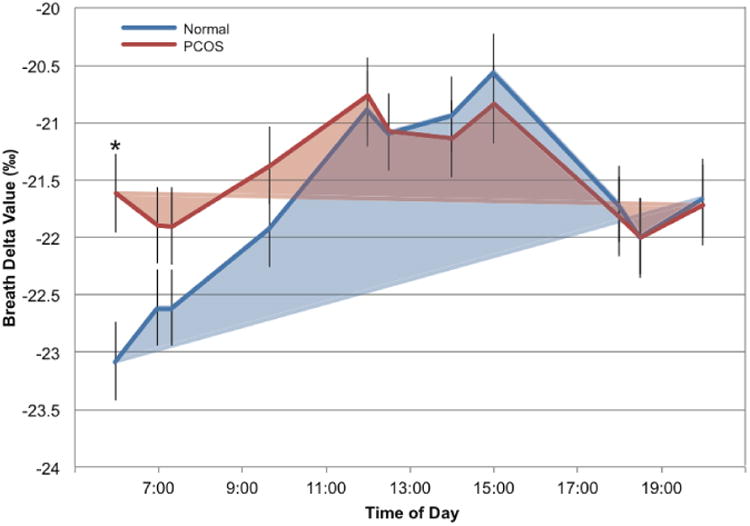
Normal and PCOS women were given a defined diet that was designed to meet their caloric needs (see methods). Breath samples were taken after an overnight fast (at wake-up, 0600h), before and after every meal and before and after an afternoon exercise bout. Breath δ13CO2values were determined using an isotopic CO2 cavity ring-down spectrometer. The observed means are shown as lines in blue for normal women and red for PCOS women. Morning-to-evening variation in breath delta values was analyzed by repeated measures analysis of covariance (ANCOVA) using the mean of the wake up and pre-breakfast delta values as the covariate.
Fig. (2)
Fig. (2)
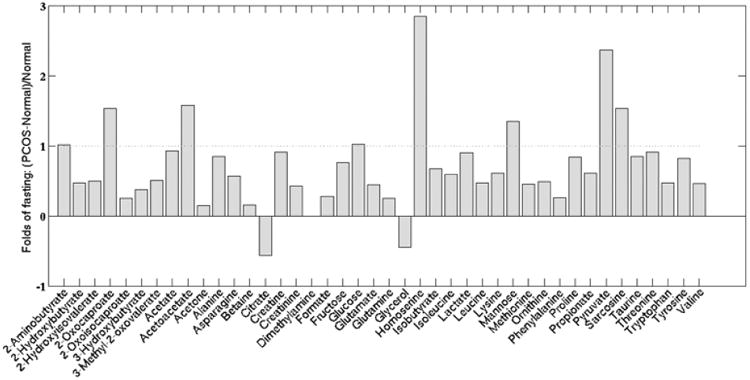
Fold changes in fasted serum metabolite levels in PCOS as compared to normal subjects. The dotted line indicates a 1-fold (2×) increase. All metabolites, with the exception of citrate and glycerol, were increased in PCOS compared to normal women.
Fig. (3)
Fig. (3)
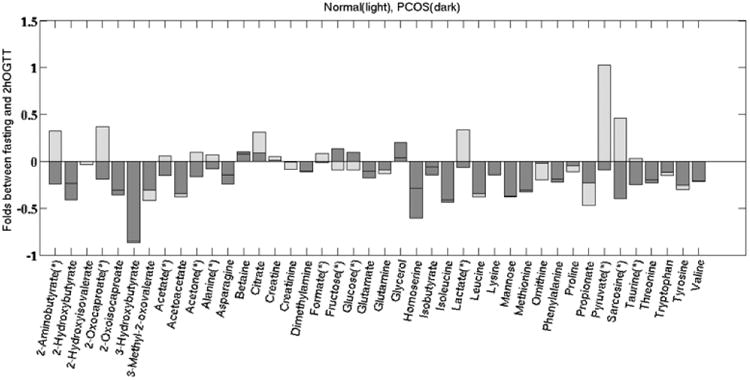
Fold changes between the fasting and 2hOGTT conditions for the normal and PCOS subjects. Metabolites labeled with * changed oppositely between the normal and PCOS groups: with exception of glucose and fructose, these metabolites increased from fasting to 2hOGTT in the normal subjects but decreased from fasted to 2hOGTT in the PCOS subjects. Those metabolites that showed trends toward significant increase are: acetoacetate (p = 0.079), acetate (p = 0.06), 2-amino butyrate (p = 0.055), and sarcosine (p = 0.06).
Fig. (4)
Fig. (4)
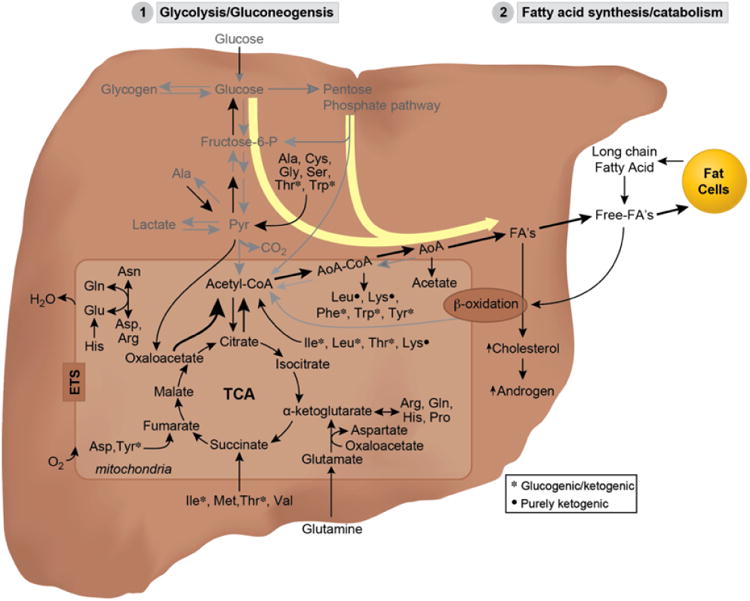
Diagrammatic representation of proposed metabolic pathways switching in PCOS suggested by NMR and supported by breath and urine data analysis. Simplified metabolic pathways and TCA cycle showing enhanced diversion of glucose metabolism through alternative pathways (i.e. glycolysis and pentose phosphate pathways) into fatty acid synthesis including increased amino acid utilization by the cell which may explain the observed increased fat accumulation and increased nitrogen excretion at fasting in PCOS women. Major metabolites identified during 2hOGTT metabolic perturbation are: formate, acetone, 2-oxocaproate, 2-aminobutyrate, sarcosine, pyruvate, which are intermediates of major metabolic processes listed in the diagram. These pathways are summarized as: 1) glycolysis/gluconeogenesis where is centered on glucose metabolism (via pyruvate), 2) fatty acid metabolism (via acetone, 2-oxocaproate, 2-aminobutyrate, sarcosine intermediates), centered on lipid metabolism as source of energy through free fatty acids, as a precursor of cholesterol biosynthesis, androgen biosynthesis or fat deposition in fat cells. 3) Redox homeostasis/detoxification (via 2-aminobutyrate, sarcosine), which is coupled with removal of free radical formation during metabolic stress and coupled to trans-sulfuration.

References

    1. Kosova G, Urbanek M. Genetics of the polycystic ovary syndrome. Molecular Cellul Endocrinol. 2013;373(1-2):29–38. - PMC - PubMed
    1. Ewens KG, Stewart DR, Ankener W, Urbanek M, McAllister JM, Chen C, et al. Family-based analysis of candidate genes for polycystic ovary syndrome. J Clin Endocr Metab. 2010;95(5):2306–15. - PMC - PubMed
    1. Goodarzi MO, Dumesic DA, Chazenbalk G, Azziz R. Polycystic ovary syndrome: Etiology, pathogenesis and diagnosis. Nat Rev Endocrinol. 2011;7(4):219–31. - PubMed
    1. Ehrmann DA, Liljenquist DR, Kasza K, Azziz R, Legro RS, Ghazzi MN. Prevalence and predictors of the metabolic syndrome in women with polycystic ovary syndrome. J Clin Endocrinol Metabol. 2006;91(1):48–53. - PubMed
    1. Diamanti-Kandarakis E. Current aspects of antiandrogen therapy in women. Curr Pharm Des. 1999;5(9):707–23. - PubMed

LinkOut - more resources